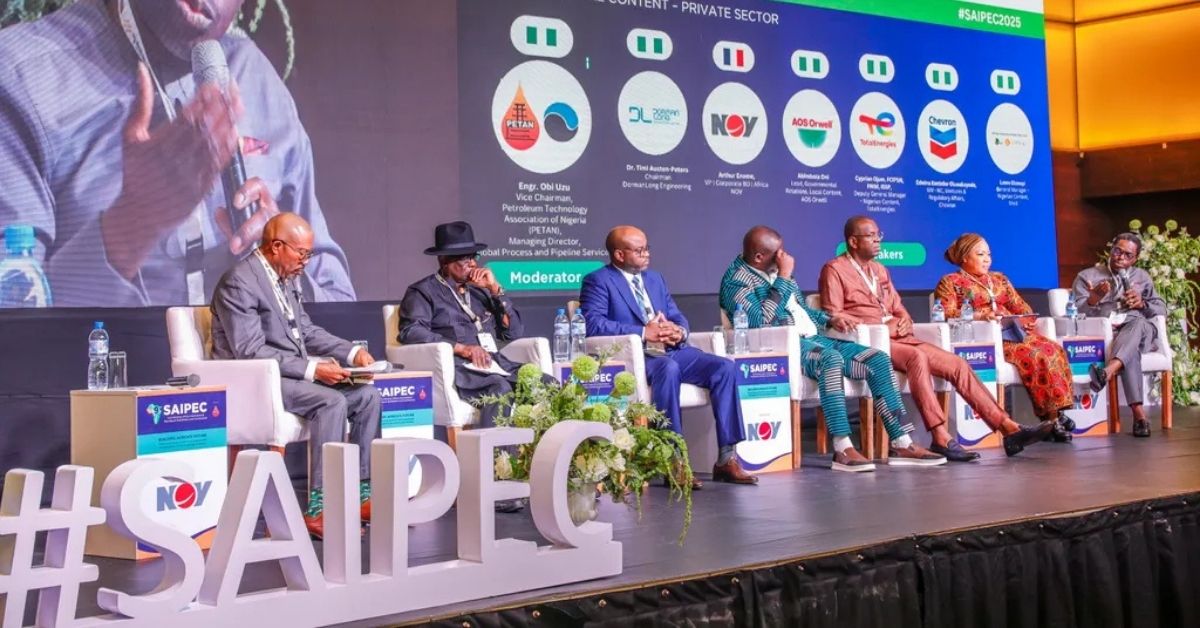

SAIPEC 2026 opened today in Lagos, marking the start of a three-day gathering that brings together policymakers, national oil companies, regulators, service providers and investors to take stock of Africa’s energy sector at a moment of heightened fiscal pressure, energy transition uncertainty and renewed focus on domestic value creation.
The Sub-Saharan Africa International Petroleum Exhibition and Conference, now in its tenth edition, is being held at the Eko Convention Centre in Lagos from 10 to 12 February and is hosted by the Petroleum Technology Association of Nigeria, with participation from governments and industry players across the continent.
The conference begins against a backdrop of uneven investment flows into African energy markets, persistent infrastructure gaps and growing scrutiny of how hydrocarbon development aligns with climate and transition objectives.
According to organisers, this year’s programme is structured to reflect those tensions, moving from policy and regulatory questions on the opening day, through gas development and industrialisation, and closing with sessions focused on workforce development, inclusion and leadership renewal.
Day one centres on the role of policy, regulation and local content in sustaining investment in Africa’s energy sector. Senior Nigerian officials, alongside executives from national oil companies and regulators from other African producers, are expected to address how governments are balancing revenue needs with investor confidence and longer-term transition planning.
Nigeria’s experience features prominently, particularly the implementation of its petroleum sector reforms and local content framework, which are often cited by other African countries as reference points when designing their own regulatory systems.
Discussions are expected to examine how local content policies have shifted from compliance mechanisms to broader industrial strategies. According to industry participants, the challenge now is not whether local participation should be prioritised, but how it can be financed, scaled and aligned with competitiveness, especially as capital becomes more selective and global oil and gas investment faces structural headwinds.
Gas takes centre stage on the second day, reflecting its growing importance in African energy strategies. Many governments view gas as a means to support power generation, fertiliser production and industrial development while also responding to global demand for lower-carbon fuels.
Panels will explore cross-border infrastructure, domestic gas utilisation and the policy frameworks needed to unlock long-term investment. These discussions are taking place as several African producers, including Nigeria, Senegal and Mozambique, seek to position gas as both a transition fuel and a source of export revenue, even as financing conditions tighten and timelines for large-scale projects lengthen.
Alongside the conference sessions, the exhibition brings together more than 150 companies offering engineering, technology and service solutions across the energy value chain. The exhibition floor reflects the continued importance of oil and gas services to African economies, while also highlighting incremental shifts toward digitalisation, efficiency and emissions management rather than wholesale transformation.
The final day of SAIPEC 2026 turns attention to human capital and institutional resilience. Sessions on workforce development, diversity and inclusion, and youth participation are framed within a broader concern about skills gaps and succession planning in African energy institutions. As older assets mature and new technologies emerge, companies and regulators face increasing pressure to attract and retain talent while ensuring continuity of technical and governance capacity.
Speakers across the programme include ministers, chief executives of national oil companies, regulators and senior industry figures from across West, East and Southern Africa. Their participation underscores SAIPEC’s role as a convening platform where national experiences are compared and regional lessons exchanged, rather than a forum dominated by external perspectives.

The conference is supported by Nigerian and regional institutions that play central roles in shaping energy outcomes, including national oil and gas bodies, regulatory agencies and indigenous service companies. Their involvement reflects the continued emphasis on domestic capability as a pillar of energy policy, particularly at a time when public finances are under strain and governments are seeking to maximise the development impact of natural resource revenues.
For African economies, the issues under discussion at SAIPEC have implications well beyond the energy sector. Oil and gas revenues remain critical to fiscal stability in several countries, while gas-to-power projects underpin industrial growth strategies and energy access goals. At the same time, debates around transition pathways, financing costs and global demand trajectories raise questions about how long hydrocarbons can continue to anchor development models.
As the conference unfolds, it offers a snapshot of an industry in transition, not only in technological terms but in how African countries are defining their strategic priorities. Rather than focusing solely on production growth, discussions increasingly centre on governance, domestic value, resilience and the management of risk in an uncertain global energy landscape.
Engage with us on LinkedIn: Africa Sustainability Matters