


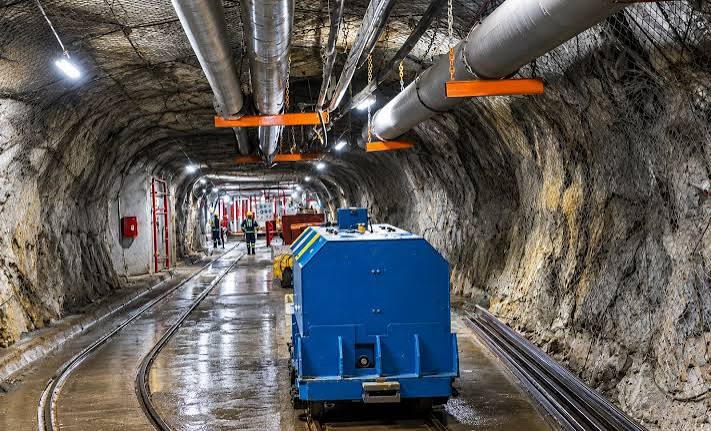
South African gold producer Harmony Gold is generating renewable electricity from water pressure in its deep-level mines, recovering energy from underground cooling systems to reduce emissions and improve operational efficiency as the mining sector faces rising electricity costs and pressure to decarbonise. The technology, deployed at the company’s Kusasalethu, Moab Khotsong and Mponeng mines, has generated 70 gigawatt-hours of electricity since financial year 2024, according to information presented at the Minerals Council South Africa’s inaugural Climate Change Day of Learning on November 2.
The system uses pressure that builds naturally as chilled water travels thousands of metres underground. Rather than allowing that pressure to dissipate, Harmony directs the water through hydroelectric turbines, converting its energy into electricity before the water continues through the mine’s existing reticulation network. The process does not require additional water consumption, allowing the company to recover energy while maintaining the water supply needed for underground operations.

According to Harmony, the electricity generated has avoided about 73,000 tonnes of carbon dioxide equivalent emissions from purchased electricity, while reducing water temperatures by one degree celsius and improving underground cooling efficiency. At Kusasalethu, four Pelton wheel turbines supply electricity directly to the mine, supported by a rehabilitation programme intended to improve reliability, performance and monitoring.
The results illustrate how South Africa’s energy-intensive mining industry is looking beyond conventional renewable power projects to identify efficiency gains within existing infrastructure. For mines operating at substantial depths, ventilation, cooling, pumping, hoisting and processing require large and continuous electricity supplies. Recovering energy from water systems can therefore reduce both the cost and emissions associated with operations, while helping to manage the energy demands of deep level mining.
Harmony’s experience also reflects the broader electricity challenge facing South African mining. The company’s emissions are driven largely by Scope 2 emissions from electricity purchased from state-owned utility Eskom. Although energy recovery can reduce demand, it does not eliminate the need for a more reliable and lower carbon electricity supply, particularly as mining companies expand production or develop new assets.
Mohammed Asmaljee, Harmony’s Strategic Lead for Climate and Integration, said the company’s decarbonisation strategy was increasingly tied to energy security, operating costs, competitiveness and access to capital. The challenge, he said, was to grow the business while progressively reducing emissions, rather than treating climate targets as separate from investment and operational decisions.
That tension is significant for South Africa, where mining remains an important source of employment, export earnings and economic activity, but electricity constraints and high energy costs have affected the competitiveness of industrial operations. Improving energy efficiency can help reduce exposure to supply disruptions and price volatility, while supporting production and investment. However, the scale of the benefit depends on the technology’s reliability, maintenance requirements and the extent to which recovered electricity can meet operational demand.
Harmony has also expanded its renewable energy programme. The company began with its 30-megawatt Sungazer 1 project in financial year 2024 and expects its 100-megawatt Sungazer 2 project to be operational by early 2027. Its broader planned behind-the-meter and wheeled electricity capacity is approximately 900 megawatts, reflecting an effort to reduce reliance on grid electricity as its operations grow.
The company estimates that Sungazer 1 and Sungazer 2 could deliver annual savings of R470-million once operational. Its energy-efficiency programme has generated cumulative direct savings of more than R3-billion, while associated emissions reductions have reached nearly three million tonnes of carbon dioxide equivalent across Scope 2 and Scope 3, according to figures presented at the event.
These investments are part of Harmony’s target to reduce Scope 1 and Scope 2 emissions by 63% by financial year 2036, a goal validated by the Science Based Targets initiative. The company established its target in 2023 using 2021 emissions data, but changes in its portfolio, mine-life assumptions and emissions data have prompted it to reassess its decarbonisation roadmap. It is also working to improve its understanding of Scope 3 emissions, which arise across its value chain.
The need to update emissions strategies as mining portfolios evolve is becoming more important across the sector. New projects and acquisitions can increase energy demand and emissions even as existing operations become more efficient. For companies expanding into copper and other minerals needed for energy transition technologies, the challenge is to ensure that production growth does not outpace emissions reductions.
For African mining economies, this issue extends beyond individual company targets. Mining investment supports employment, infrastructure and public revenues, while the sector’s energy requirements place pressure on national electricity systems. Efficiency measures and renewable power procurement can help companies reduce operating risks, but the wider transition also depends on grid capacity, regulatory certainty, financing and the ability to connect new generation to industrial demand.
Harmony’s approach suggests that decarbonisation is increasingly being treated as an operational and financial discipline rather than solely a reporting exercise. The company has established a Climate Community of Practice to connect sustainability teams with mine-site operations, engineering, finance, procurement and management. The aim is to embed climate considerations into investment decisions, operational planning and accountability across the business.
The Minerals Council South Africa has also linked the sector’s climate and energy transition to its wider investment and growth agenda, including work with government and business through the Government-Business Partnership for Growth and Jobs. The mining industry’s ability to attract capital will depend in part on its capacity to manage energy costs, emissions, regulatory changes and climate-related risks while maintaining production and employment.
Nevertheless, underground hydropower is one component of a broader energy strategy. Its contribution depends on the availability of suitable water systems, pressure conditions and infrastructure, making it less applicable to operations without comparable underground networks. Renewable electricity, sustained energy efficiency and future electrification remain central to reducing emissions across the industry.

As South African mines seek to improve productivity while managing electricity costs and climate commitments, the recovery of energy from underground water systems demonstrates how existing infrastructure can provide additional value. The longer-term economic significance will depend on whether such projects can be maintained reliably, scaled where technically feasible and integrated with wider investments in renewable power and energy security.


