


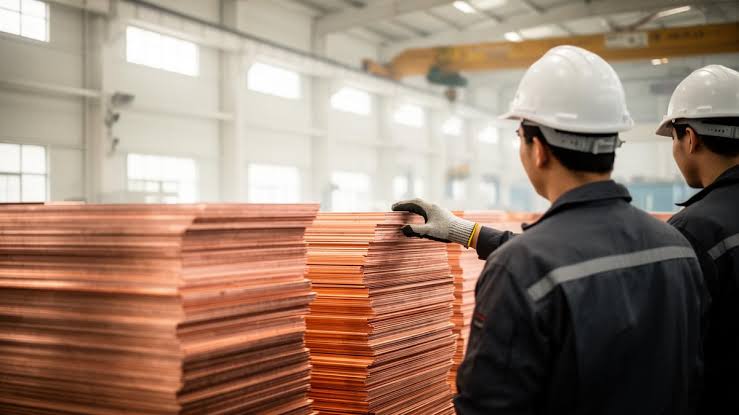
South Korea is using state-backed financing to secure long-term access to copper from global commodities producer Glencore, underscoring the intensifying competition among industrial economies for minerals needed to expand power grids, renewable energy, electric infrastructure and data centres. The $1 billion financing from the Export-Import Bank of Korea to Glencore International AG, announced as South Korean companies seek greater supply security, comes as Glencore’s copper production rises sharply, including from its African operations, placing the Democratic Republic of Congo and other copper-producing economies in a market where industrial policy and resource security are becoming increasingly intertwined.
According to the terms reported by Bloomberg, Glencore will supply copper to South Korean companies for the duration of the financing, although the Korean bank has not disclosed the volume of metal involved or specified which mines will provide the material. The financing is intended to support Glencore’s general working-capital needs rather than a particular mining project, giving the commodities group flexibility to draw on its global production and trading network when meeting supply commitments. South Korea’s state-owned export credit agency said Glencore’s network of mines and trading partners, including operations in Chile and Peru, could provide alternative sources if individual production centres face disruptions.
The arrangement illustrates a broader shift in the global copper market. Governments and industrial companies are increasingly treating access to copper as a strategic economic issue rather than simply a commercial procurement decision. Copper is essential to electricity transmission and distribution, renewable-energy installations, electric vehicles, telecommunications infrastructure and data centres. As electricity consumption rises alongside digitalisation and the expansion of clean-energy systems, demand for the metal is expected to remain structurally important.
For South Korea, the issue is particularly significant because the country has a highly industrialised economy but limited domestic mineral resources. Its manufacturing base includes electronics, semiconductors, batteries, automobiles and heavy industry, sectors that depend on stable access to imported raw materials. Securing copper supplies through a state-backed financial institution allows Seoul to link trade finance with industrial supply security.
The Glencore agreement also comes at a time when the company’s copper production is expanding. Glencore reported own-sourced copper production of 397,000 tonnes in the first half of 2026, an increase of 15% from the same period a year earlier. African operations accounted for 138,400 tonnes, up 66%, representing an increase of approximately 55,000 tonnes compared with the first half of 2025. Much of that African production is concentrated in the Democratic Republic of Congo, one of the world’s most important copper and cobalt producing countries. The increase reflects higher production volumes and improved grades at Glencore’s African operations. Changes in cobalt production have also affected the company’s production mix, with Glencore reporting a 46% decline in cobalt output to 10,200 tonnes during the first half of the year.

The shift is relevant to the wider copper market because copper and cobalt production in the Democratic Republic of Congo are closely connected through the country’s mineral deposits and processing infrastructure. Glencore’s African assets give the company an important position in a region where copper production is expanding while governments are increasingly seeking greater economic value from mineral resources.
The Democratic Republic of Congo has been attempting to increase the benefits it derives from its mineral wealth while managing the strategic importance of its copper and cobalt resources. The country’s copperbelt is central to global supply chains for energy-transition technologies, yet much of the value generated from the sector continues to be associated with mining and the export of concentrates and refined materials rather than the manufacture of higher-value industrial products.
That presents both an opportunity and a policy challenge as competition for copper intensifies. For African producers, stronger global demand could attract capital into exploration, mine development, processing capacity, railways, roads, ports and electricity infrastructure. But increased competition between industrial economies can also reinforce an older pattern in which African countries supply raw materials while higher-value manufacturing and technology development occur elsewhere. The South Korean financing arrangement therefore raises a question that extends beyond Glencore and Seoul: what conditions will African governments establish when negotiating with companies and governments seeking secure access to critical minerals?
The answer will influence whether the current copper boom becomes primarily an export opportunity or contributes to broader industrial development. South Korea is not alone in seeking greater control over mineral supply chains. The United States, European Union, China, Japan and other major economies have introduced policies designed to reduce exposure to concentrated mineral supply chains and secure access to materials considered strategically important. Copper has increasingly joined lithium, cobalt, nickel, graphite and rare earth elements on the list of minerals receiving greater attention from policymakers.
The reason is straightforward. Copper is difficult to substitute at scale in many electrical applications because of its conductivity, durability and established industrial supply chain. Expanding electricity networks requires large quantities of copper in cables, transformers and other equipment, while renewable-energy projects can require substantial quantities of the metal for generation and transmission infrastructure. Data-centre expansion is adding another source of demand. Artificial intelligence and cloud computing are driving investment in large computing facilities, which require extensive electrical infrastructure, cooling systems and connections to power networks. As data-centre operators seek increasingly reliable and larger power supplies, copper demand is linked indirectly to the broader build-out of electricity infrastructure.
The energy transition creates a similar dynamic. Solar and wind projects require copper for electrical connections and grid infrastructure, while electric vehicles use significantly more copper than conventional internal-combustion vehicles. The expansion of electricity networks needed to connect new renewable generation further increases the importance of the metal. This combination of digitalisation, electrification and renewable-energy investment has made copper strategically important even though it is not typically discussed with the same geopolitical intensity as oil.
Glencore’s position gives it an advantage in that environment because it combines mining with global commodity trading. The company can source material from its own assets while also accessing third-party production through commercial relationships. That flexibility is important for a financing arrangement such as the one with Korea Eximbank because supply obligations can potentially be managed across multiple geographical markets. The company’s African production is consequently becoming increasingly relevant to its global supply portfolio. In addition to its existing operations in the Democratic Republic of Congo, Glencore has been expanding its exposure to copper projects elsewhere on the continent.
In South Africa, for example, Glencore agreed in February to provide Orion Minerals with a $250 million prepayment facility for the Prieska copper-zinc project. Under the arrangement, Glencore is expected to receive a share of future concentrate production. The deal provides Orion with financing for project development while giving Glencore potential future access to copper and zinc supply. Prieska is significant because it illustrates how financing can become a mechanism through which commodity traders secure future mineral supply. Similar arrangements are increasingly relevant in a market where the development of new mines requires substantial capital and long lead times.
For African governments, this creates a strategic choice. Foreign financing and offtake agreements can accelerate mine development, create employment and generate export revenues. However, the terms of such agreements can determine how much value remains in the producing country and how much control governments retain over future production. The Korean-Glencore agreement does not specify that African copper will be supplied to South Korea. Korea Eximbank has pointed to Glencore’s global network, including mines and trading relationships in Chile and Peru, as sources that can help manage supply risks. It would therefore be premature to assume that copper from the Democratic Republic of Congo or South Africa will directly satisfy the Korean commitment.
Nevertheless, Africa’s growing role in Glencore’s copper production makes the continent relevant to the broader supply-security equation. The Democratic Republic of Congo is particularly important. Its copper output has expanded rapidly in recent years, supported by major investments in the country’s copperbelt. The country is already one of the world’s largest copper producers and has the potential to increase production further if investment in mining, energy and transport infrastructure keeps pace.
The principal constraint is not simply geological. Mining projects require reliable electricity, roads, railways, processing facilities, skilled workers and access to international markets. Infrastructure bottlenecks can increase production costs and reduce the ability of African producers to compete for investment against established mining jurisdictions. This is why the current scramble for copper could become an important test for Africa’s industrial policy. If global buyers simply compete to secure long-term supplies of concentrates, African countries may benefit through increased export earnings but remain positioned primarily as commodity suppliers. If supply agreements are linked to domestic refining, processing, skills development and infrastructure investment, the same demand could support deeper industrialisation.
The distinction matters for public finances. Mining revenues can provide governments with foreign exchange, royalties, taxes and employment, but commodity prices remain cyclical. Developing processing and manufacturing capabilities can potentially broaden the economic contribution of the mining sector by creating additional sources of employment, tax revenue and industrial activity. There is also a regional dimension. The African Continental Free Trade Area provides a framework through which mineral-producing countries could potentially develop regional value chains rather than exporting all raw materials directly to overseas markets. Copper from the Democratic Republic of Congo and Zambia, for example, could support regional processing and manufacturing if energy and transport infrastructure are developed sufficiently.
Zambia has also been seeking to expand its copper production and attract investment into mining and processing as part of its economic diversification strategy. Its geographical proximity to the Democratic Republic of Congo creates opportunities for a more integrated copper-industry corridor across southern and central Africa, although infrastructure and policy coordination remain significant challenges. For South Korea, securing copper through Glencore represents a relatively direct way to manage an industrial supply risk. For Africa, the implications are more complicated. The continent possesses some of the world’s most important deposits of copper and other critical minerals, but mineral wealth alone does not guarantee industrial development.
The terms under which capital enters the sector will matter. Governments seeking to attract mining investment are likely to face greater competition among potential buyers as manufacturers and states pursue long-term supply contracts. That could strengthen the negotiating position of producers, particularly where deposits are large, production costs are competitive and infrastructure can support expansion. However, stronger bargaining power will only translate into broader development gains if governments have the institutional capacity to negotiate contracts, enforce environmental standards, manage revenues and ensure that communities benefit from mining activity.
Environmental considerations will also become more important as copper production expands. Mining can place pressure on water resources, land and local ecosystems, while the energy required for extraction and processing can affect the emissions intensity of production. African producers seeking to attract global buyers may therefore face growing expectations around traceability, emissions reporting, water management and responsible sourcing. This creates an additional reason for African mining jurisdictions to invest in stronger regulatory institutions and transparent mineral governance. Buyers increasingly need to demonstrate where critical minerals originate and how they are produced, particularly when those materials enter supply chains for technologies marketed as part of the energy transition.
The South Korean financing deal illustrates how financial institutions can become active participants in this process. Korea Eximbank is not simply providing capital to a commodity company; it is using financing to support a national industrial objective ensuring that Korean manufacturers have access to a critical input. Other industrial economies are likely to pursue similar approaches through export-credit agencies, development banks, strategic stockpiles, direct investment and long-term purchasing agreements. That could create more financing opportunities for African mining projects, but it could also intensify competition over strategic assets.
For Africa, the strategic objective should therefore extend beyond producing more copper. The more consequential question is whether rising demand can be used to build the infrastructure and industrial capabilities needed to retain more value locally. That means reliable electricity for mines and processing facilities, efficient rail and port systems, investment in refining and smelting capacity, technical training and stronger regional trade links. It also means creating regulatory frameworks that give investors sufficient certainty while protecting public revenues and environmental interests.
Glencore’s rising African copper output demonstrates that the continent is already becoming more important to global supply. South Korea’s decision to use state-backed financing to secure access to copper demonstrates that governments increasingly recognise the metal’s strategic importance. The next stage of the competition will determine who captures the wider economic value. For South Korea, the immediate priority is supply security for advanced industries. For Glencore, stronger copper production provides greater flexibility in a tightening strategic-commodities market. For African producers, the opportunity is potentially larger: to convert geological advantage into investment, infrastructure and industrial capacity.
Whether that happens will depend less on the headline value of individual mining deals than on the structure of the agreements surrounding them. As global economies compete for copper needed to electrify grids, build renewable-energy systems and power the digital economy, African governments have an opportunity to negotiate from a position of greater strategic importance. The challenge is ensuring that the resulting investment does more than move copper from African mines to overseas factories.


