


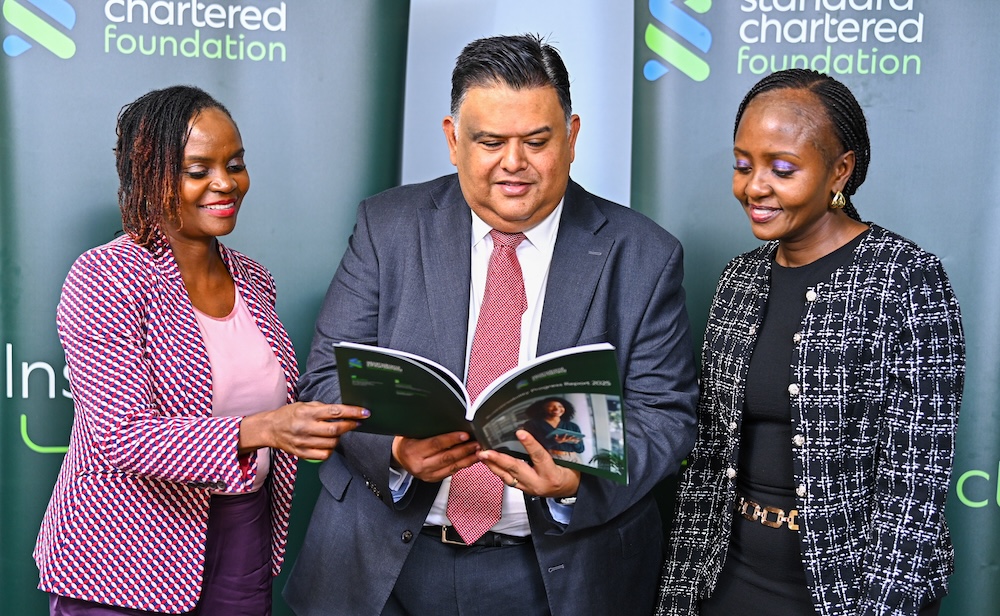
Standard Chartered Bank Kenya has expanded its sustainable finance portfolio to KSh62.5 billion (approximately US$484.5 million), underscoring the growing commercial importance of environmental, social and governance (ESG) financing within Kenya’s banking sector. The lender reported an 11 per cent increase in sustainable finance assets in its 2025 Sustainability Progress Report released on Wednesday, reflecting rising demand for sustainability-linked financial products as businesses accelerate investments in climate resilience, energy transition and inclusive economic growth.
The report also showed that sustainable finance has become an increasingly significant contributor to the bank’s financial performance. Revenue generated from sustainable finance activities rose by 16 per cent during the reporting period to KSh3.5 billion (approximately US$27.1 million), bringing cumulative sustainable finance revenue since 2021 to KSh7.9 billion (approximately US$61.2 million). According to the bank, the growth was largely driven by its Corporate and Investment Banking division through sustainability-linked loans, green trade finance, transaction banking solutions and advisory services designed to support clients’ ESG commitments and decarbonisation strategies.
The results reflect a broader transformation taking place across Africa’s financial sector, where sustainability is increasingly becoming integrated into core banking operations rather than remaining a niche product offering. Financial institutions across the continent are expanding green lending portfolios, sustainable investment products and climate-related advisory services as governments introduce stricter climate policies, investors strengthen ESG expectations and businesses seek financing for low-carbon and climate-resilient investments.
Speaking during the release of the report, Standard Chartered Kenya Chief Executive Officer and Head of Coverage Birju Sanghrajka said sustainability has become central to the bank’s long-term business model rather than an additional corporate responsibility initiative.
“Sustainability is no longer a separate conversation from business growth,” Sanghrajka said, highlighting the bank’s strategy of integrating sustainable finance across lending, investment and advisory services.
According to the report, the expansion of sustainable finance reflects increasing client demand for financing solutions that support renewable energy, climate-smart infrastructure, sustainable trade and corporate transition strategies. Sustainability-linked financing has emerged as one of the fastest-growing segments within commercial banking as companies seek capital aligned with both regulatory requirements and investor expectations.
For Kenya, this trend carries wider implications for national development priorities. The country has positioned itself as one of Africa’s leading sustainable finance markets, supported by ambitious renewable energy investments, green bond initiatives, climate finance strategies and a rapidly evolving sustainable banking framework. Commercial banks are expected to play a central role in mobilising private capital required to achieve Kenya’s climate commitments while financing economic transformation.
According to the Climate Change Act and Kenya’s Nationally Determined Contribution (NDC), achieving national climate targets will require substantial investment from both public and private sectors. Financial institutions are therefore increasingly viewed as essential intermediaries capable of directing capital towards renewable energy, sustainable agriculture, clean transport, resilient infrastructure and circular economy investments.
Beyond corporate banking, Standard Chartered also reported strong growth in retail sustainable investment products. Assets under management within the bank’s digital SC Shilingi Money Market Fund increased by 47 per cent to KSh27.8 billion (approximately US$215.5 million), demonstrating growing investor confidence in digital wealth management platforms.
The demographic profile of investors also reflects broader changes occurring within Kenya’s financial services sector. According to the report, clients below the age of 40 accounted for 62 per cent of SC Shilingi investors, while women represented 49 per cent of the customer base. The figures suggest increasing participation by younger and more diverse investor groups as digital financial services continue expanding across the country.
Financial inclusion remains another strategic component of the bank’s sustainability agenda. Through its Women International Network (WIN) programme, Standard Chartered now supports 491 women-led enterprises managing assets worth KSh2.9 billion (approximately US$22.5 million). The initiative provides financial solutions, networking opportunities and business support aimed at improving access to capital for female entrepreneurs, who continue to face structural financing barriers across many African economies.
For Africa, improving access to finance for women-owned businesses remains an important economic priority. According to development finance institutions, narrowing the financing gap for women entrepreneurs could significantly increase business growth, employment creation and economic productivity while strengthening inclusive development.
The report also highlighted continued progress in reducing the bank’s operational environmental footprint. During 2025, Standard Chartered Kenya reduced its Scope 1 and Scope 2 greenhouse gas emissions by 9.7 per cent while lowering water consumption by 22.6 per cent. Waste management performance also improved, with 84 per cent of operational waste recycled during the reporting period.
Although operational emissions represent only a portion of a financial institution’s overall climate impact, reducing direct emissions aligns with broader commitments by global banks to achieve net-zero operational footprints while supporting clients’ decarbonisation pathways. Increasingly, investors and regulators are evaluating financial institutions not only on operational sustainability but also on the environmental impact of financed activities.
The bank also reported continued investment in community development through the Standard Chartered Foundation. Since 2019, Foundation programmes have reached more than 55,900 young people, supported the creation of 1,583 jobs through entrepreneurship initiatives and facilitated decent employment opportunities for 519 young people, with a particular emphasis on women and persons with disabilities.
Employee engagement also remained strong during the reporting period. Staff contributed 4,039 hours of skills-based volunteering, representing an employee participation rate of 87 per cent. Such initiatives increasingly form part of broader corporate sustainability strategies by linking employee expertise with community development and social impact programmes.
Environmental conservation initiatives also featured prominently. The 2025 Standard Chartered Nairobi Marathon attracted 30,668 participants and raised KSh76.3 million (approximately US$591,500) to support Foundation programmes. The event also incorporated environmental restoration activities through the distribution of 10,000 tree seedlings and 30,000 seedballs, reflecting the growing integration of biodiversity and ecosystem restoration into corporate sustainability initiatives.
Across Africa, commercial banks are increasingly positioning sustainability as a driver of long-term competitiveness rather than solely a compliance requirement. Growing climate risks, evolving regulatory frameworks and rising investor demand for responsible finance are reshaping banking strategies, encouraging institutions to develop products that simultaneously generate commercial returns and contribute to broader environmental and social objectives.
For Kenya, the continued expansion of sustainable finance demonstrates the financial sector’s growing role in supporting the country’s green transition. As financing requirements for renewable energy, climate adaptation, resilient infrastructure and inclusive economic development continue to increase, banks are expected to play an increasingly significant role in mobilising capital, supporting innovation and strengthening economic resilience.
Standard Chartered’s latest results illustrate how sustainability is becoming embedded within mainstream financial services, connecting commercial banking with climate action, financial inclusion and long-term economic development. As Kenya continues positioning itself as a regional leader in sustainable finance, such investments could help strengthen capital flows towards sectors that are critical for achieving both national development objectives and Africa’s broader transition to resilient, low-carbon economies.


