
The Western Cape High Court recently concluded hearings in a high-profile case challenging the environmental approval granted to TotalEnergies for ultra-deep-water oil and gas exploration in the Deep Western Orange Basin (DWOB), off South Africa’s West Coast.
The case, brought by The Green Connection, Natural Justice, and the Aukotowa Primary Fishing Co-operative, questions the legality and rationality of the authorisation process, arguing that it is inconsistent with South Africa’s constitutional, environmental, and climate obligations. The applicants have asked the Court to review and set aside both the Director-General’s original decision and the Minister’s dismissal of prior appeals.
“This project introduces risks unlike anything South Africa has faced before, in both water depth and technical complexity,” said Neville van Rooy, Outreach Ambassador for The Green Connection. “The Environmental Impact Assessment (EIA) did not adequately address these heightened risks. Small-scale fishers, already on the frontline of climate impacts, deserve protections that were ignored in the approval process.”
The legal challenge traces back to October 2023, when the Department of Mineral and Petroleum Resources granted environmental authorisation for the DWOB exploration. Appeals by five other stakeholders were ultimately dismissed by the Minister of Forestry, Fisheries, and Environment, sparking national debate over offshore fossil fuel expansion.
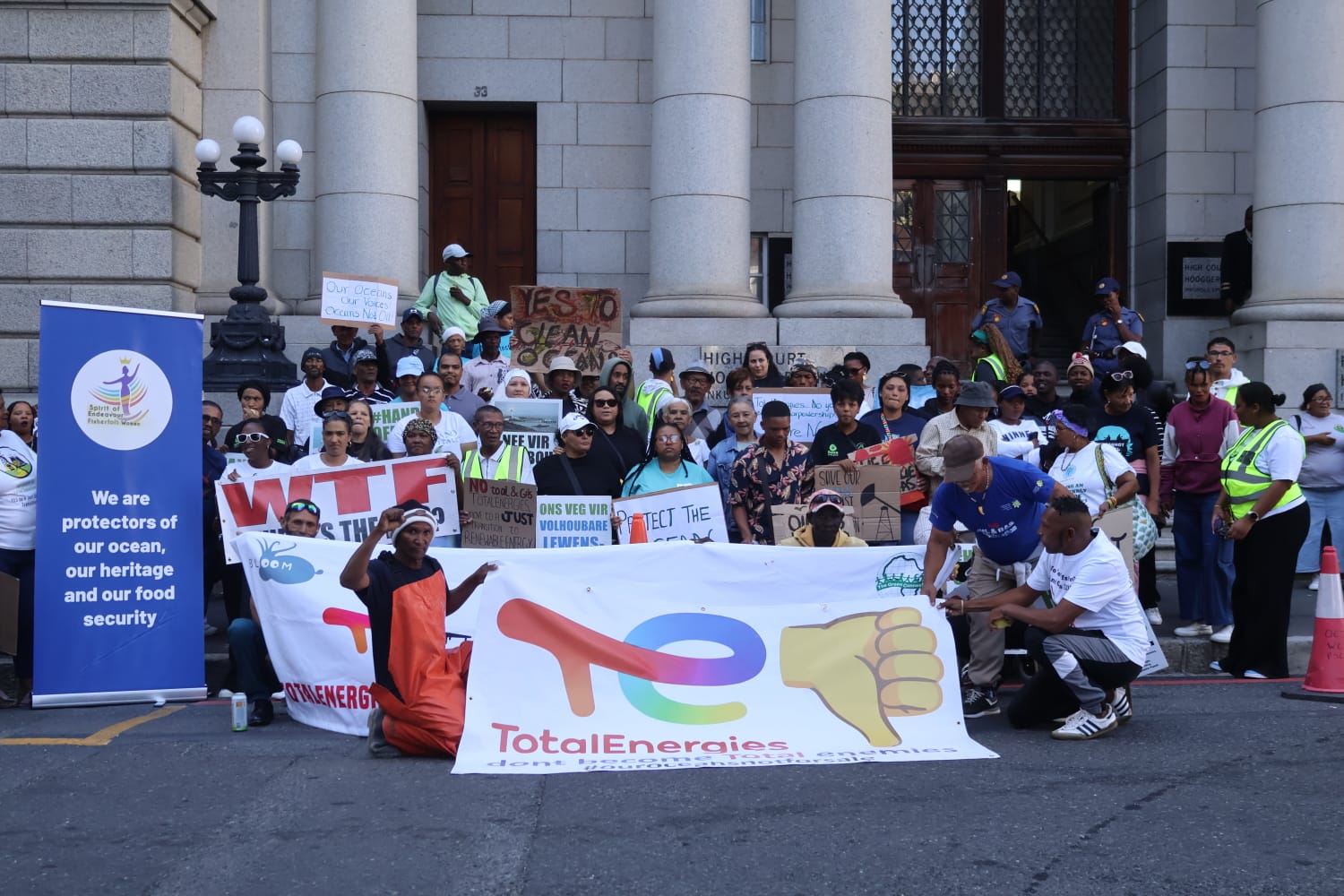
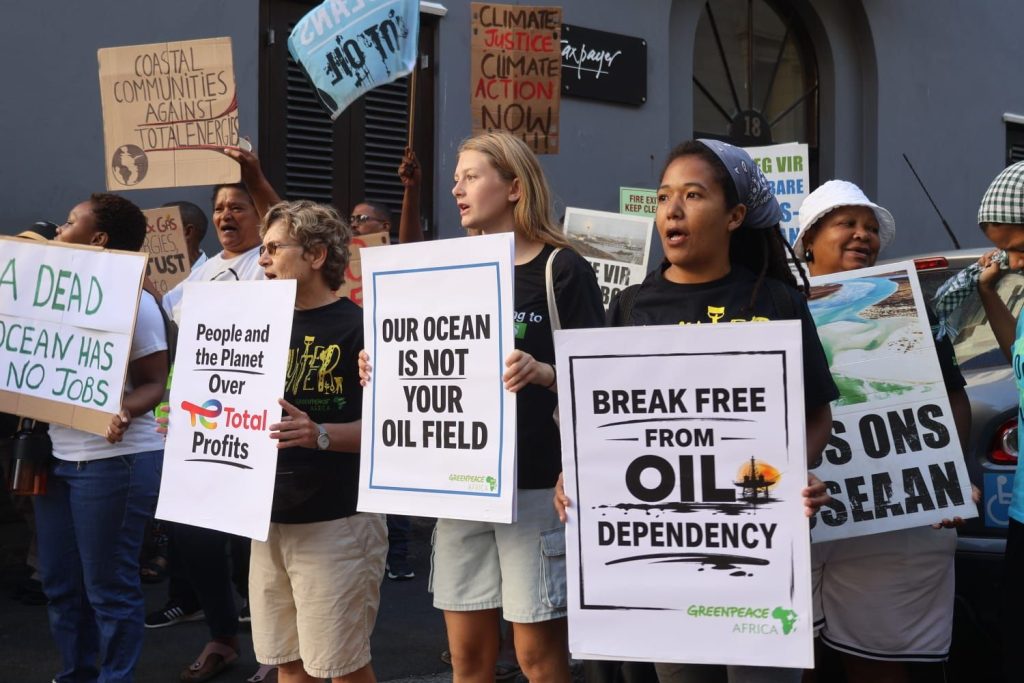
Ahead of the hearings, nearly 100 small-scale fishers and coastal community members staged a peaceful demonstration outside the High Court, joined by environmental justice organisations. Solidarity actions also took place along the Eastern Cape and KwaZulu-Natal coasts, highlighting concerns over marine ecosystems, food security, and livelihoods.
Walter Steenkamp of the Aukotowa Fisheries Co-operative in Port Nolloth said: “Communities along the West Coast are already experiencing declining fish stocks and the growing effects of climate change. Yet the approval process prioritised corporate interests over the rights and livelihoods of fishing communities. Our livelihoods, cultural heritage, and food security depend on a healthy ocean.”
Steenkamp also raised concerns about drilling at depths exceeding 2,000 metres, noting that the EIA fails to provide robust site-specific evidence or a fully tested Blow-out Contingency Plan, essential to uphold the precautionary principle.
The applicants argue that the State assessed only the exploration phase in isolation, overlooking lifecycle impacts, including emissions from eventual extraction and combustion. They contend this approach conflicts with South Africa’s net-zero commitments and undermines climate accountability at a time when international law, including ICJ guidance, emphasises preventing harm to the climate system.
Melissa Groenink-Groves, Programme Manager at Natural Justice, added: “The Integrated Coastal Management Act (ICMA) was largely ignored. The State failed to safeguard coastal public property and uphold intergenerational justice, undermining the public trustee duty that requires protecting the coastline for current and future generations.”
Read also: South Africa’s small-scale fishers urge SAHRC to tackle food system inequality
Community voices were unanimous in expressing the stakes. Ernest Titus from Lambert’s Bay highlighted the intergenerational impact: “Decisions about offshore drilling directly affect our ability to provide for our families and communities. We need a sustainable approach that protects marine life and the fishing industry.”
Environmental activists across the West Coast, including Justin Montzinger, Andries Booysen, and Deborah De Wee, emphasised the urgent need to protect oceans, livelihoods, and cultural heritage from the risks posed by deep-water oil and gas exploration.
The High Court’s upcoming judgment will be closely watched as a potential turning point for South Africa’s offshore energy policy, climate commitments, and the rights of coastal communities.
Engage with us on LinkedIn: Africa Sustainability Matters