


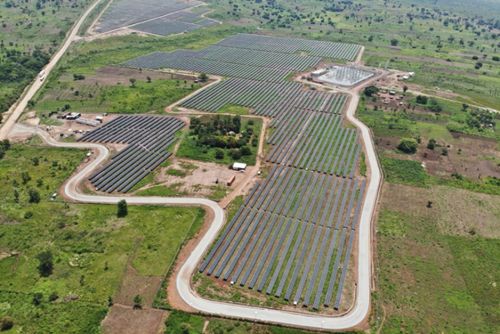
Uganda has added another utility-scale solar project to its electricity system with the start of operations at AMEA Power’s 24 MWp Ituka solar plant, strengthening generation in a part of the country recently connected to the national grid while highlighting a growing constraint for future renewable-energy investment: the ability of the power system to absorb additional variable generation.
Located in Ombachi in Madi Okollo District, the project is designed to supply up to 20 MWac to Uganda’s national grid through a 25 MVA substation connected to the 132 kV Lira-Gulu-Nebbi-Arua transmission line. Uganda Electricity Transmission Company Limited (UETCL) is purchasing the electricity under a 20-year power purchase agreement.
The project has taken several years to reach commercial operation. Uganda approved the development in 2022 at a tariff of $0.08 per kilowatt-hour, while the power purchase and implementation agreements were signed in September 2023. Construction began in August 2024 after the Eastern Africa Infrastructure Fund committed about $19 million in debt financing for the project.
The commissioning adds capacity to a power system that has expanded rapidly in recent years. According to Uganda’s Electricity Regulatory Authority (ERA), installed generation capacity reached about 2,099 MW at the end of 2025, up from 1,362 MW in 2021. Renewable energy accounted for 95.2% of installed capacity, with hydropower contributing 82.1%, bagasse 9% and solar photovoltaic generation 4.2%.

Solar’s share remains relatively small compared with hydropower, but the sector has been attracting increasing private investment. Ituka adds to that diversification by bringing more generation from a source that can complement Uganda’s predominantly hydro-based electricity system. The plant is also strategically located in north-western Uganda, where transmission infrastructure has been expanded to connect areas that previously had limited access to the national grid. The ability to generate power closer to newly connected demand centres can reduce the geographic concentration of generation and support broader electrification and economic activity.
The more difficult question now concerns what comes next. Uganda’s regulator has already warned that the national grid’s capacity to absorb additional solar and wind generation is constrained. In October 2025, ERA reduced the firm absorption ceiling for variable renewable energy from 250 MW to 200 MW following technical studies by the system operator. The regulator said that, as of August 2025, the technical capacity to accommodate additional grid-connected solar and wind projects had already been fully committed through existing licences and permits.
That does not mean Uganda has run out of renewable-energy potential. Instead, it means the next phase of investment will increasingly depend on the infrastructure and technologies used to integrate that generation. Solar and wind differ from conventional generation because their output varies according to weather conditions. Solar generation falls when sunlight disappears, while wind output changes with wind conditions. As their share of the power mix increases, system operators need sufficient flexibility to balance supply and demand and maintain frequency and voltage stability.
Uganda’s response has already begun to move beyond simply licensing more generation. ERA has temporarily paused new licences and permits for additional grid-connected solar and wind projects while a comprehensive grid stability study is undertaken. At the same time, the regulator is prioritising projects incorporating hybrid systems and energy storage where they can improve grid flexibility and reliability.
The shift could reshape the economics of renewable-energy investment in Uganda. Developers may increasingly need to consider battery storage, hybrid generation, stronger grid connections and more sophisticated energy-management systems when designing new projects. For investors, this creates both a constraint and a potential new market. Battery energy storage can allow electricity generated during periods of strong solar output to be stored and dispatched when demand rises or renewable generation falls. Hybrid projects can combine solar with other generation technologies or storage to create a more predictable supply profile. Stronger transmission and distribution networks can also increase the amount of renewable power that the system can absorb without compromising reliability.
Uganda is already examining this direction. A technical paper presented through the Electricity Regulatory Authority’s Africa Electricity 2025 programme identified battery energy storage, flexible generation, demand-side management and stronger transmission and distribution networks as among the measures that could support variable renewable-energy integration. The paper also notes Uganda’s long-term ambition to integrate 12,000 MW of solar and 300 MW of wind power into the national energy mix by 2040.
That ambition is substantially larger than the country’s current solar and wind capacity, making grid planning increasingly important. The challenge is particularly relevant because Uganda’s generation pipeline continues to expand. ERA reported at the end of 2025 that 31 licensed projects with a combined capacity of 324.6 MW were under development across hydropower, solar, biomass, cogeneration, wind and gas-to-power technologies, while another 28 projects were at the feasibility stage. About 65 MW was expected to connect to the national grid during 2026.
Without corresponding investment in transmission, distribution and system flexibility, new generation capacity could face delays or require more complex integration arrangements. The experience also illustrates an important distinction in Africa’s energy transition. Increasing installed generation capacity is only one part of expanding electricity supply. The power must also be transported from where it is generated to where it is needed, and the system must be capable of managing different generation profiles throughout the day.
For Uganda, this means that the next phase of renewable-energy development could increasingly involve investment in the electricity network itself. Transmission lines, substations, grid management systems, battery storage and flexible generation can become as important to renewable deployment as the solar panels and turbines generating the electricity.
This has implications for financing as well. Investors assessing new renewable projects will need to consider not only resource quality and power purchase agreements but also connection availability, curtailment risk, transmission capacity and the cost of any additional flexibility required to integrate the project. Uganda’s regulatory framework already provides some long-term certainty for renewable projects. ERA’s renewable-energy framework allows eligible grid-connected renewable generators to enter into long-term power purchase agreements with UETCL, helping address off-take risk.

But a bankable power purchase agreement does not eliminate physical grid constraints. A project can have a credible buyer and a competitive tariff while still requiring transmission investment or storage to ensure that its electricity can be delivered reliably. Ituka therefore arrives at an important point in Uganda’s electricity transition. Its 20 MW contribution demonstrates that solar can be integrated into areas newly connected to the national grid and can diversify a generation system dominated by hydropower. At the same time, the project’s commissioning coincides with a regulatory environment in which additional solar and wind capacity is being assessed against the physical limits of the grid.
The implication for Uganda’s renewable-energy market is that the next investment cycle will likely be less about adding generation in isolation and more about building the systems that allow different sources of electricity to work together. For policymakers, that means aligning generation planning with transmission investment, storage deployment and demand growth. For developers, it means designing projects around the technical realities of the grid. For financiers, it means evaluating infrastructure beyond the power plant itself.
Uganda’s solar opportunity is therefore entering a different phase. The question is no longer only how much renewable electricity the country can generate. It is increasingly about how much of that electricity the grid can absorb, move and deliver when consumers need it. Ituka adds another 20 MW of solar power to Uganda’s system. The next challenge is ensuring that the country’s transmission network and flexibility infrastructure can make room for the much larger renewable pipeline still being planned.


