


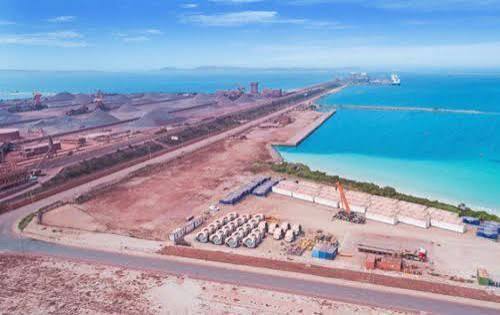
Phelan Green’s synthetic aviation fuel project at Saldanha Bay has become the first of six projects in South Africa’s initial green hydrogen development wave to reach final investment decision, moving the country’s hydrogen strategy from project development into construction planning and commercial execution.
The milestone was confirmed at the Africa Green Hydrogen Summit in Cape Town, where South Africa’s government said Phelan Green had secured an offtake agreement and committed $100 million in equity. Construction is expected to begin in the first quarter of 2027, with the first exports of electro-sustainable aviation fuel, or e-SAF, targeted for the first quarter of 2029.
The development is significant beyond the project itself. The International Energy Agency’s 2026 Global Hydrogen Review found that Africa has 31 low-emissions hydrogen projects targeting production by 2030, but only one had reached FID. The agency identifies high financing costs, uncertain demand and infrastructure constraints among the main barriers to moving the continent’s hydrogen pipeline into construction.
Phelan’s project therefore provides a test case for whether South Africa can convert its renewable-energy resources and industrial infrastructure into bankable export-oriented hydrogen derivatives. The government’s first-wave portfolio includes projects spanning sustainable aviation fuel, green ammonia, green iron, green methanol and smaller-scale domestic hydrogen applications. The remaining five projects are at different stages of development and still require further commercial, technical or financial progress before reaching FID.
Phelan has disclosed a $100 million equity commitment, an offtake agreement and the ordering of major equipment. The project has also assembled a technology chain involving Johnson Matthey and Honeywell. Johnson Matthey’s HyCOgen technology is designed to convert captured carbon dioxide and electrolytic hydrogen into carbon monoxide and syngas, while the associated FT CANS process is intended to convert the syngas into synthetic crude. Honeywell UOP’s Fischer-Tropsch Unicracking technology will then upgrade the resulting hydrocarbons into aviation fuel.
The first phase is expected to produce about 35,000 tonnes of e-SAF a year. Johnson Matthey estimates that volume could represent as much as 6% of the combined European Union and UK mandated e-SAF volumes for 2030. The wider Phelan Green Hydrogen Project is associated with investment of about R47 billion, but that figure covers the broader development rather than representing the disclosed capital requirement for the first e-SAF phase.
That distinction matters when assessing the project’s financing. The $100 million equity commitment cannot, on its own, be treated as evidence that a corresponding proportion of the wider R47 billion development has already been financed. The government has confirmed the equity commitment and offtake, but the full financing structure for the first phase has not been publicly detailed. The scale and terms of project debt, any additional equity, and the contractual structure supporting future revenues will be important indicators of how much construction risk has actually been transferred from the developer to financial partners.
The offtake agreement is particularly important because synthetic aviation fuel remains substantially dependent on policy-driven demand. The buyer has not been publicly identified, and details such as contract tenor, committed volumes and pricing terms have not been disclosed. Those terms would help determine the degree of revenue certainty available to lenders and investors.
Europe nevertheless provides an emerging regulatory demand base. Under the EU’s ReFuelEU Aviation framework, synthetic aviation fuels must account for 1.2% of fuel supplied at EU airports from 2030, rising to 35% by 2050. The European Commission describes the framework as a mechanism to progressively increase sustainable aviation fuel use across the bloc.
The challenge is that regulation does not automatically create physical supply. The European Commission has previously noted that more than 40 e-SAF projects in Europe were still awaiting final investment decisions. This leaves a gap between mandated future consumption and production capacity that has actually secured investment.
Europe is also developing financial mechanisms to address that gap. The European Commission has announced further competitive hydrogen auctions, including a 2026 hydrogen auction with a budget of up to €500 million. These mechanisms form part of a wider effort to reduce the revenue uncertainty that has prevented some low-emissions hydrogen and derivative projects from progressing.
For African producers, the structure of that support matters because export-oriented hydrogen projects must compete on both production cost and revenue certainty. The IEA says near-term deployment in Africa will require instruments such as blended finance, credit guarantees, insurance and stronger offtake arrangements to reduce financing costs and improve project bankability.
South Africa is simultaneously building its own financial architecture for the sector. The SA-H2 Fund, managed by Climate Fund Managers and Invest International, reached a first close of R3 billion in August 2026, backed by commitments including the European Commission under Global Gateway, Invest International, the Public Investment Corporation, Sanlam Life and the Industrial Development Corporation.
The fund has already committed up to $20 million in development funding to Hive Hydrogen’s Coega Green Ammonia Project, alongside an option to participate in construction financing of up to $200 million. It has also committed up to $4 million to Green eFuels Producers for a wastewater-to-green-methanol project in Gauteng.
The comparison with Phelan is not straightforward because the projects have different technologies, scales and target markets. Hive’s Coega project is designed to produce about one million tonnes of green ammonia annually and has been associated with an investment requirement of roughly $5.8 billion. Phelan’s first e-SAF phase is substantially smaller, with production of about 35,000 tonnes a year.
The contrast nevertheless illustrates a broader financing pattern. Development capital is increasingly being used to move projects through engineering, permitting, environmental assessments and offtake negotiations before larger construction capital is committed. Phelan’s FID demonstrates that one project has moved beyond that development stage, but the remaining portfolio will still need to convert preparation work into financeable commercial structures.
Execution risks have not disappeared with FID. The project depends on renewable electricity, water and biogenic carbon dioxide, while the economics of a capital-intensive electrolyser will depend partly on how consistently the equipment can operate. Higher utilisation can spread fixed capital costs over greater production, while lower utilisation can increase the effective cost of each tonne of fuel.

The timing of construction will therefore be closely watched. Earlier project announcements had pointed to construction during 2026, but the latest government timetable now places the start of construction in the first quarter of 2027 and first exports in the first quarter of 2029. That makes the next phase of Phelan’s development less about demonstrating that e-SAF technology can be assembled and more about demonstrating that the project can execute at commercial scale. Contractors, financing arrangements, input supply agreements and the terms of the offtake will determine whether the FID translates into physical infrastructure.
For South Africa, the significance extends beyond one aviation-fuel plant. The government has positioned green hydrogen alongside sustainable aviation fuel, green chemicals, green shipping fuels and advanced manufacturing as part of a broader industrialisation strategy. Trade and Industry Minister Parks Tau said at the September summit that the objective was to move from exporting raw potential towards greater value addition and domestic production.
The Phelan project is therefore an early measure of whether that strategy can move from a large development pipeline to operating industrial assets. Its FID establishes a starting point. The more consequential test will be whether construction begins on schedule, financing remains sufficient through delivery and a commercially competitive export market emerges for the fuel once production starts in 2029.


