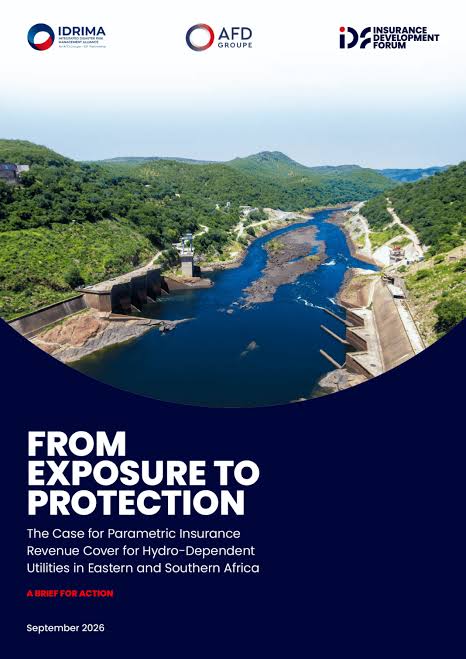
Africa’s heavy dependence on hydropower is creating a climate-financial exposure that extends beyond electricity generation, with droughts and changing rainfall patterns increasingly capable of affecting utility revenues, government budgets, electricity tariffs and sovereign finances. A new paper from the Integrated Disaster Risk Management Alliance (IDRIMA) is calling for greater use of parametric insurance to protect hydro-dependent utilities in Eastern and Southern Africa against revenue shocks linked to hydrological variability.
The paper, titled From Exposure to Protection: The Case for Parametric Insurance Revenue Cover for Hydro-Dependent Utilities in Eastern and Southern Africa, was launched by IDRIMA, a partnership between the Insurance Development Forum and AFD Group, comprising Agence Française de Développement and Expertise France. It argues that insurance can complement investments in resilient infrastructure by providing a financial mechanism to absorb revenue losses when climate conditions disrupt hydropower generation.
The exposure is substantial. Hydropower accounts for more than 17% of Africa’s electricity generation, while its contribution exceeds 80% in the Democratic Republic of Congo, Ethiopia, Malawi, Mozambique, Uganda and Zambia. The International Energy Agency has previously warned that this concentration makes power systems vulnerable to changes in rainfall, streamflow and evaporation, with climate change expected to increase variability in many parts of the continent.

For hydro-dependent utilities, the financial consequences can move quickly beyond the power plant itself. Lower water availability can reduce generation, forcing utilities to purchase more expensive alternative electricity or operate with lower revenues. Where utilities are publicly owned or financially constrained, the resulting pressure can ultimately be transferred to government balance sheets.
That creates a risk-management problem for governments that have traditionally focused disaster financing on emergency response rather than protecting revenue streams before a shock occurs. IDRIMA’s proposal is to add parametric insurance to the financial instruments available to governments and utilities, alongside budget reserves, contingent credit and other forms of disaster-risk financing.
Unlike conventional indemnity insurance, parametric insurance is triggered when an objectively measurable indicator reaches a predefined threshold. For a hydropower utility, that trigger could be based on variables such as reservoir inflows, river flows, rainfall or other hydrological measurements. Once the agreed threshold is reached, the policy pays according to the contract rather than requiring a lengthy assessment of the actual financial loss. Research on hydropower insurance has similarly examined inflow and electricity-price indices as ways of linking insurance triggers more closely to revenue exposure.
The distinction is important because the financial loss from a hydrological shock may emerge before physical infrastructure is damaged. A drought does not have to destroy a dam to create a material economic loss. Reduced reservoir levels or river flows can simply mean that turbines operate below expected capacity, reducing electricity sales and potentially increasing the cost of maintaining supply.
Mozambique provides a recent illustration of the exposure. The country generates more than 80% of its electricity from hydropower, with the Cahora Bassa reservoir playing a central role in the system. The IEA reported that the reservoir fell to 19% of storage capacity in January 2025, its lowest level in three decades, while warning that changing precipitation patterns could create further risks for electricity security.
The challenge is therefore not simply how to build stronger dams or diversify generation. It is also how to ensure that utilities and governments retain financial stability when hydrological conditions fall outside historical expectations.
Céline Boulay, IDRIMA facility lead at the AFD Group, said the current El Niño-Southern Oscillation has made the risks facing energy utilities particularly visible in Africa and Latin America. She said the alliance wants the paper to support the integration of parametric insurance for critical infrastructure into national disaster-risk financing strategies alongside reserves and contingent credit.
Ekhosuehi Iyahen, Secretary General of the Insurance Development Forum, said the consequences of energy disruptions extend to people, businesses and economies, placing insurance within a wider development and resilience framework. The proposed approach also reflects a broader shift in how climate risk is being considered by financial institutions. Insurance is increasingly being treated not only as a mechanism for compensating losses after disasters, but as part of the architecture through which governments and infrastructure operators manage financial volatility.
For public utilities, predictable insurance payouts can potentially help smooth revenues during periods of reduced generation. For ministries of finance, such protection can reduce the need for unplanned fiscal transfers or emergency borrowing. For electricity consumers, it could help reduce the pressure to recover sudden system costs through higher tariffs, although the ultimate effect would depend on the structure and pricing of individual insurance arrangements.
The paper also points to regional risk pooling as a potential way of making coverage more accessible. Hydrological risks frequently cross national borders because major river basins span several countries. The Nile, Congo and Zambezi systems, for example, connect electricity generation and water resources across national boundaries. A regional approach could allow risks to be pooled across multiple utilities and jurisdictions, although such arrangements would require compatible data, regulation, contractual structures and financial capacity.
That requirement for reliable data is central to the viability of parametric insurance. A trigger must be measurable, independently verifiable and sufficiently correlated with the financial exposure being insured. If rainfall or river-flow data do not accurately represent the revenue risk faced by a utility, payouts may occur without corresponding financial losses, or losses may occur without triggering adequate compensation.
Recent research into parametric insurance for hydropower has highlighted the importance of designing indices around the relationship between hydrological conditions, electricity prices and actual revenue exposure. This suggests that insurance design cannot simply rely on a generic drought indicator; it must reflect the specific operating and financial characteristics of the utility being protected.
This is particularly relevant as African power systems become more interconnected and renewable generation expands. Hydropower is expected to remain an important part of Africa’s electricity mix because of its ability to provide relatively low-carbon generation and, in some systems, flexibility that complements variable solar and wind power. The IEA has projected that hydropower’s share of African electricity generation could rise above 23% by 2040 under continued clean-energy and access expansion.
Greater reliance on hydropower, however, increases the importance of managing water-related financial risk. Investment in transmission, storage, diversified generation and climate-resilient infrastructure can reduce physical exposure, but those measures require time and capital. Financial protection can operate alongside them rather than replacing them.
For development finance institutions and private investors, the issue is also linked to bankability. A utility whose revenues can fall sharply during drought conditions may present a different credit profile from one with diversified generation and established financial protection. Insurance can potentially form part of a broader risk-allocation structure that makes infrastructure projects more resilient to climate variability.

The IDRIMA paper calls on utilities, ministries of finance and energy, insurance regulators, international financial institutions, development banks and private financial institutions to take practical steps towards establishing such protection. These include assessing exposure, improving data and modelling, determining appropriate insurance triggers, establishing regulatory frameworks and identifying financing structures that can make premiums affordable.
The wider challenge is scale. Parametric insurance is already being used in several climate-risk contexts, but applications covering major energy infrastructure remain relatively limited. For African hydropower systems, the opportunity lies in moving from isolated or pilot applications towards structured protection that can be incorporated into national disaster-risk financing strategies. That shift would also change the way governments view climate shocks. Instead of treating drought-related electricity losses primarily as unforeseen fiscal emergencies, governments could increasingly regard them as quantifiable financial risks that can be measured, priced and partly transferred.
The economics will ultimately determine how widely the model is adopted. Premium costs, trigger design, data quality, basis risk, regulatory requirements and the financial strength of utilities will all influence whether insurance provides meaningful value. Parametric cover is not a substitute for maintaining dams, diversifying power systems or improving water management, and it cannot eliminate the underlying climate risk. Its potential role is narrower but potentially significant: protecting the financial flows that keep essential energy systems operating when physical climate conditions become less predictable.
For countries where hydropower supplies the overwhelming majority of electricity, that distinction matters. The question is no longer only whether governments can build infrastructure capable of withstanding climate variability, but whether the financial systems surrounding that infrastructure can absorb the resulting shocks without transferring the full cost to utilities, consumers and public budgets. IDRIMA’s proposal places parametric insurance within that emerging conversation, positioning financial protection as another layer of resilience for Africa’s increasingly climate-exposed power systems.