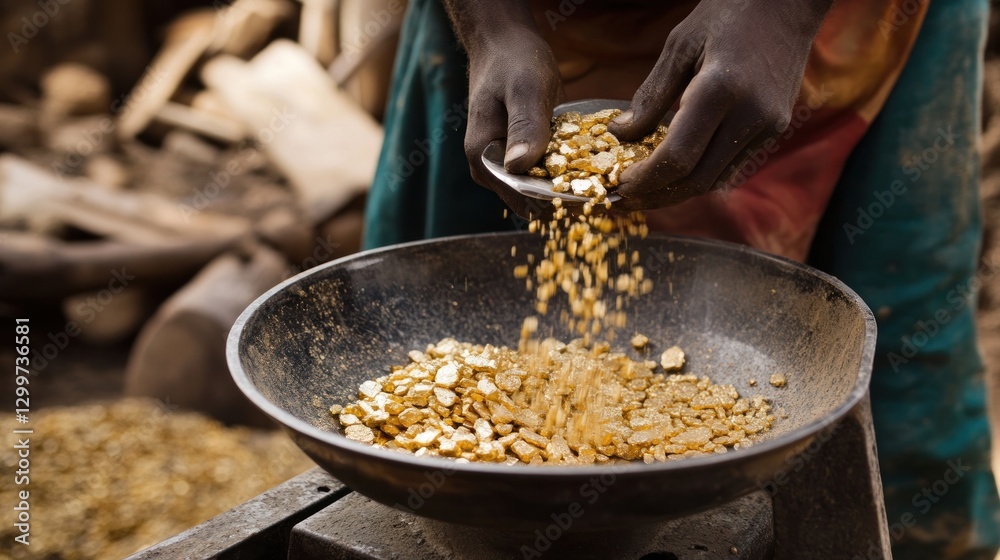
Askari Metals Ltd has raised A$1.15 million ($760,000) to fund exploration at its new gold project in Ethiopia, marking a renewed wave of investment interest in one of Africa’s most promising but underdeveloped mineral regions.
The funding, secured from a mix of existing shareholders and new investors, will support an initial drilling program at the Nejo project, targeting previously identified prospects at Guji, Komto 1, and Komto 2. The move comes as Ethiopia seeks to leverage its estimated 500 tones of gold reserves to attract responsible mining investment while balancing environmental and community considerations.

The drilling campaign, expected to cover between 3,000 and 5,000 meters in its first phase, is designed to lay the groundwork for a more comprehensive exploration effort spanning more than 20,000 metres, alongside systematic mapping and soil sampling across the broader Nejo site.
Askari’s executive director, Gino D’Anna, described Nejo as the company’s flagship project, with the potential to evolve into a JORC-compliant mineral resource. Such a certification, based on internationally recognized standards, would provide a reliable measure of the project’s economic potential and is often a key factor in attracting large-scale investment.
Read also: DRC and Rwanda formalize mineral export oversight with the United States in Strategic Security Pact
Ethiopia’s mineral sector has historically been underdeveloped, but recent years have seen a surge in both exploration and production activity. In November 2024, the country opened its first gold mine since 1994, signaling a cautious but clear opening to private investment.
Projects such as Tulu Kapi and Kurmuk have moved forward, and the government has expressed interest in creating a regulatory framework that encourages foreign investment while maintaining oversight over environmental and social impacts.
Nejo, situated in the western part of the country, lies within a region that has seen sporadic artisanal mining activity for decades, but its full geological potential has remained largely untapped.

The timing of Askari’s fundraising is significant. Global gold prices, which hovered around $2,050 per ounce in mid-2025, have provided both incentive and cushion for junior exploration companies, allowing them to raise capital more efficiently and plan multi-phase drilling campaigns.
In Ethiopia, where logistical and infrastructure challenges can slow project development, the injection of fresh capital is crucial to maintain momentum and attract further partnerships. The funds will allow for mobilization of drilling rigs, acquisition of necessary permits, and engagement with local communities to ensure that exploration proceeds with social license.
Exploration at Nejo is focused not just on quantity but on understanding the quality and accessibility of deposits. Gold in Ethiopia is often found in complex geological formations, where metallurgical characteristics can vary significantly from site to site. Systematic drilling and sampling will provide data on ore grades, mineralogy, and the feasibility of extraction, all of which feed into future economic modeling.
Analysts familiar with the region note that while 500 tonnes represents a substantial reserve on paper, unlocking it requires careful planning, substantial investment, and adherence to environmental safeguards.
Infrastructure remains a central factor in the project’s potential. Access to Nejo, like many remote Ethiopian mining sites, is limited by seasonal roads and underdeveloped transport networks. Askari and other operators are investing not only in drilling equipment but also in logistical support, including temporary road upgrades, water management, and energy solutions. These investments, while often overlooked in early-stage exploration reports, are essential for turning geological potential into viable mining operations.
Community engagement is another critical component. Ethiopia’s gold-mining regions are home to rural populations that rely on subsistence agriculture and pastoralism. Companies like Askari are increasingly aware that long-term sustainability requires meaningful consultation and benefit-sharing with local communities.
Initial exploration programs may appear small in scale, but they set the tone for future operations, including employment opportunities, training programs, and local procurement of goods and services. Missteps in this area can delay or derail projects, particularly in regions where artisanal mining already provides informal livelihoods.
The Nejo project also has broader implications for Africa’s mineral sector. As Ethiopia positions itself as a stable and resource-rich country, it is joining a wave of East African nations attracting international investment in gold, copper, and other critical minerals. These projects contribute to regional economic diversification, infrastructure development, and the potential for industrial down streaming, where raw materials are processed locally rather than exported as unrefined ore.
Askari has not disclosed a timeline for completing a JORC resource estimate, but the company has emphasized a phased approach that allows for incremental learning and risk management. The first drilling phase will help identify high-priority zones for deeper investigation, while ongoing mapping and sampling will inform decisions on project scale, metallurgical processing, and investment partnerships.
For investors and policymakers, these initial results will be closely watched as a barometer of Ethiopia’s emerging role in global gold markets.
Engage with us on LinkedIn: Africa Sustainability Matters