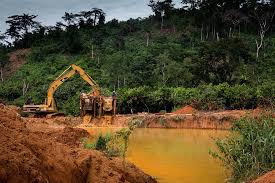
Ghana has announced a nationwide ban on mining in forest reserves, reversing a legal position adopted in 2022 that permitted extraction under defined conditions. The decision, confirmed last week by the Ministry of Environment, applies across all protected forest lands and is intended to halt further ecological damage in a country where mining has become both a major economic driver and a leading cause of environmental decline.
The move affects existing mining concessions, future exploration licenses, and the regulatory posture of Ghana’s extractive sector, placing the government at the center of a growing regional debate about how African economies balance natural resource extraction with long-term environmental security.

The repeal immediately drew support from civil society groups who have spent years documenting how forest protections were steadily eroded after the 2022 law came into force. According to data cited by Ghanaian environmental organizations, nearly 89 percent of the country’s forest reserves were technically opened to mining under the previous framework.
Of Ghana’s 288 forest reserves, more than 50 are now classified as severely threatened, with degraded watersheds, declining biodiversity, and contamination of rivers that supply drinking water to millions of people. Forests such as Subri, Tano Offin and Atewa have become reference points in national conversations about the costs of weak environmental regulation.
The challenge now lies less in the announcement itself than in what happens next. Ghana’s principal mining legislation, passed in 2006, still does not explicitly prohibit mining in forest reserves. Legal experts and former government officials point out that several mining leases granted between 2005 and 2012 remain active and legally binding, including concessions held by multinational firms operating within protected forest boundaries.
Without amendments to the core mining law, enforcement agencies may face legal constraints when attempting to revoke or suspend those permits, leaving the ban vulnerable to selective application or prolonged court disputes.
This uncertainty reflects a broader pattern seen across Africa’s resource-rich states. From the Democratic Republic of Congo’s cobalt belts to Guinea’s bauxite corridors and Zambia’s copper zones, governments have repeatedly announced environmental safeguards that struggle to survive contact with existing contracts and fiscal pressures.
Ghana’s mining sector contributes roughly 7 percent of national GDP and accounts for more than 40 percent of export earnings. Gold alone generated over US$6 billion in export revenue in 2023. These figures help explain why environmental enforcement often collides with economic imperatives, particularly in countries managing debt obligations and rising unemployment.
The Atewa Forest illustrates the stakes involved. The forest is a critical water source for more than five million people in southern Ghana and forms part of the Upper Guinean biodiversity hotspot, one of the most ecologically important regions in West Africa. At the same time, it sits atop an estimated 150 million tonnes of bauxite, a resource viewed by successive governments as central to industrialization plans. Similar tensions play out in Liberia’s iron ore zones, Sierra Leone’s rutile fields, and Mozambique’s coal provinces, where forest loss and water pollution are increasingly documented by satellite data and public health studies.
Across Africa, deforestation rates remain among the highest globally. The continent lost approximately 4 million hectares of forest annually between 2010 and 2020, according to the UN Food and Agriculture Organization. Mining is not the sole driver, but in countries like Ghana, Burkina Faso and Tanzania, small-scale and industrial mining has become a significant contributor to forest degradation and river contamination. Mercury pollution from artisanal gold mining alone affects river systems shared across national borders, complicating enforcement efforts.

Ghana’s ban therefore resonates beyond its borders. It tests whether an African state with a relatively strong institutional framework can align environmental commitments with economic governance. It also sends a signal to financiers, insurers and development partners increasingly tying funding to environmental compliance.
Multilateral lenders and climate finance mechanisms have shown growing interest in forest conservation as a cost-effective climate solution, but only where legal certainty and enforcement credibility exist.
Read also: How Tanzania is using Nature-Based Solutions to secure the future of its Tourism industry
In the coming months, Ghana’s credibility will hinge on whether existing permits are reviewed, whether the mining law is amended, and whether enforcement agencies are resourced to act. For communities living near forest reserves, the outcome will be measured less by policy statements than by whether rivers run clear again, whether farms remain productive, and whether forests continue to provide livelihoods.
For Africa’s sustainability agenda, Ghana’s experience may offer a rare case study in whether political declarations can translate into lasting environmental protection in an extractive economy.
Engage with us on LinkedIn: Africa Sustainability Matters