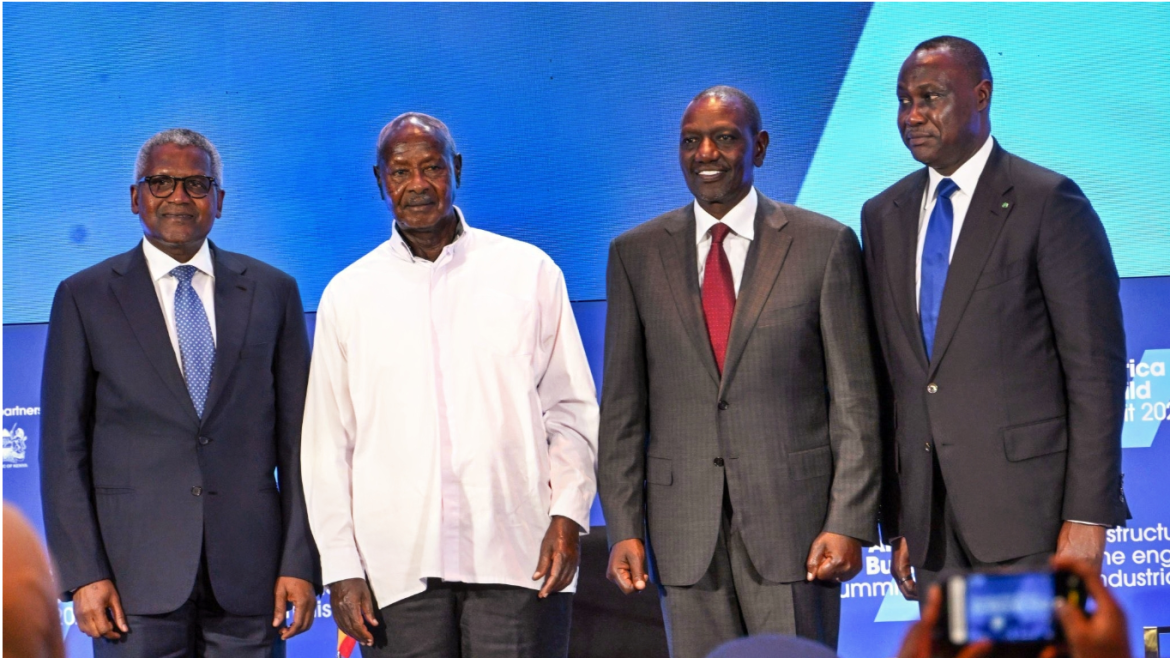
Aliko Dangote, Africa’s wealthiest industrialist, committed on Thursday 23rd April 2026, to leading the development of a multi-billion-dollar oil refinery in Tanzania, a move aimed at restructuring the energy architecture of East Africa and reducing the region’s long-standing exposure to volatile global fuel markets.
Speaking at the Africa We Build Summit in Nairobi alongside Presidents William Ruto of Kenya and Yoweri Museveni of Uganda, Dangote pledged to deliver a facility in the port city of Tanga within five years that mirrors the scale and technical specifications of his recently commissioned 650,000 barrel-per-day complex in Lagos. The proposed project represents a critical pivot toward midstream self-sufficiency for a regional bloc that, despite significant upstream discoveries, remains a net importer of refined petroleum products.
Read also: Dangote Cement signs $1B Sinoma deal to expand production across 7 African nations
The strategic rationale for the Tanga refinery rests on a collaborative regional framework intended to aggregate crude oil feedstock from the Democratic Republic of Congo and South Sudan, alongside contributions from Uganda’s nascent oil fields. This integrated approach addresses a historical bottleneck in African energy development, where fragmented national markets and a lack of processing infrastructure have forced economies to export raw crude while paying a premium for imported fuel.
According to Bloomberg, the investment forms part of a broader $40 billion expansion strategy by the Dangote Group, which seeks to leverage its technical experience in Nigeria to stabilize energy costs across the East African Community. For regional governments, the project offers a fiscal reprieve by potentially lowering the import bill and easing the persistent pressure on foreign exchange reserves, a primary driver of inflation in non-oil producing states like Kenya and Tanzania.
The timing of the announcement coincides with a period of heightened geopolitical risk in the Middle East, which has historically supplied up to three-quarters of the refined fuel consumed in East and Southern Africa.
Recent supply chain disruptions in the Persian Gulf have underscored the vulnerability of African economies to external shocks, leading to renewed urgency in domesticating refining capacity. This vulnerability is a consequence of decades of underinvestment and the subsequent closure of aging refineries in Mombasa, Lusaka, and Durban, which left the continent with a widening gap between crude production and refining output.
While Africa accounts for approximately 7% of global crude production, its share of global refining capacity has declined sharply, creating a structural dependency that the Tanga project and similar initiatives in Mozambique and Uganda seek to reverse.
The economic implications extend beyond fuel security to the viability of regional infrastructure. The Tanga refinery is expected to complement the 1,443-kilometer East African Crude Oil Pipeline (EACOP), which links Uganda’s Lake Albert basin to the Tanzanian coast. By providing a localized destination for a portion of that crude, the project enhances the commercial logic of the pipeline and creates a secondary industrial hub in Tanga.
For Tanzania, the facility transforms a transit corridor into a value-addition center, generating employment and stimulating ancillary industries in chemicals and logistics. According to President Ruto, the facility will be supported by a pipeline linking Tanga to Mombasa, effectively creating a cross-border energy grid that can supply the broader hinterland, including Rwanda and Burundi.

However, the path to implementation carries significant capital and regulatory risks. Developing a refinery of this magnitude requires deep integration of regional energy policies and harmonized standards for fuel specifications. Furthermore, as global financial institutions tighten ESG criteria for fossil fuel projects, the financing of large-scale refining infrastructure in Africa increasingly relies on private equity and regional development banks.
The success of the Tanga project will likely depend on the ability of East African states to provide the necessary sovereign guarantees and a stable regulatory environment for a five-year construction cycle. There is also the challenge of balancing this industrial expansion with the continent’s long-term energy transition goals, necessitating a design that accounts for future shifts toward cleaner fuels or carbon-capture integration.
Ultimately, the Dangote-led initiative in Tanzania signals a maturing of African capital, where indigenous investors are increasingly taking the lead on projects of systemic importance.
For the East African Community, the project is less about the expansion of a single corporate empire and more about the fundamental economic necessity of sovereign energy security. If realized, the refinery would not only provide a buffer against global price fluctuations but would also establish a template for regional industrial cooperation.
By converting regional resources into finished products for local consumption, the project addresses the core developmental challenge of moving Africa up the global value chain, ensuring that the economic dividends of the continent’s natural wealth are retained within its borders.