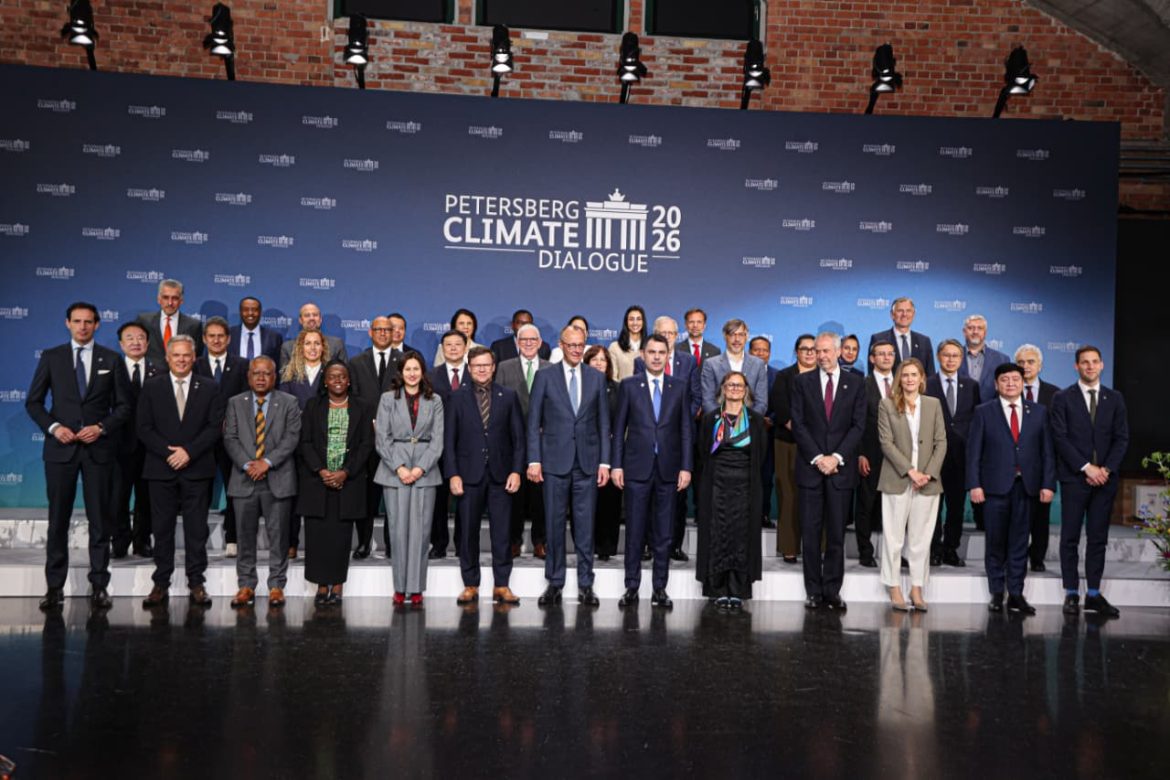
Kenya is seeking to expand the role of carbon markets and blended finance in its climate strategy, Environment Cabinet Secretary Deborah Barasa told global ministers and negotiators at the Petersberg Climate Dialogue 2026 in Berlin, outlining a policy approach aimed at unlocking private capital while strengthening oversight of emissions trading systems.
Speaking during a high-level session focused on implementation gaps, Barasa said the government is advancing mechanisms under Article 6 of the Paris Agreement, alongside the rollout of a national carbon registry designed to improve transparency and credibility in carbon transactions. The measures are intended to position Kenya as a structured participant in emerging global carbon markets while addressing longstanding concerns around integrity and verification.

Kenya’s approach reflects a broader shift among African economies seeking to translate climate commitments into financing strategies that can support infrastructure, energy systems and industrial transitions. According to Barasa, the focus is on developing “high-integrity mechanisms” that can attract private investment into sectors where public financing alone remains insufficient.
Alongside carbon markets, the government is scaling up financial instruments including green bonds, first-loss guarantees and climate investment funds. These tools are increasingly used across developing markets to de-risk projects and crowd in institutional capital, particularly in renewable energy, transport and climate-resilient infrastructure. For African governments facing fiscal constraints and rising debt servicing costs, such instruments are becoming central to maintaining investment flows without widening budget deficits.
Kenya’s energy profile provides part of the foundation for this strategy. A significant share of the country’s electricity is generated from renewable sources, including geothermal and wind, reducing exposure to fossil fuel price volatility and supporting long-term energy cost stability. Barasa said policy attention is now shifting towards expanding electrification, particularly in transport, through measures such as differentiated electricity tariffs aimed at supporting electric mobility while improving grid efficiency.

The government is also investing in regional power interconnections, battery energy storage systems and workforce reskilling, as it seeks to align energy infrastructure with anticipated demand shifts and technological change. These investments carry implications for industrial productivity, urban transport systems and employment patterns, particularly as countries across Africa assess pathways to lower-carbon growth.
Barasa linked the climate agenda to Kenya’s broader development framework, noting that implementation is anchored in the country’s Bottom-Up Economic Transformation Agenda, which positions climate action as a driver of growth and job creation rather than a standalone environmental objective. This reflects an emerging policy direction across the continent, where climate strategies are increasingly embedded within economic planning, with a focus on returns in productivity, resilience and employment.
Read also :Why Africa’s carbon future depends on integrity, not discounts
At the international level, she called for expanded cooperation on technology transfer and financing, highlighting persistent gaps between climate commitments and available resources. For many African countries, limited access to affordable capital continues to constrain the pace of transition, particularly in capital-intensive sectors such as energy and transport.
The Petersberg Dialogue, which convenes ministers ahead of formal United Nations climate negotiations, has increasingly focused on implementation challenges, including how to align financial systems, regulatory frameworks and investment pipelines with climate targets. For African participants, the discussions carry immediate relevance for domestic policy design and access to global climate finance.
Kenya’s positioning at the forum underscores a broader recalibration in Africa’s climate engagement, with governments seeking to shape market mechanisms and financing structures in ways that reflect domestic development priorities. The effectiveness of this approach will depend on the credibility of regulatory systems, the depth of financial markets and the extent to which global partners respond to calls for more equitable access to capital and technology.