


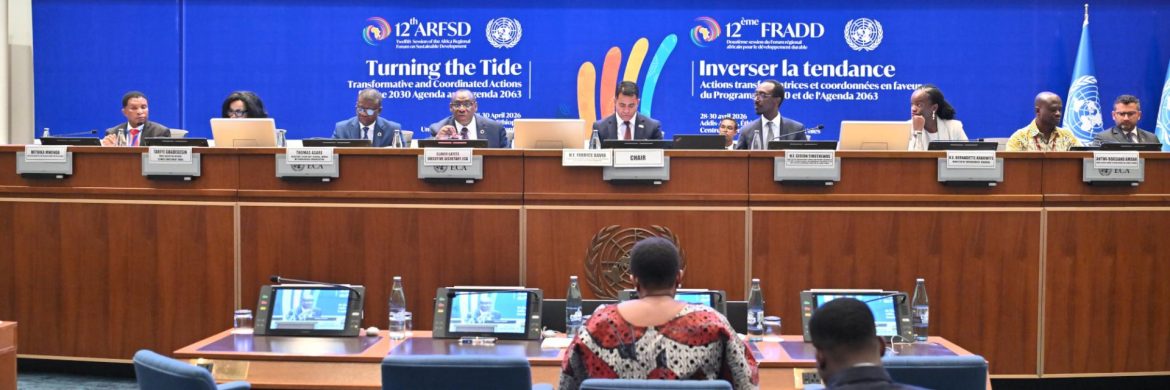
African governments are being urged to adopt a unified continental position on water governance ahead of key global policy forums in 2026, as the United Nations Economic Commission for Africa warns that water security is becoming a central economic, environmental and geopolitical issue for the continent.
Speaking at a high-level pre-event linked to the African Regional Forum on Sustainable Development, Executive Secretary Claver Gatete said water must be repositioned from a social service to a strategic development asset, underpinning growth, stability and resilience. The call comes as African countries prepare for major international engagements, including the UN Water Conference 2026 and the High-Level Political Forum on Sustainable Development, where global water governance and financing frameworks are expected to be debated.
According to the ECA, Africa holds substantial freshwater resources, yet more than 400 million people still lack access to basic drinking water, while roughly twice that number remain without adequate sanitation. These gaps continue to impose economic costs through reduced labour productivity, public health burdens and constraints on industrial and agricultural output.
The structural challenge is compounded by geography. More than 60% of the continent’s land lies within transboundary river basins, making water governance inherently regional. According to Gatete, this creates interdependencies that require coordinated policy frameworks, particularly as climate variability intensifies competition over shared resources.
The push for a common position reflects growing concern that fragmented national approaches could weaken Africa’s negotiating leverage in global forums where financing, technology transfer and regulatory standards are shaped. Water is increasingly linked to broader development systems, with implications for energy generation, food production, urbanisation and trade.
Examples from across the continent illustrate both progress and uneven implementation. In Morocco, water management is being integrated into renewable energy systems, including desalination powered by solar infrastructure. In parts of West Africa and the Sahel, expanded irrigation investments are supporting agricultural productivity and mitigating climate-related food risks. However, such initiatives remain limited in scale relative to demand, and financing continues to be fragmented across sectors and institutions.
According to the ECA, this fragmentation reflects a broader policy gap in how water is valued within national planning systems. Despite its cross-cutting role, water infrastructure is often treated as a standalone sector rather than as an enabling asset for economic transformation. This has implications for public finance allocation, private sector participation and long-term infrastructure development.
Gatete outlined a set of priorities aimed at addressing these constraints, including recognising water as core economic infrastructure, strengthening integrated planning across water, energy and agriculture systems, and scaling up both public and private investment. Central to these proposals is the call for a unified African position that aligns national strategies with continental objectives.
The timing is significant. The African Union has designated 2026 as the International Year of Water, placing additional political emphasis on the sector. This creates an opportunity for African states to consolidate positions ahead of global negotiations that will shape funding flows and governance standards for water-related investments.
For African economies, the implications extend beyond access and service delivery. Water availability and management are increasingly linked to fiscal stability, given the rising cost of climate adaptation and infrastructure deficits. In agriculture, which remains a primary employer across much of the continent, water access directly affects yields, export capacity and food import bills. In energy systems, hydropower reliability is becoming more uncertain under changing rainfall patterns, adding pressure to diversify generation sources.
The ECA’s intervention signals a broader shift in how natural resources are being framed within development policy — not as isolated sectors, but as interconnected systems with direct economic consequences. A coordinated African stance could strengthen the continent’s ability to influence global frameworks, but its effectiveness will depend on translating high-level commitments into aligned national policies and bankable investment strategies.


