


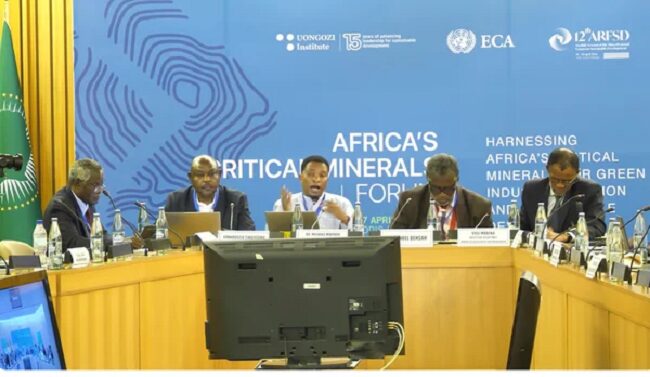
African policymakers and development actors are being urged to reposition the continent within the global minerals economy as preparations get under way for the 12th Africa Regional Forum on Sustainable Development (ARFSD-12) in Addis Ababa, with calls to shift from raw material exports towards industrial value creation amid rising global demand for critical minerals.
Speaking at a pre-forum session, Mithika Mwenda of the Pan African Climate Justice Alliance said Africa’s longstanding role as a primary exporter of unprocessed resources has delivered limited economic transformation, despite the continent’s significant mineral endowment. He argued that the current global transition towards low-carbon technologies—driven by demand for inputs such as cobalt, lithium and rare earth elements—creates a narrow but strategic window for African economies to capture greater value.
For decades, African countries have remained concentrated at the extraction stage of global value chains, while processing, manufacturing and higher-margin activities have been located elsewhere. This structure has constrained industrialisation, limited job creation and exposed public finances to commodity price volatility. According to regional economic assessments, dependence on raw exports continues to shape trade balances and fiscal revenues across several mineral-rich economies.
Mwenda said reversing this pattern requires a shift towards beneficiation, defined not only as mineral processing but as a broader industrial strategy encompassing energy systems, logistics infrastructure, skilled labour and trade integration. Without these enabling conditions, he cautioned, efforts to localise value addition risk replicating extractive models under new market conditions linked to the energy transition.
Regional integration emerged as a central theme in the discussions. Given the uneven distribution of resources and infrastructure across countries, no single economy is positioned to build a complete minerals value chain independently. Initiatives such as the Democratic Republic of Congo–Zambia battery value chain and the Lobito Corridor linking Angola, the DRC and Zambia were cited as early attempts to coordinate production, processing and export logistics.
However, participants noted that such corridors carry differing development outcomes depending on their design. While improved transport infrastructure can reduce costs and increase export volumes, the absence of parallel investments in industrial capacity risks reinforcing the export of unprocessed commodities. Ensuring that these projects support midstream and downstream activities will be critical to their long-term economic impact.
Examples from outside traditional extractive models were also highlighted. Morocco’s expansion into battery manufacturing, supported by industrial policy and integration into global markets, illustrates how coordinated investment and policy alignment can shift countries up the value chain. The model underscores the importance of linking resource endowment with industrial planning and market access.
Governance challenges remain a key constraint. Some countries, including Zimbabwe, have introduced export restrictions on raw minerals such as lithium in an effort to stimulate domestic processing. While such measures can signal policy intent, analysts caution that their effectiveness depends on complementary investments in energy supply, processing facilities and financing. Fragmented policy frameworks, power shortages and limited access to capital continue to hinder large-scale industrial development in many parts of the continent.
The discussion also reflects broader changes in global supply chains, as geopolitical tensions and diversification strategies prompt major economies to seek alternative sources of critical minerals. This reconfiguration could create opportunities for African producers, but it also increases competition and raises standards related to environmental, social and governance requirements.

Mwenda called for a shift from competition among African states towards coordinated strategies that prioritise regional value creation and local participation. Tax incentives and regulatory concessions aimed at attracting investment, he said, often erode public revenues without guaranteeing long-term industrial benefits. A more integrated approach would align mineral policy with energy planning, industrial development and trade frameworks.
The outcomes of these debates are likely to influence discussions at ARFSD-12, convened by the United Nations Economic Commission for Africa and partners, where sustainable development priorities are increasingly linked to resource governance and economic transformation. For African economies, the central issue is whether the current surge in demand for critical minerals can be leveraged to build resilient industrial systems, rather than reinforcing dependence on commodity exports.
As global demand for inputs into clean energy technologies continues to expand, the choices made by African governments on policy coordination, infrastructure investment and regional integration will shape how mineral wealth translates into growth, employment and fiscal stability. The shift from extraction to value addition remains a structural challenge, but one that is becoming more urgent as the global energy transition accelerates.


