


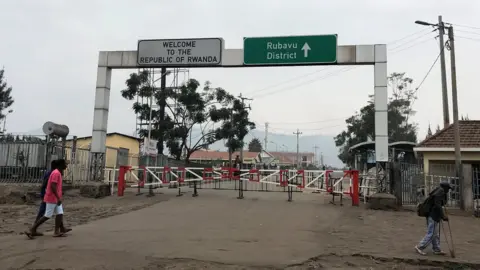
Rwanda has intensified health screenings and tightened cross-border movement with the Democratic Republic of Congo following a rapidly escalating Ebola outbreak linked to the rare Bundibugyo strain, as regional governments and international health agencies move to contain a crisis that has already caused at least 131 deaths and more than 530 suspected infections in eastern Congo. The measures, introduced at key border crossings near the city of Goma, include temperature checks, traveller screening and restrictions on the movement of goods and people, reflecting growing concern that the outbreak could spread further across East Africa amid ongoing conflict and large-scale population displacement.
The outbreak, centered in Ituri province in North Eastern Congo, has prompted the World Health Organization to declare an international public health emergency, underscoring fears that fragile healthcare systems, insecurity and limited humanitarian access could complicate containment efforts. According to health authorities, the outbreak involves the Bundibugyo strain of Ebola, a relatively rare variant for which there is currently no approved vaccine or specific treatment, increasing the complexity of the regional response.
Rwandan officials say tighter border monitoring is necessary given the heavy movement of traders, transporters and communities between eastern Congo and western Rwanda. Border towns such as Rubavu and Goma form part of one of the region’s busiest commercial corridors, where thousands of people cross daily for trade, employment and family connections. While authorities maintain that restrictions are intended to protect public health, residents and small-scale traders say the measures are disrupting livelihoods and increasing economic uncertainty in communities already dependent on fragile informal trade networks.
Local traders report delays in the movement of agricultural produce, consumer goods and small commercial shipments, with some forced to transfer goods at the border rather than crossing directly into Congolese territory. According to regional trade analysts, prolonged restrictions could place additional pressure on household incomes and cross-border commerce, particularly in areas where informal trade remains a primary source of employment and food distribution. Eastern Congo and Western Rwanda maintain strong economic interdependence through markets linked to agriculture, retail trade and transport services.
The health emergency also highlights broader structural vulnerabilities facing African economies during disease outbreaks. Public health crises frequently extend beyond healthcare systems, affecting labour markets, transport corridors, tourism revenues and public finances. Governments across the region are already managing fiscal pressures linked to debt servicing, food inflation and climate-related shocks, limiting the financial flexibility available for emergency health responses.
Compounding the challenge is the deteriorating security situation in eastern Congo. The outbreak’s epicentre, Mongbwalu, lies in territory affected by armed violence involving the CODECO militia, while attacks linked to the Allied Democratic Forces (ADF) continue in nearby areas. Further south, fighting persists between Congolese forces and the Rwanda-backed March 23 Movement (M23) rebel group despite earlier peace agreements. Humanitarian agencies warn that insecurity is restricting access to affected communities and complicating surveillance, isolation and contact tracing efforts considered essential to containing Ebola transmission.
The confirmation of an Ebola case in Goma has heightened regional concern because of the city’s strategic importance as a transport and commercial hub bordering Rwanda. Goma connects Eastern Congo to regional supply chains stretching across East Africa, making uninterrupted public health monitoring critical for both economic stability and disease containment. Health experts note that densely populated urban centres with high mobility rates present elevated risks for rapid transmission if outbreaks are not quickly controlled.
Read more: https://www.bbc.com/pidgin/articles/c5y9pkqxzv1o
International concern has also intensified. The United States has raised its travel advisory for the Democratic Republic of Congo, South Sudan and Uganda to Level Four, advising against travel, while also warning Americans to reconsider travel to Rwanda because of the Ebola outbreak. Such advisories can have wider economic implications for tourism, aviation and foreign investment flows, sectors that remain important sources of foreign exchange for several East African economies.

The Bundibugyo strain previously caused outbreaks in Uganda in 2007 and Congo in 2012, with mortality rates estimated between 30 and 50 percent. Unlike the Zaire strain, which has benefited from vaccine development in recent years, the current outbreak relies heavily on traditional containment measures such as isolation, hygiene protocols and movement monitoring. According to epidemiologists, the absence of an approved vaccine increases pressure on already stretched regional health systems and heightens the importance of rapid detection and coordinated cross-border surveillance.
The outbreak also underscores the intersection between public health resilience and regional stability in Africa. Disease outbreaks in conflict-affected regions often expose weaknesses in governance systems, healthcare infrastructure and emergency coordination mechanisms. Analysts note that the ability of East African governments to manage cross-border health threats increasingly carries implications not only for public safety, but also for trade integration, labour mobility and long-term economic resilience across the region.


