


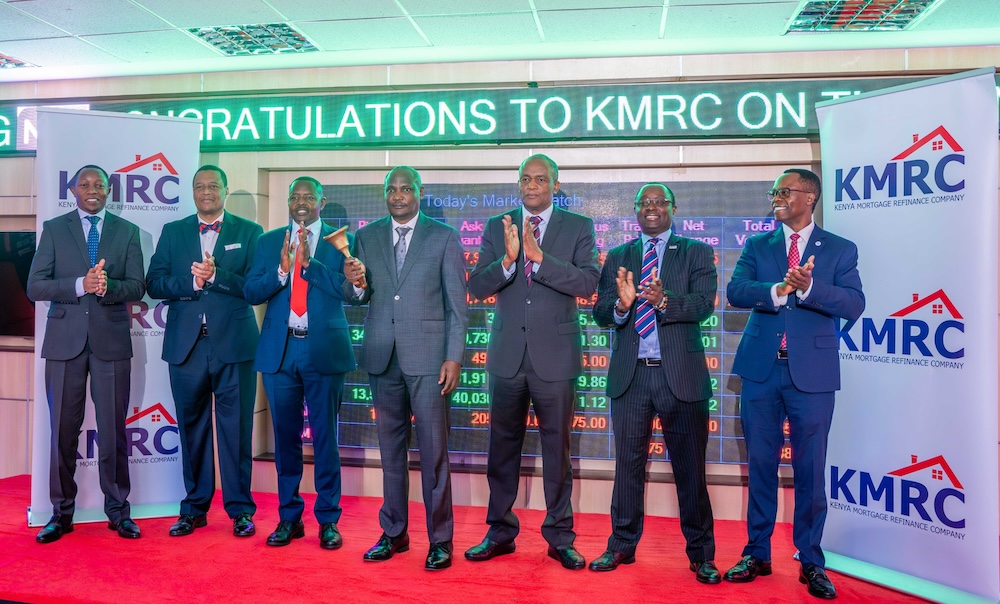
The Kenya Mortgage Refinance Company (Kenya Mortgage Refinance Company) has listed a KES 3 billion sustainability bond on the Nairobi Securities Exchange (Nairobi Securities Exchange), after receiving KES 9.38 billion in orders from investors, translating to an oversubscription of 313 percent that signals sustained liquidity appetite for structured, housing-linked debt instruments in Kenya’s capital markets. The bond, issued under KMRC’s KES 10.5 billion Medium-Term Note Programme, will be used to refinance affordable and green housing projects as well as expand social mortgage lending targeting low-income households and women.
The issuance comes against a backdrop of rising pressure on African governments and financial institutions to mobilise domestic capital for long-term infrastructure and housing needs, as concessional funding becomes increasingly constrained and public debt servicing costs rise. In Kenya, housing demand continues to outstrip supply, with estimates frequently pointing to a deficit running into millions of units, driven by rapid urbanisation, population growth and the high cost of formal housing finance.
The strong investor response mirrors KMRC’s earlier market entry in 2022, when its inaugural KES 1.4 billion bond attracted KES 8.5 billion in applications. That pattern of repeated oversubscription suggests that institutional investors, including pension funds and insurance firms, are increasingly seeking fixed-income assets that combine relatively stable returns with exposure to real economy sectors such as housing and infrastructure.
According to KMRC Chief Executive Johnstone Oltetia, the outcome reflects confidence in the institution’s refinancing model and the growing role of capital markets in addressing structural housing constraints. KMRC operates as a secondary mortgage liquidity facility, providing long-term funding to primary mortgage lenders, which in turn enables them to extend fixed-rate, single-digit mortgages—products that remain limited in Kenya due to high funding costs and maturity mismatches in the banking sector.
Since its establishment, KMRC has refinanced approximately KES 30 billion in mortgages, supporting 5,811 home loans across 39 counties. It has also extended loan tenors to improve affordability, easing repayment pressure on borrowers and expanding access to formal housing finance. This model is increasingly viewed within policy circles as a mechanism to deepen Kenya’s mortgage market, which remains small relative to the size of its economy and urban population.
The proceeds of the latest bond will be blended with concessional funding and directed toward refinancing green affordable housing developments and social housing loans. The focus on climate-resilient construction reflects a broader shift in African urban development policy, where housing is increasingly being integrated into climate adaptation strategies. Urban centres across the continent face growing exposure to flooding, heat stress and infrastructure strain, making housing quality and location a critical resilience issue rather than only a social welfare concern.
Sustainability-labelled bonds have gained traction across emerging markets as governments and development finance institutions seek to align capital flows with environmental and social objectives. In Africa, however, the market remains relatively shallow, and issuers often rely on development finance institutions to provide credibility, pricing stability and anchor demand. The KMRC transaction therefore adds to a small but growing pipeline of thematic bonds in East Africa, where Kenya has been one of the more active sovereign and quasi-sovereign issuers.
Board Chairman Dr Haron Sirima said the listing demonstrates that affordable housing can attract commercial capital while still delivering measurable social and environmental outcomes. His remarks reflect a broader shift among African policymakers and financial institutions toward blended finance structures that combine concessional resources with market-based funding to de-risk long-term investments.
Cabinet Secretary for the National Treasury John Mbadi positioned the issuance within Kenya’s broader capital markets development agenda, noting that the government is increasingly relying on domestic debt instruments to finance development priorities. He added that deepening and diversifying the debt market is central to strengthening financial resilience, particularly as global financing conditions tighten and competition for external capital intensifies.
NCBA Group (NCBA Group), which acted as lead arranger, said the transaction underscores the importance of structured execution in capital markets and reflects growing collaboration between commercial banks and development-oriented institutions in mobilising long-term finance for housing.
The oversubscription highlights both the depth of institutional liquidity in Kenya’s financial system and the attractiveness of asset-backed instruments tied to essential services. However, it also underscores a broader structural challenge across African economies: converting strong investor demand into scalable, affordable housing delivery systems capable of meeting rapidly expanding urban populations. Without parallel reforms in land markets, construction costs and urban planning frameworks, financing alone may not be sufficient to close the housing gap.

https://www.aecweek-registration.com/2026/?repid=
Across the continent, similar initiatives are emerging as governments experiment with green bonds, sustainability-linked instruments and mortgage refinancing facilities to address infrastructure deficits. Yet the scale of demand continues to outpace supply, placing sustained pressure on capital markets to evolve beyond traditional sovereign debt into more diversified instruments that can support long-term development outcomes.


