


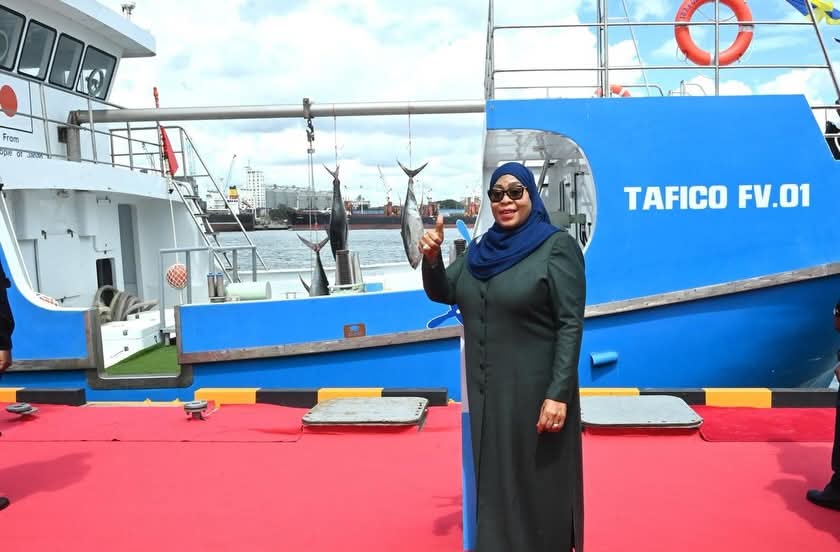
Tanzania has launched its first deep-sea fishing vessel, marking a significant step in the country’s efforts to expand its blue economy, strengthen domestic fisheries capacity, and increase the economic returns derived from its marine resources. The vessel was officially commissioned on 25 April 2026 at the Tanzania Fisheries Corporation (TAFICO) headquarters in Kigamboni, Dar es Salaam, by President Samia Suluhu Hassan, who described the development as a strategic milestone in the country’s long-term economic transformation agenda.
The launch represents a shift in Tanzania’s approach to managing and utilising its vast marine resources. For decades, much of the country’s offshore fishing activity has been dominated by foreign industrial fleets operating within Tanzania’s Exclusive Economic Zone (EEZ), limiting the extent to which fisheries revenues and associated economic benefits have been retained domestically. According to government officials, the introduction of a nationally operated deep-sea fishing vessel is intended to strengthen local participation in commercial fisheries while enhancing oversight and value capture within the sector.
 President Hassan stated that the initiative forms part of broader efforts to ensure that Tanzania derives greater economic value from its maritime resources. By expanding domestic fishing capacity, the government aims to improve national revenue collection, increase fish production, and reduce dependence on foreign operators in offshore waters. The vessel is expected to support commercial fishing operations in deeper waters that have historically remained underutilised by local industry players due to limited technical capacity and infrastructure.
The project is also closely linked to the revitalisation of TAFICO, the state-owned fisheries corporation that has been tasked with spearheading the modernisation of Tanzania’s fisheries sector. According to government officials, the vessel is one component of a wider investment programme that includes fleet expansion, port development, cold-chain infrastructure, and processing facilities designed to strengthen fisheries value chains and improve competitiveness in regional and international markets.
The Minister for Livestock and Fisheries indicated that complementary investments are already underway, including the near completion of the Kilwa Masoko fishing port. Such infrastructure is expected to enhance fish handling, storage, processing, and export capabilities while reducing post-harvest losses that continue to affect fisheries productivity across East Africa. Improved logistics and cold storage facilities could also strengthen Tanzania’s ability to meet export standards and access higher-value international seafood markets.
The vessel was constructed in Japan and delivered through bilateral cooperation between Tanzania and Japan. Speaking during the commissioning ceremony, Japanese Ambassador Yoichi Mikami noted that the project reflects longstanding cooperation between the two countries and supports Tanzania’s efforts to modernise its fisheries sector. He added that enhanced fishing capacity could contribute to improved fish availability for domestic consumers while supporting export growth.
For Tanzania, the fisheries sector represents a significant but largely underdeveloped economic opportunity. The country possesses an extensive coastline along the Indian Ocean, abundant inland water resources, and access to one of Africa’s largest Exclusive Economic Zones. Yet industry experts have frequently pointed to infrastructure limitations, inadequate investment, and illegal, unreported and unregulated (IUU) fishing as key barriers to maximising the sector’s contribution to national development.
The economic implications extend beyond fishing activities alone. Fisheries support a broad ecosystem of industries including processing, transportation, refrigeration, logistics, equipment maintenance, and export services. According to development practitioners, expanding domestic participation in deep-sea fishing can create employment opportunities, particularly for young people in coastal regions, while stimulating private investment across related sectors.
The initiative also aligns with broader efforts across Africa to develop sustainable blue economy strategies as countries seek new drivers of economic growth. The African Union has increasingly highlighted the blue economy as a critical component of Agenda 2063, recognising the potential of oceans, seas, and coastal resources to support industrialisation, trade, food security, and employment creation. Several African coastal states, including Kenya, Seychelles, Mauritius, and South Africa, have introduced policies aimed at expanding marine industries while improving governance of ocean resources.
 From a sustainability perspective, the success of Tanzania’s fisheries expansion will depend on balancing economic objectives with responsible resource management. Marine ecosystems across Africa face growing pressures from overfishing, climate change, habitat degradation, and illegal fishing activities. As domestic fishing capacity increases, effective monitoring, enforcement, and fisheries management systems will remain essential to ensuring that resource utilisation remains environmentally sustainable over the long term.
The launch of the vessel therefore represents more than a single infrastructure investment. It reflects a broader policy effort to strengthen economic sovereignty within the fisheries sector, improve value retention from marine resources, and position the blue economy as a contributor to Tanzania’s long-term development strategy. As investments in ports, fleets, processing facilities, and maritime governance continue, the country’s experience may provide an important case study in how African coastal economies can leverage ocean resources to support sustainable growth while protecting critical marine ecosystems.


