


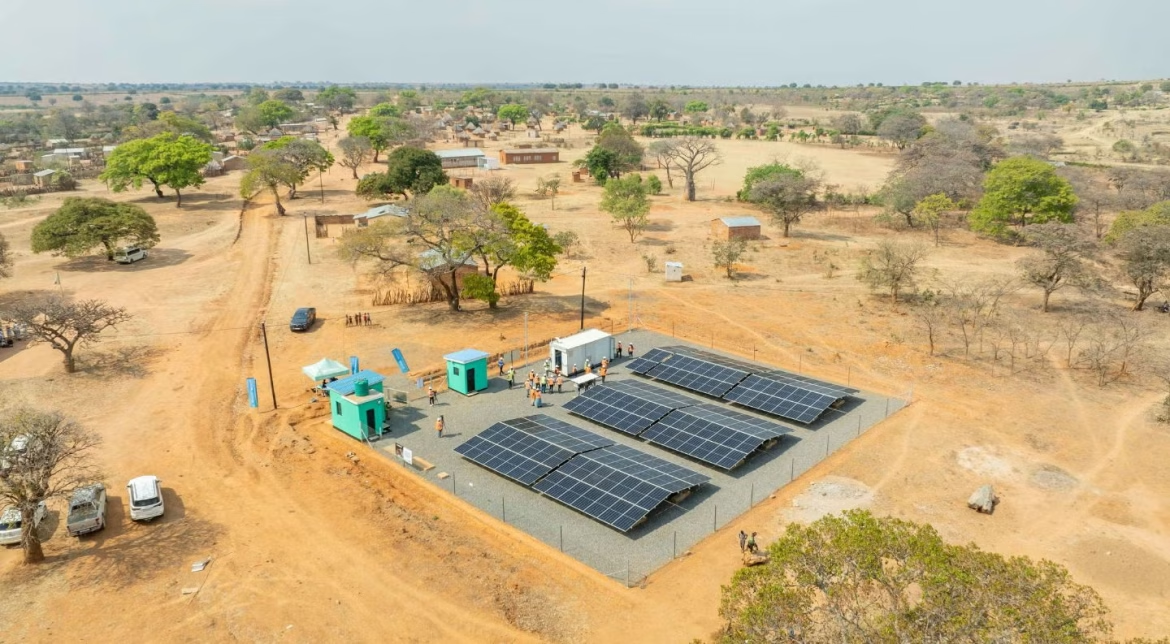
More than 50 million people across 40 African countries have gained access to electricity under Mission 300, a continent-wide energy initiative led by the World Bank Group and the African Development Bank Group, marking a significant milestone in efforts to connect an additional 300 million people to power by 2030. The achievement, announced this week, reflects a rapid acceleration in electrification efforts driven by coordinated financing, policy reforms, private sector participation and investments spanning generation, transmission and last-mile distribution infrastructure.
The milestone comes at a critical moment for Africa’s development trajectory. Despite substantial progress in recent years, the continent remains home to most of the world’s population without access to electricity, a constraint that continues to limit industrial growth, agricultural productivity, healthcare delivery, educational outcomes and digital inclusion. According to the World Bank Group and the African Development Bank Group, Mission 300 is now delivering electricity access at nearly twice the pace recorded when the initiative was launched in 2024, highlighting the impact of a coordinated approach that aligns governments, development finance institutions, philanthropic partners and private investors around shared national energy priorities.
 Unlike previous electrification programmes that often operated through fragmented interventions, Mission 300 seeks to address barriers across the entire energy value chain. Investments have targeted both grid expansion and off-grid solutions, enabling countries to accelerate connections in urban, peri-urban and rural areas simultaneously. The initiative combines infrastructure financing with policy reforms designed to improve utility performance, strengthen regulatory frameworks and attract private capital into underserved markets.
The results are already evident in several participating countries. Tanzania has connected approximately 7.5 million people under the initiative, representing a five-fold increase in the annual pace of electrification achieved before Mission 300. In Ethiopia, around 4.6 million people have gained access to electricity following reforms that reduced the cost of grid connections and expanded service coverage. Nigeria has connected more than 4.5 million people through private sector-led delivery models supported by public financing instruments and risk-sharing mechanisms.
The scale of financing mobilised through Mission 300 reflects growing recognition that energy access remains one of Africa’s most important development priorities. To date, the World Bank Group and the African Development Bank Group have committed nearly US$15 billion to Mission 300-related programmes, while approximately US$4.5 billion has been mobilised through co-financing arrangements. Additional development partners have pledged more than US$7 billion to support energy sector investments across participating countries.
The initiative’s financing structure is designed to address one of the most persistent challenges facing African energy markets: the perception of investment risk. By combining grants, concessional financing, guarantees and policy support, Mission 300 lowers barriers for private sector participation in areas where commercial returns have historically been uncertain. This approach is helping expand energy access in communities that conventional market mechanisms have often overlooked.
Beyond household connections, the broader economic implications are substantial. Reliable electricity remains a prerequisite for industrialisation, value addition, agricultural processing and digital economic growth. Expanded access can reduce production costs for businesses, improve healthcare services through reliable refrigeration and medical equipment, and enhance educational outcomes by extending study hours and enabling access to digital learning resources.
The initiative is also becoming a platform for energy sector reform. Thirty African countries have already launched National Energy Compacts, country-led frameworks outlining plans to strengthen electricity systems, expand renewable energy generation, improve regional power integration and increase private sector participation. Additional compacts are expected to be introduced by Burkina Faso, the Central African Republic, Djibouti, Gabon, Rwanda and Uganda during the Africa Energy Forum, further expanding the programme’s reach.
According to World Bank Group President Ajay Banga, the significance of the milestone extends beyond the number of people connected. He noted that the initiative demonstrates how coordinated partnerships and country-led reforms can accelerate development outcomes while creating foundations for long-term economic transformation. The emphasis, he argued, is not simply on electricity provision but on the opportunities that reliable power enables across multiple sectors.
African Development Bank Group President Sidi Ould Tah similarly described the milestone as an important step toward broader development objectives, highlighting the role of electricity in improving food security through irrigation, supporting healthcare systems and creating economic opportunities. His comments reflect a growing consensus among development institutions that energy access is increasingly linked to resilience, competitiveness and inclusive growth.
Development partners supporting the initiative have also highlighted its significance within the wider sustainability agenda. The Rockefeller Foundation, Sustainable Energy for All (SEforALL), and the Global Energy Alliance for People and Planet have positioned Mission 300 as an example of how public, private and philanthropic capital can be aligned to address structural development challenges at scale. Their support reflects growing recognition that achieving universal energy access is essential to meeting climate, economic and social development goals simultaneously.
From an African perspective, Mission 300 arrives at a time when demographic growth, urbanisation and industrial ambitions are increasing demand for reliable electricity systems. The continent’s population is expected to continue expanding rapidly over coming decades, intensifying pressure on governments to provide affordable and dependable energy services capable of supporting economic diversification and job creation.
The initiative also aligns closely with the African Union’s Agenda 2063, which identifies energy infrastructure as a cornerstone of economic transformation, regional integration and sustainable development. By supporting investments in both conventional and renewable energy systems, Mission 300 is contributing to efforts to build more resilient energy networks while expanding opportunities for productive economic activity.
 While significant challenges remain, including financing gaps, infrastructure deficits and the need for continued policy reform, the latest figures suggest that coordinated action is beginning to alter the pace of electrification across the continent. For many African countries, the milestone represents not only progress toward universal energy access but also a broader shift in how governments, financiers and private investors are approaching one of the continent’s most persistent development challenges.
As additional countries implement energy compacts and new financing commitments come online, the focus will increasingly turn to whether the momentum generated by Mission 300 can be sustained. The outcome will have implications not only for electricity access but also for Africa’s wider ambitions around industrialisation, climate resilience, employment creation and long-term economic transformation.


