


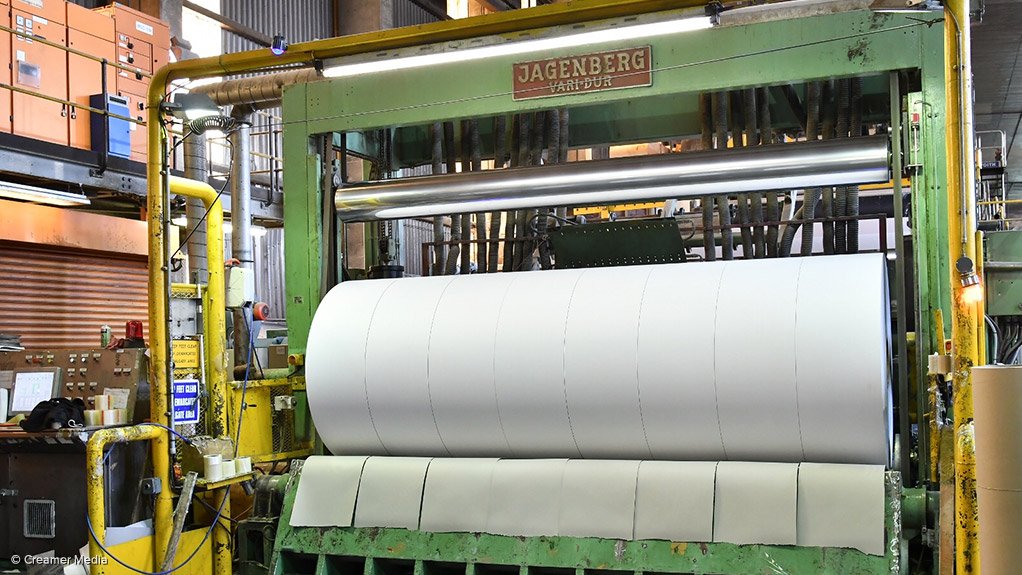
South Africa’s manufacturing sector has suffered a significant setback after packaging and paper group Mpact shut down the BM6 coated carton board machine at its Springs Mill in Gauteng, ending the country’s only domestic production of carton board used in takeaway packaging and consumer goods. The closure follows sustained pressure from lower-cost imports, rising municipal utility costs and operational challenges that collectively eroded the competitiveness of local production, raising broader questions about industrial resilience, trade policy and the future of value-added manufacturing in Africa.
The decision marks the end of a production line that supplied packaging materials for several widely recognised consumer brands, including KFC, Blitz firelighters and Freshpak Rooibos. According to Mpact, a global oversupply of carton board enabled foreign producers to offer products at prices approximately 20 per cent below the company’s production costs, placing local manufacturing at a significant disadvantage.
 The situation escalated in January 2026 when the Springs Mill’s largest customer informed the company that it would cease purchasing locally produced carton board and switch to imported alternatives. Without sufficient demand to sustain operations, Mpact concluded that continued production on the BM6 machine was no longer commercially viable.
The closure highlights the growing challenges facing African manufacturers operating in increasingly competitive global markets. While trade liberalisation and international supply chains have improved access to lower-cost products, they have also intensified pressure on domestic industries that face higher production costs, infrastructure constraints and regulatory burdens. For many manufacturers across the continent, competing against imported goods remains difficult when energy, logistics and municipal service costs continue to rise faster than productivity gains.
According to Mpact, the Springs Mill’s competitiveness had been weakened by years of elevated electricity and water tariffs imposed by the Ekurhuleni Municipality, alongside recurring service disruptions that affected operational efficiency. Unlike some of the company’s other facilities, Springs Mill remained heavily dependent on municipal infrastructure and lacked alternative water and energy sources that could have reduced exposure to rising utility costs.
The company’s experience reflects a broader challenge confronting industrial economies across Africa. Reliable and affordable infrastructure remains central to manufacturing competitiveness, yet many businesses continue to operate in environments characterised by energy instability, aging municipal systems and rising service costs. These factors increasingly influence investment decisions and determine whether local production can compete with imported goods.
Mpact’s other operations present a contrasting picture. The company has invested approximately R2 billion in its Felixton and Mkhondo Mills, facilities that benefit from proximity to natural water resources and alternative energy systems. In 2025, the group expanded its renewable energy portfolio by installing approximately 18 megawatts of solar photovoltaic capacity and securing a five-year power purchase agreement for renewable electricity. These investments have improved operational resilience while reducing dependence on municipal infrastructure.
The financial pressures facing Springs Mill became increasingly evident in recent years. Revenue at the facility reached R1.75 billion during the 2025 financial year, yet operating profit declined sharply from R32.1 million in 2024 to only R2 million in 2025. The deterioration illustrated how narrow margins had become despite continued production and demand from established customers.
Beyond the company’s financial performance, the closure carries implications for employment, industrial capability and supply chain security. The section 189A consultation process affected hundreds of workers at the Springs facility, while South Africa has now lost domestic capacity in a specialised segment of the packaging industry. Although alternative supply remains available through imports, the loss of local production reduces industrial diversification and increases dependence on foreign suppliers for a product previously manufactured domestically.
The development also raises strategic questions about industrial policy in Africa’s largest manufacturing economy. Governments across the continent are seeking to strengthen local value addition, expand industrial employment and reduce dependence on imported manufactured goods. Yet achieving these objectives requires competitive operating environments, predictable infrastructure services and policy frameworks capable of supporting domestic producers against global market distortions and excess capacity.
Trade policy may become increasingly relevant in this context. The continued operation of Mpact’s BM3 coreboard machine is reportedly dependent on the potential introduction of protective tariffs. Such measures often involve balancing the interests of local manufacturers seeking protection from low-cost imports against those of downstream industries that benefit from cheaper imported inputs.
 From a sustainability perspective, the closure illustrates the complex relationship between environmental transition, industrial competitiveness and economic resilience. Investments in renewable energy and resource efficiency can strengthen long-term competitiveness, but they require significant capital expenditure that not all facilities are positioned to undertake. As industries across Africa navigate the transition toward lower-carbon production models, access to affordable financing and enabling infrastructure will become increasingly important.
The Springs Mill closure therefore represents more than the loss of a single production line. It reflects broader structural tensions facing African manufacturing as global trade patterns, infrastructure challenges and sustainability imperatives reshape industrial economics. For policymakers, businesses and investors, the episode serves as a reminder that industrial development depends not only on market demand but also on the conditions that allow domestic producers to compete effectively in an increasingly interconnected global economy.


