


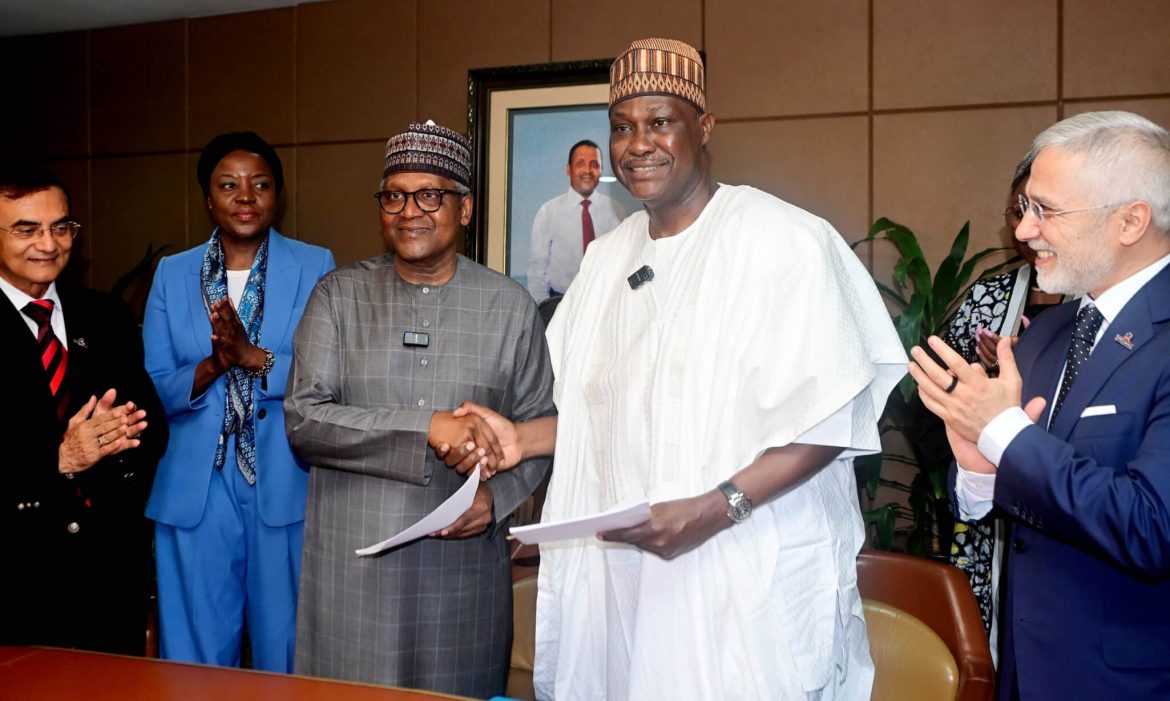
The Africa Finance Corporation (AFC) will provide $600 million to support a major expansion of the Dangote Group’s fertilizer business, a project that aims to triple production capacity, strengthen Africa’s food security, reduce dependence on imported agricultural inputs and increase non-oil export revenues across the continent.
The financing, which will be directed to Greenview Fertilizer Corporation, the holding company overseeing Dangote’s fertilizer operations, forms part of a broader $7 billion expansion programme that will significantly increase urea production capacity in Nigeria while establishing a major new fertilizer manufacturing facility in Ethiopia. The investment reflects growing efforts by African development finance institutions and industrial groups to address structural weaknesses in agricultural value chains at a time when food security has become a central economic and political concern across the continent.
Under the expansion plan, the Dangote fertilizer complex in Nigeria will increase annual urea production capacity from 3 million metric tons to 9 million metric tons. In parallel, a new fertilizer plant with an annual capacity of 3 million metric tons will be developed in Ethiopia. Once completed, the combined facilities will create an integrated fertilizer production platform with total annual output of 12 million metric tons, making it one of the largest fertilizer production networks in the world and one of the most significant industrial investments in Africa’s agricultural sector.
The announcement comes as African governments seek to improve agricultural productivity and reduce vulnerability to disruptions in global commodity markets. Fertilizer availability has emerged as a critical issue in recent years following supply chain disruptions, geopolitical tensions and volatile energy prices that have contributed to rising input costs for farmers across the continent. According to AFC, Africa’s approximately 1.5 billion people currently consume around 6 million metric tons of urea annually, substantially below consumption levels in other regions with comparable populations. India consumes nearly 40 million metric tons each year, while China uses close to 50 million metric tons. The disparity reflects longstanding challenges related to affordability, distribution networks, local production capacity and access to agricultural inputs.
Agricultural experts have frequently identified low fertilizer usage as one of the key constraints limiting crop yields across much of sub-Saharan Africa. While the continent possesses around 60% of the world’s uncultivated arable land, productivity levels remain significantly below global averages for many staple crops. Limited access to fertilizers has been cited as a major factor contributing to these yield gaps, alongside inadequate irrigation, mechanization constraints and financing challenges faced by smallholder farmers. Against this backdrop, AFC views the expansion as part of a broader strategy to strengthen Africa’s agricultural resilience while supporting industrialization and regional value addition. By increasing local production capacity, policymakers hope to reduce dependence on imported fertilizers, improve supply reliability and enhance food production systems across multiple regions.
The project also carries important economic implications beyond agriculture. Nigeria has spent several years pursuing policies aimed at diversifying export revenues away from crude oil, which continues to dominate foreign exchange earnings despite efforts to broaden the country’s economic base. Expanding fertilizer exports is increasingly viewed as a strategic opportunity to strengthen non-oil exports while leveraging Nigeria’s abundant natural gas resources, which serve as a key feedstock for urea production.
According to Dangote Group President and Chief Executive Officer Aliko Dangote, the planned increase in production capacity could generate more than $4 billion annually in export revenues within the next three years. Such earnings would represent a significant contribution to Nigeria’s foreign exchange reserves and support broader efforts to improve macroeconomic stability amid ongoing currency and fiscal pressures.
Since commencing commercial production in 2022, the Dangote Fertilizer plant has supplied both domestic and international markets, exporting products to countries across Africa as well as destinations in Europe, Latin America and other regions. The facility has already contributed to reducing fertilizer imports into Nigeria while positioning the country as an emerging exporter of agricultural inputs.

The Ethiopian component of the expansion highlights the growing importance of regional industrial integration in Africa’s development agenda. Ethiopia remains one of Africa’s largest agricultural economies and among the continent’s fastest-growing fertilizer markets. Establishing a large-scale production facility in East Africa could improve regional supply chains, reduce transportation costs and enhance fertilizer accessibility for farmers across the Horn of Africa and neighbouring markets. The investment also underscores AFC’s expanding role in financing large-scale industrial infrastructure projects across Africa. The corporation has previously partnered with the Dangote Group on several landmark projects, including the Dangote Refinery in Lagos, where AFC arranged a $3 billion syndicated financing package and provided a $300 million senior loan facility.
Development finance institutions are increasingly prioritizing projects that address multiple development objectives simultaneously. Fertilizer production investments have become particularly attractive because they intersect with food security, industrial development, export diversification, job creation and regional trade integration. As Africa’s population is projected to exceed 2.5 billion people by 2050, ensuring adequate agricultural productivity will become increasingly important for economic stability and social development.
https://www.aecweek-registration.com/2026/
The AFC-backed expansion therefore represents more than a manufacturing project. It reflects a broader shift toward building strategic industrial capacity within Africa, reducing dependence on imported inputs and strengthening the foundations of agricultural growth. If successfully implemented, the Nigeria and Ethiopia facilities could enhance fertilizer availability across the continent, support agricultural productivity gains and reinforce Africa’s position in the global fertilizer market while contributing to broader economic diversification efforts.
For policymakers, investors and development institutions, the project illustrates how industrial investments linked to agriculture can simultaneously address food security challenges and create new export opportunities. As African economies continue to seek pathways toward sustainable growth, fertilizer production is increasingly being viewed not only as an agricultural necessity but also as a strategic industrial asset capable of supporting long-term economic transformation.


