


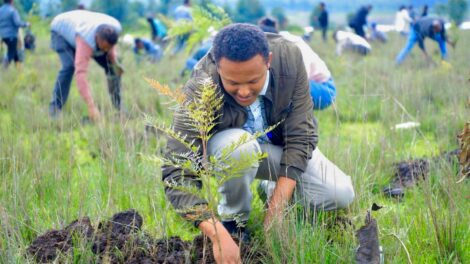
Ethiopia has launched an ambitious new phase of its Green Legacy Initiative, targeting the planting of 8 billion seedlings in 2026 as the government seeks to strengthen climate resilience, restore degraded landscapes and reinforce environmental sustainability as a central pillar of national development. The programme was officially launched in Addis Ababa by Prime Minister Abiy Ahmed earlier this week, with senior government officials calling for nationwide participation in what has become one of Africa’s largest environmental restoration efforts.
Speaking at the Addis Ababa City Administration’s launch of this year’s campaign under the theme “Planting Hope,” Speaker of the House of Federation Agegnehu Teshager urged citizens across the country to actively support the initiative, describing it as a critical instrument for advancing Ethiopia’s long-term development agenda. His remarks come as the country continues to position environmental restoration as an integral component of economic growth, climate adaptation and natural resource management.
 The Green Legacy Initiative, first introduced in 2019, has evolved beyond a large-scale tree-planting campaign into a broader environmental policy framework aimed at addressing deforestation, land degradation and climate-related vulnerabilities. According to Ethiopian officials, the programme has mobilised public institutions, communities, businesses and development partners around a common objective of restoring ecosystems while strengthening environmental stewardship.
The latest planting target reflects the scale of Ethiopia’s environmental challenges as well as the growing recognition of nature-based solutions within development planning. Like many African countries, Ethiopia faces increasing pressure from climate variability, soil erosion and declining ecosystem productivity, all of which carry significant implications for agriculture, water resources and rural livelihoods. Environmental degradation remains a major economic concern in a country where agriculture continues to support a large share of employment and economic activity.
According to government officials, the Green Legacy Initiative has contributed to reforestation efforts across multiple regions while supporting watershed rehabilitation and landscape restoration. Although the long-term ecological impact of large-scale tree planting depends on factors including species selection, survival rates and ongoing land management, the programme has attracted international attention as one of the most extensive restoration initiatives undertaken on the continent.
The campaign also reflects a broader shift across Africa towards integrating environmental sustainability into national development strategies. Governments increasingly view ecosystem restoration not only as a climate response measure but also as an economic intervention capable of improving agricultural productivity, reducing disaster risks and protecting natural capital. For countries facing growing climate-related pressures, investments in landscape restoration are becoming increasingly relevant to food security, water management and infrastructure resilience.
Agegnehu noted that the initiative has gained international recognition and has strengthened Ethiopia’s profile in environmental governance and climate action. He argued that the programme demonstrates how coordinated institutional commitment can support environmental objectives while contributing to broader development priorities.
The launch also coincides with continued efforts by Addis Ababa to expand urban greening and infrastructure development programmes. City authorities have promoted green corridors, urban landscaping and public space improvements as part of a wider strategy to enhance environmental quality and improve urban resilience. Rapid urbanisation across Africa has increased attention on the role of green infrastructure in mitigating heat stress, improving air quality and supporting sustainable city development.
For Ethiopia, the Green Legacy Initiative carries implications beyond environmental conservation. Large-scale restoration programmes can generate employment opportunities, support community-based natural resource management and strengthen ecosystem services that underpin economic activity. Improved forest cover and restored watersheds may contribute to more stable agricultural production and reduce the economic costs associated with land degradation over time.
However, environmental experts have consistently emphasised that tree-planting initiatives achieve the greatest impact when combined with broader land-use planning, biodiversity protection and sustainable resource management policies. Long-term success depends not only on the number of seedlings planted but also on survival rates, ecosystem suitability and sustained community engagement.
 The initiative aligns with the African Union’s Agenda 2063, which identifies environmental sustainability, climate resilience and natural resource management as critical foundations for inclusive economic transformation. Across the continent, governments are increasingly seeking approaches that link ecological restoration with economic development objectives, recognising that environmental degradation can undermine productivity, public welfare and long-term growth prospects.
As Ethiopia embarks on another year of large-scale planting efforts, the Green Legacy Initiative illustrates how environmental restoration is becoming embedded within national development planning. While the ultimate outcomes will depend on implementation and ecological performance over time, the programme reflects a growing understanding that climate resilience, ecosystem restoration and economic development are increasingly interconnected priorities for African countries navigating the challenges of sustainable growth.


