


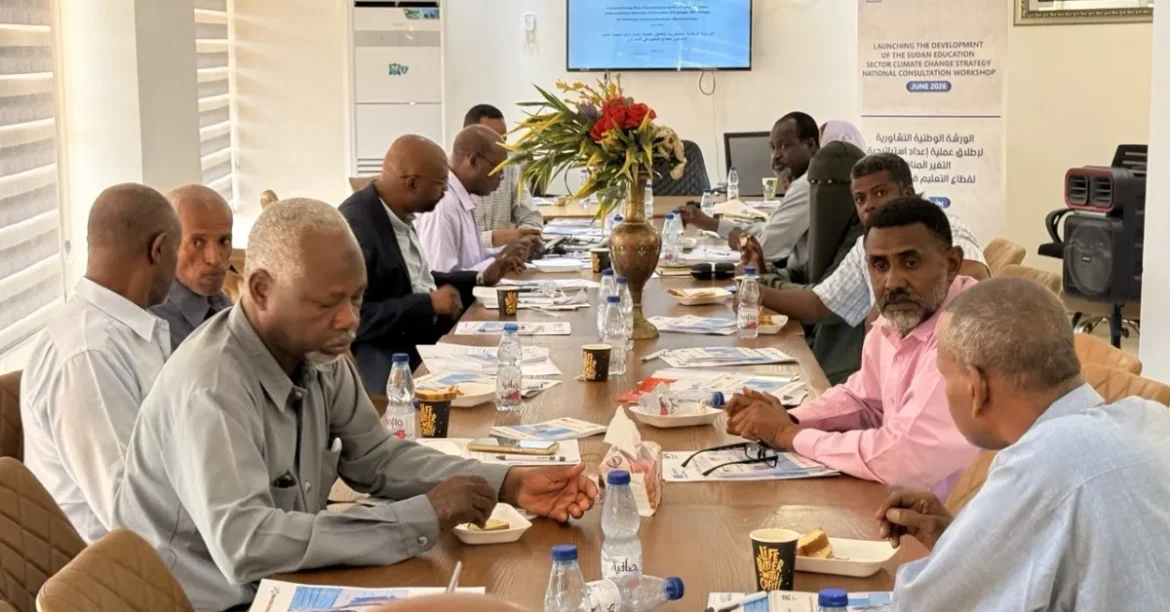
Sudan has launched the development of its first Education Sector Climate Change Strategy in partnership with UNESCO, marking a significant policy shift aimed at integrating climate resilience into national education planning as the country rebuilds its institutions amid conflict, climate shocks and economic pressures.
The initiative was formally launched during a national consultation workshop convened by Sudan’s Ministry of Education and UNESCO, bringing together government officials, development partners, academics and civil society representatives to establish the strategic priorities for a climate-responsive education system. The process will culminate in Sudan’s first dedicated roadmap for strengthening the education sector against climate-related risks while equipping future generations with the knowledge and skills required to adapt to a changing environment.
 Education Minister Dr. Al-Tahami Al-Zain Hajar said rebuilding schools remains central to Sudan’s wider recovery agenda, emphasising that integrating climate resilience into education planning will help protect learning continuity while strengthening the country’s long-term capacity to withstand future crises.
The strategy comes at a critical juncture for Sudan, where years of armed conflict have disrupted education systems, displaced millions of people and placed significant pressure on already fragile public institutions. At the same time, climate change continues to intensify environmental risks across the country through recurrent droughts, flooding, desertification and declining agricultural productivity, all of which have direct implications for school infrastructure, student attendance and community livelihoods.
According to UNESCO, Sudan is embarking on the development of a dedicated climate change strategy for the education sector for the first time, positioning education alongside infrastructure, agriculture and health as a priority area within national climate resilience planning. The organisation will provide technical assistance throughout the process, drawing on international frameworks including the Greening Education Partnership and the Climate Smart Education Systems Initiative while ensuring the strategy reflects Sudan’s national priorities.
The consultation process identified several priority areas, including climate-resilient education planning, safer and more resilient school infrastructure, curriculum reform, teacher training, disaster risk reduction, improved education data systems and greater access to climate financing. These components reflect an increasingly integrated approach to education policy, where schools are viewed not only as learning institutions but also as critical infrastructure supporting community resilience and long-term economic development.
Across Africa, education systems are becoming increasingly exposed to climate-related disruption. Floods, prolonged droughts, cyclones and extreme heat continue to damage school infrastructure, interrupt learning and strain already constrained education budgets. According to international development assessments, millions of school days are lost annually across the continent because of climate-related disasters, with children in vulnerable rural communities disproportionately affected.
For Sudan, strengthening climate resilience within education carries implications beyond classroom learning. Human capital development remains one of the country’s most important long-term economic assets, particularly as policymakers seek to rebuild institutions, restore agricultural production and stimulate economic recovery. More resilient schools can reduce disruption to learning, protect public investment in education infrastructure and improve workforce readiness over time.
The initiative also reinforces the growing recognition that climate adaptation requires investment in institutional capacity as much as physical infrastructure. Climate-informed curricula can prepare young people to participate in emerging sectors including sustainable agriculture, renewable energy, environmental management and disaster preparedness, supporting economic diversification while strengthening national resilience.
 From a governance perspective, integrating climate considerations into education planning aligns with broader international commitments under the Sustainable Development Goals (SDGs), particularly those relating to quality education, climate action and resilient institutions. It also supports the African Union’s Agenda 2063 aspirations to build knowledge-driven, climate-resilient economies capable of responding to increasingly complex environmental and development challenges.
The development of Sudan’s first Education Sector Climate Change Strategy therefore represents more than an education reform exercise. It signals an effort to embed climate resilience into one of the country’s most important public institutions at a time when rebuilding human capital has become inseparable from rebuilding national resilience. If effectively implemented, the strategy could provide a framework for protecting learning from future climate shocks while contributing to Sudan’s broader recovery, institutional strengthening and sustainable development objectives.


