


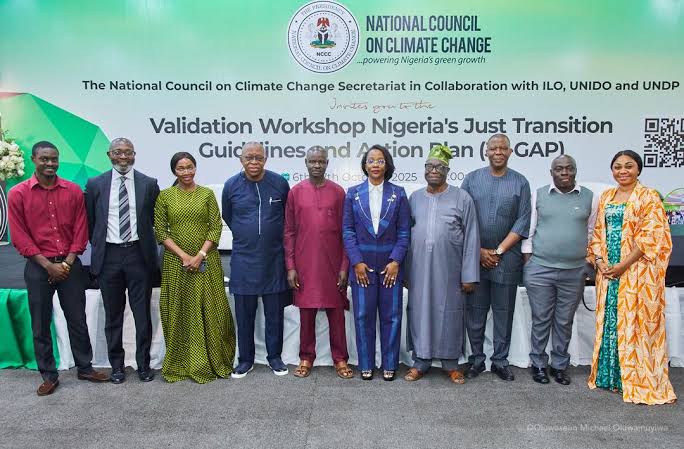
Nigeria has launched the second phase of its Social Dimension of Ecological Transition Project in partnership with the International Labour Organization (ILO), marking a renewed effort to ensure the country’s climate transition generates decent employment, strengthens local enterprises and delivers inclusive economic growth. The initiative, unveiled in Abuja on July 2, 2026, will run from 2025 to 2029 and seeks to translate Nigeria’s climate commitments into practical investments that support workers, businesses and vulnerable communities while advancing the country’s transition toward a low-carbon economy.
The programme brings together the Federal Government, employers’ organisations, labour unions, development partners and the ILO to implement a framework that places social protection and employment creation at the centre of climate policy. The project reflects a growing recognition that the transition to cleaner energy systems and climate-resilient economies will require deliberate measures to protect livelihoods while creating new economic opportunities.
 Speaking during the launch, Nigeria’s Minister of Labour and Employment, Dr. Muhammed Dingyadi, said the renewed programme represents an opportunity to move beyond policy commitments towards implementation capable of delivering measurable outcomes for citizens. According to the Minister, the second phase will prioritise support for sustainable local businesses, expansion of green employment opportunities, improved livelihoods, enterprise development and the strengthening of climate-resilient communities.
His remarks underscore a broader challenge facing many African economies. While governments across the continent have adopted ambitious climate policies, implementation remains constrained by financing gaps, institutional capacity and concerns over the socioeconomic implications of transitioning away from carbon-intensive sectors. For countries such as Nigeria, where unemployment and underemployment remain persistent structural challenges, integrating labour market considerations into climate policy has become increasingly important.
The International Labour Organization says the first phase of the programme, implemented between 2020 and 2025 with financial support from the Government of France, helped establish much of the institutional groundwork needed for a just transition. According to ILO Country Representative Vanessa Phala, more than 100 government institutions and social partners received training on just transition principles, strengthening national capacity to integrate labour and social protection into climate governance.
One of the programme’s most significant outcomes was the inclusion of just transition principles within Nigeria’s updated Nationally Determined Contribution (NDC), placing the country among a relatively limited number of nations globally to formally embed employment and social protection considerations within their national climate commitments.
Read also: https://allafrica.com/stories/202607030018.html
The second phase is expected to focus on implementing Nigeria’s Just Transition Guidelines and Action Plan while supporting clean energy deployment and strengthening alignment with the country’s Energy Transition Plan. These frameworks seek to balance emissions reduction with economic diversification by promoting renewable energy industries, expanding green skills development and supporting workers affected by structural changes within the economy.
The emphasis on implementation comes at a critical time for Nigeria’s energy transition. Africa’s largest economy has committed to achieving net-zero emissions by 2060 while simultaneously addressing significant energy access deficits, industrial development needs and rising demand for electricity. Managing these competing priorities will require substantial investment in renewable energy infrastructure alongside policies that encourage domestic manufacturing, innovation and workforce development.
According to the National Council on Climate Change (NCCC), climate action can no longer be separated from employment, economic security and social inclusion. Director-General Omotenioye Majekodunmi said the Council remains committed to ensuring that every stage of Nigeria’s transition protects workers while promoting dialogue among government, employers and organised labour. She noted that the second phase aligns closely with Nigeria’s broader climate and development objectives by translating policy commitments into practical economic benefits through clean energy expansion, green jobs and implementation of the country’s forthcoming NDC 3.0.
Labour representatives argue that maintaining worker participation throughout the transition will be essential to sustaining public confidence in climate policies. Nigeria Labour Congress President Joe Ajaero called for stronger worker representation within climate governance structures, emphasising that those most directly affected by economic restructuring should play a meaningful role in shaping transition policies.
The concept of a just transition has gained increasing prominence across Africa as governments seek to reconcile climate ambitions with development priorities. Unlike wealthier economies where transitions often focus primarily on decarbonising established industries, African countries must simultaneously expand energy access, industrial capacity and employment while reducing long-term climate vulnerability. This places greater emphasis on ensuring that climate investments generate broad-based economic opportunities rather than simply reducing emissions.
International financial institutions and development partners have similarly increased support for programmes linking climate action with employment creation, recognising that successful transitions depend not only on technological change but also on institutional reform, workforce development and social protection systems. Nigeria’s partnership with the ILO reflects this broader shift toward integrating labour market policies within national climate strategies.
 For Africa more broadly, the programme highlights the evolving relationship between climate policy and economic development. As countries pursue renewable energy investments, carbon market participation and industrial decarbonisation, the quality and distribution of employment created through these transitions will increasingly shape both public acceptance and long-term economic resilience.
The success of Nigeria’s second-phase programme will therefore be measured not only by emissions reductions or policy implementation, but also by its ability to create sustainable livelihoods, strengthen local enterprises and ensure that communities most vulnerable to economic change benefit from the continent’s transition toward a greener economy. If effectively implemented, the initiative could offer a practical model for integrating climate action with inclusive development across other African economies facing similar structural challenges.


