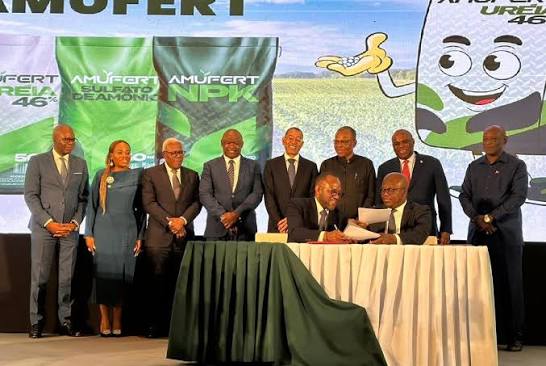
Angola’s fertiliser development company AMUFERT has formally inaugurated a new Board of Directors, marking a significant governance milestone as the country advances one of its most strategically important industrial projects aimed at strengthening food security, expanding domestic fertiliser production and supporting economic diversification. The appointment signals AMUFERT’s transition from project planning and institutional preparation into the implementation phase, as construction and operational planning gather pace for the fertiliser complex located in Soyo, in Zaire Province.
The project represents a key component of Angola’s broader industrialisation agenda, which seeks to reduce dependence on imports, strengthen agricultural productivity and develop domestic value chains capable of supporting long-term economic growth beyond the oil sector. According to the company, the newly constituted Board comprises seven executive directors and two non-executive directors, combining operational management with independent oversight to strengthen governance during a critical stage of project execution. The new leadership team will oversee strategic priorities including industrial project implementation, procurement and supply chain development, operational readiness, financial management, local skills development, technology transfer and sustainability integration as the project progresses towards commercial operations.

The Board’s inauguration ceremony brought together shareholders, government representatives, institutional partners and members of the company’s governing bodies, underlining the project’s strategic importance within Angola’s economic transformation agenda. The AMUFERT project arrives at a time when many African countries are seeking to strengthen domestic fertiliser production in response to rising global supply chain disruptions, volatile commodity markets and increasing concerns over food security. Fertiliser availability has become a central issue across the continent as governments work to improve agricultural productivity while reducing vulnerability to external market shocks.
According to the Food and Agriculture Organization (FAO), improving access to affordable fertiliser remains one of the most effective pathways for increasing crop yields and supporting food security across sub-Saharan Africa, where fertiliser application rates remain among the lowest globally. Limited domestic manufacturing capacity has historically left many African countries dependent on imported fertiliser, exposing farmers to fluctuations in international prices, foreign exchange shortages and supply disruptions. Angola is no exception. Despite possessing significant natural gas reserves that could support fertiliser production, the country has traditionally relied heavily on imported agricultural inputs. Developing domestic manufacturing capacity therefore represents both an agricultural and industrial policy priority.
Located in Soyo, one of Angola’s major energy and industrial hubs, the AMUFERT project seeks to leverage the country’s natural gas resources to produce fertiliser locally, creating opportunities to support farmers while strengthening domestic industrial capacity. The project aligns closely with Angola’s national strategy to diversify its economy beyond hydrocarbons. Although oil remains the country’s dominant export and primary source of government revenue, authorities have increasingly prioritised agriculture, manufacturing and agro-processing as key sectors capable of generating employment, strengthening food systems and reducing import dependency.
According to the African Development Bank, industrialisation linked to agriculture offers one of Africa’s greatest opportunities for inclusive economic growth by creating value-added industries, expanding rural employment and strengthening domestic supply chains. Fertiliser manufacturing occupies a strategic position within this agenda because it directly supports agricultural productivity while stimulating broader industrial development. Corporate governance will play a critical role in determining the project’s long-term success. Large-scale industrial investments require robust oversight mechanisms capable of ensuring effective financial management, procurement integrity, environmental compliance and operational efficiency throughout construction and production.
By combining executive leadership with non-executive oversight, AMUFERT’s governance structure reflects international corporate governance practices increasingly adopted across Africa’s state-supported industrial enterprises. Strong governance is particularly important for capital-intensive infrastructure projects, where effective decision-making, accountability and risk management directly influence investor confidence and project delivery. The Board’s mandate extends beyond overseeing construction activities. It will also supervise knowledge transfer, local workforce development and supply chain localisation—areas that have become increasingly important as African governments seek to maximise the domestic economic benefits of large industrial investments.
Developing local technical expertise remains essential for ensuring the long-term sustainability of fertiliser production. Skills development programmes can reduce dependence on foreign expertise while creating employment opportunities for Angolan engineers, technicians and industrial specialists. Procurement and supply chain development similarly present opportunities to stimulate local enterprise participation. Integrating domestic suppliers into industrial value chains can generate wider economic spillovers, supporting small and medium-sized businesses while strengthening national manufacturing capabilities.
Sustainability considerations are also becoming increasingly important within the global fertiliser industry. Fertiliser production is energy intensive and contributes significantly to industrial greenhouse gas emissions. Consequently, new production facilities are increasingly expected to incorporate energy-efficient technologies, environmental safeguards and resource management practices capable of reducing their environmental footprint while maintaining competitiveness.
https://www.aecweek-registration.com/2026/
The AMUFERT project therefore has the potential to contribute not only to agricultural productivity but also to broader discussions around sustainable industrial development in Africa. Balancing industrial expansion with responsible environmental management is becoming a central objective for governments seeking to align economic growth with climate commitments and sustainable development goals. The project also supports the objectives of the African Union‘s Agenda 2063, which identifies industrialisation, agricultural transformation and regional value addition as key pillars of Africa’s long-term economic development strategy. Expanding domestic fertiliser production can strengthen regional food systems while reducing reliance on imported agricultural inputs from outside the continent.
For Angola, AMUFERT represents more than an industrial investment. It is part of a broader effort to reposition the country’s economy by leveraging natural resources to develop higher-value manufacturing industries capable of supporting diversification, job creation and long-term resilience. As African countries continue pursuing food security, industrialisation and sustainable development simultaneously, investments in strategic industries such as fertiliser manufacturing are likely to assume increasing importance. Success will depend not only on infrastructure development and financing but also on strong governance, operational excellence and institutional accountability.
The inauguration of AMUFERT’s new Board of Directors marks an important step in that process. By strengthening corporate governance at a pivotal stage of project implementation, the company aims to position one of Angola’s flagship industrial initiatives to deliver lasting economic, agricultural and social benefits while supporting the country’s transition towards a more diversified and resilient economy.