


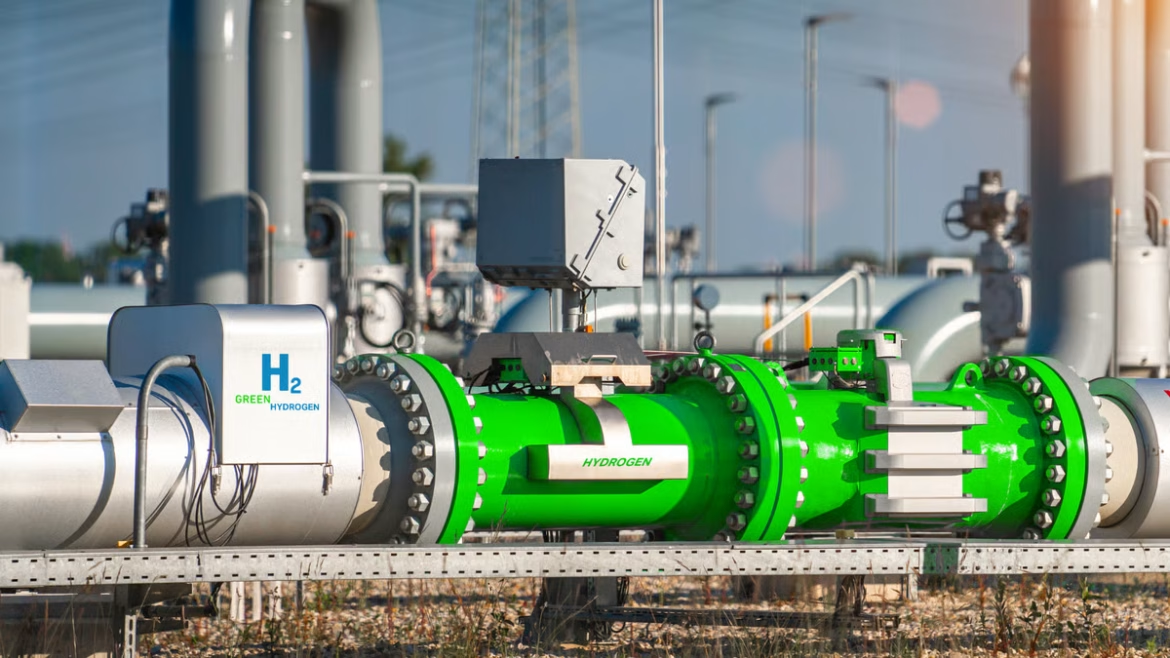
Climate Fund Managers has raised ZAR3 billion ($182 million) at the first close of a blended-finance fund designed to develop green hydrogen infrastructure in Southern Africa, providing a new financing channel for projects aimed at reducing industrial emissions while building new clean-energy value chains.
The SA-H2 fund is targeting a final close of ZAR12 billion ($728 million) by mid-2028, according to Climate Fund Managers, with capital intended for projects spanning green hydrogen production, green ammonia and methanol, and the decarbonisation of industries where direct electrification remains difficult.
The fund’s structure reflects a persistent challenge in Africa’s energy transition: many large clean-energy and industrial projects require substantial early-stage capital before they can attract commercial investors. SA-H2 is designed to address that gap by combining public and development finance with private capital, using concessional or risk-bearing capital to help prepare projects and reduce investment risks.
The fund’s Development Tranche provides early-stage financing and technical assistance intended to move projects towards final investment decisions, while its blended Equity Tranches are designed to support projects through financial close and construction. This approach places project preparation at the centre of the financing model, rather than treating capital availability alone as the principal constraint.
The first close includes commitments from Invest International, the European Commission through its Global Gateway strategy and South Africa’s Industrial Development Corporation. The Public Investment Corporation, on behalf of the Government Employees Pension Fund, Sanlam Life Insurance, Invest International and the European Commission are participating in the equity tranches, while the Development Bank of Southern Africa is also supporting the fund.
The financing comes as South Africa seeks to establish itself as a significant producer of green hydrogen and its derivatives, leveraging its renewable-energy resources and industrial base. The country’s existing steel, chemicals, mining and fertiliser industries provide potential domestic demand for low-carbon fuels, while ports and established export infrastructure could support future international markets.
For South Africa and neighbouring economies, the economic significance extends beyond the production of hydrogen itself. A functioning green hydrogen industry could create demand across renewable power, electrolyser manufacturing, engineering, transport, water infrastructure and specialised services. The extent to which these benefits remain within the region, however, will depend on the development of local supply chains, skills and industrial capacity alongside the headline investment volumes.
Two projects have already received development funding agreements from SA-H2. The first is Green eFuels Producers’ proposed wastewater-to-green-methanol facility in Gauteng. The project is intended to convert municipal sewage sludge into green methanol using renewable energy, linking energy transition investment with waste management and circular-economy objectives. Recent project information indicates that the proposed facility would process about 90,000 tonnes of sewage sludge annually and use a 10 MW electrolyser powered by renewable electricity.
The second is the Hive Hydrogen Coega Green Ammonia Project in the Eastern Cape, which is being developed as a large-scale green ammonia facility. Earlier support from the SA-H2 Fund included up to $20 million in development funding, with the project expected to contribute to South Africa’s emerging green hydrogen and ammonia value chain.
These projects illustrate an important feature of the emerging hydrogen economy: investment is increasingly moving beyond standalone renewable-energy generation towards industrial applications that can create demand for clean power and potentially support domestic manufacturing and exports.
Green ammonia is particularly relevant to Africa because of its links to agriculture and international trade. Ammonia is a critical input for fertiliser production, while its potential use as a hydrogen carrier could support future energy exports. South Africa’s ability to develop these industries competitively will depend on the cost and reliability of renewable electricity, water availability, port infrastructure, transmission capacity and the regulatory environment.
The financing model also highlights the importance of development finance institutions in emerging clean-energy markets. Private institutional investors often require projects to demonstrate sufficient technical, regulatory and commercial maturity before committing significant amounts of capital. Development funding can help finance feasibility studies, environmental and social assessments, engineering work and permitting, reducing uncertainty before larger investment decisions are made.
This is particularly important in Africa, where the pipeline of proposed energy-transition projects is significantly larger than the number that have reached financial close. Weak project preparation, limited access to early-stage capital, infrastructure constraints and regulatory uncertainty can prevent projects from progressing even where the underlying renewable resources are strong.
The participation of South African institutions such as the IDC, PIC and DBSA therefore gives the fund a domestic development-finance dimension alongside its international capital base. It also creates a potential mechanism through which domestic savings and public-sector capital can participate in the emerging green industrial economy.
The European Commission’s participation through Global Gateway adds another layer to the financing landscape. Europe’s interest in securing lower-carbon industrial inputs and energy supplies is increasingly intersecting with African countries’ efforts to develop domestic industrial capacity. For Southern Africa, the challenge will be ensuring that emerging export-oriented projects generate sufficient local economic value rather than simply positioning the region as a supplier of low-carbon commodities to overseas markets.
That question is particularly relevant given the continent’s experience with extractive industries. Green hydrogen presents an opportunity to develop new industrial value chains, but the developmental outcome will depend on ownership structures, local procurement, technology transfer, skills development, tax revenues and the availability of infrastructure that can also serve domestic economic activity.
There are also environmental and social considerations that will need to remain central to the expansion of the sector. Green hydrogen production requires significant amounts of renewable electricity and water, while large industrial projects can place pressure on land, transmission systems and local infrastructure. The proposed wastewater-to-methanol project illustrates one possible response by linking hydrogen production with an existing waste-management challenge.
The financing of such projects therefore needs to be assessed not only by the amount of capital mobilised but also by whether projects can demonstrate credible environmental performance, commercially viable operating models and measurable development outcomes.
Climate Fund Managers’ SA-H2 fund is part of a broader effort to use blended finance to move energy-transition projects in emerging markets towards institutional investment. The firm was established through a partnership involving Dutch development bank FMO and South Africa’s Sanlam InfraWorks and has focused on mobilising public and private capital for climate infrastructure in emerging markets.
For Southern Africa, the immediate significance of the ZAR3 billion first close is therefore less about the headline amount than the financing architecture it represents. If the fund succeeds in converting early-stage projects into commercially viable infrastructure, it could help address one of the region’s persistent constraints: the gap between ambitious energy-transition plans and projects capable of securing long-term capital.
The larger test will be whether green hydrogen develops into a competitive industrial sector rather than remaining dependent on concessional finance. That will require falling technology costs, reliable renewable power, infrastructure investment, credible offtake agreements and policies that provide sufficient certainty for investors while protecting public and community interests.
 The proposed ZAR12 billion final target by 2028 would significantly expand the capital available to projects across the value chain if achieved. For South Africa and its neighbours, the strategic question will be how effectively that capital can be translated into productive infrastructure, local industrial capacity and jobs while keeping the cost of the transition manageable.
The first close of SA-H2 therefore marks another step in the evolution of Southern Africa’s green hydrogen market, but its broader development impact will ultimately be measured by what happens beyond the financing announcement: whether projects reach construction, whether local industries participate in their supply chains, and whether the emerging hydrogen economy strengthens the region’s industrial base while reducing its exposure to carbon-intensive production.


