


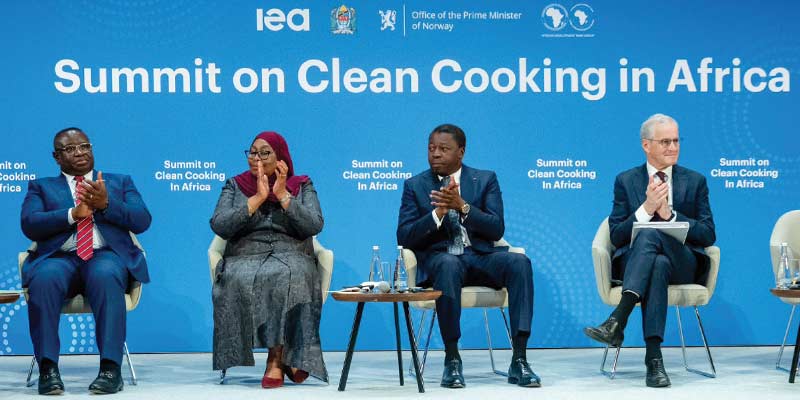
Governments and development partners have announced new financial commitments of $900 million to expand clean cooking access across Africa, as the continent faces one of the world’s largest energy access challenges. The International Energy Agency (IEA) announced the new commitments on July 9, building on previous pledges made during the first Summit on Clean Cooking in Africa held in Paris in 2024.
The additional financing comes as African countries continue efforts to address widespread dependence on traditional cooking fuels, including charcoal, firewood and other polluting sources. According to the IEA, around 970 million people in Sub-Saharan Africa lacked access to clean cooking fuels and technologies in 2024, representing the majority of the global population without modern cooking solutions. The latest commitments increase momentum behind efforts to close the clean cooking gap, but converting financial pledges into operational projects remains the sector’s biggest challenge. While international commitments have grown, governments and development institutions continue to face difficulties in mobilising funding, delivering affordable technologies and reaching rural communities where energy access remains most limited.
According to the IEA’s latest progress update, $740 million of the $2.2 billion committed during the 2024 Paris summit has already been deployed across 22 African countries. This represents an increase from the $470 million reported in July 2025, indicating progress in moving announced financing into implementation. The agency also reported that more than 30 African countries have adopted 121 new clean cooking policies since the Paris summit. Together, these countries represent approximately 80% of Africa’s population that still lacks access to clean cooking solutions, highlighting growing policy recognition of the issue.
However, the scale of the challenge remains significant. The IEA estimates that the number of people without access to clean cooking technologies in Sub-Saharan Africa is increasing by approximately 14 million people annually due to population growth. Without accelerated action, the number could exceed one billion people by 2027. The consequences extend beyond energy access. Household reliance on polluting cooking fuels has significant public health and economic implications. The IEA estimates that household air pollution linked to traditional cooking practices contributes to approximately 850,000 premature deaths annually across Africa.
Clean cooking is therefore increasingly viewed not only as an energy issue but also as a public health, gender, economic productivity and climate resilience challenge. Women and children are often disproportionately affected by inefficient cooking systems due to time spent collecting fuel and exposure to indoor air pollution. Speaking during a virtual meeting following the postponement of the second Summit on Clean Cooking in Africa, Kenyan President William Ruto emphasised the importance of investment in translating ambition into results. He noted that policy commitments must be matched with financial resources to deliver practical solutions.
The financing challenge reflects broader difficulties facing Africa’s energy transition. While international institutions have increased attention on energy access, many clean cooking initiatives require patient capital, local market development and stronger distribution networks to reach households at scale. Unlike large infrastructure projects, clean cooking solutions often require decentralised delivery models involving local businesses, entrepreneurs and community-based organisations. Scaling these models requires financing mechanisms that support manufacturing, supply chains, consumer affordability and after-sales services.
Development finance institutions are expected to play a central role in bridging this gap. By combining public funding with private sector investment, blended finance models could help reduce risks for investors while expanding access to affordable technologies. The clean cooking agenda also intersects with Africa’s climate objectives. Traditional biomass use contributes to forest degradation, carbon emissions and pressure on ecosystems. Expanding access to cleaner alternatives, including improved biomass technologies, electric cooking where power systems allow, and other modern solutions, forms part of broader strategies to improve energy efficiency and reduce environmental impacts.
For African economies, the transition has important implications for productivity and household welfare. Reliable clean cooking systems can reduce household energy costs, improve health outcomes and support economic participation, particularly in communities where energy poverty remains a major constraint. The experience of countries such as Kenya, Rwanda, Tanzania and Ethiopia demonstrates growing policy momentum around clean cooking, but implementation capacity and financing availability remain critical barriers. National strategies increasingly require stronger coordination between governments, utilities, investors, technology providers and development partners. The next Summit on Clean Cooking in Africa is expected to provide an opportunity to assess progress and examine how governments, development finance institutions and private investors are converting commitments into measurable outcomes.
https://www.aecweek-registration.com/2026/
As Africa’s population grows and energy demand increases, expanding access to clean cooking will remain an essential component of the continent’s sustainable development agenda. The effectiveness of the latest financial commitments will ultimately depend on whether they translate into affordable, scalable solutions that reach households currently excluded from modern energy systems.


