


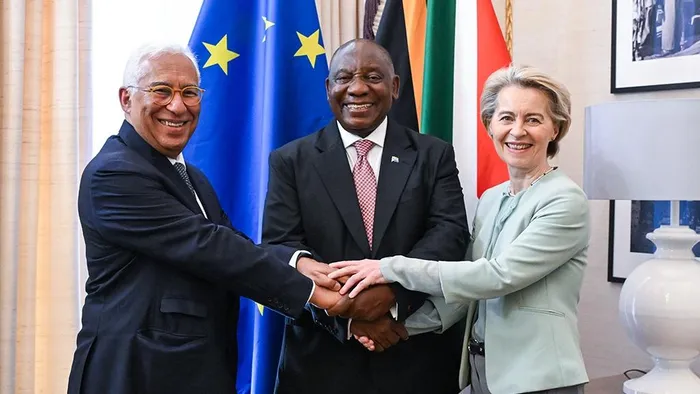
The European Union and South Africa have launched the first government-to-government dialogue under their Clean Trade and Investment Partnership (CTIP), marking a new phase in efforts to deepen investment, strengthen clean industrial value chains and support South Africa’s energy transition. The discussions, which bring together senior officials from both sides, focus on expanding strategic investments, improving trade facilitation and aligning regulatory frameworks to accelerate the development of low-carbon industries.
The dialogue represents the first formal implementation step since the partnership was signed in November 2025 and reflects a broader shift in international trade policy, where economic cooperation is increasingly linked to climate objectives, industrial competitiveness and supply-chain resilience. According to the European Commission, the partnership is designed to create a more transparent and predictable investment environment while supporting the growth of strategic sectors that are expected to underpin the transition to low-carbon economies.
 Officials are prioritising collaboration in electricity transmission infrastructure, renewable energy, sustainable aviation fuels, green hydrogen and critical raw materials. These sectors have emerged as central pillars of South Africa’s industrial transition as the country seeks to address electricity shortages, modernise its energy system and position itself within emerging global clean technology markets.
A significant component of the partnership centres on South Africa’s electricity transmission expansion programme. The country plans to construct approximately 14,500 kilometres of new transmission lines over the next decade as part of broader electricity sector reforms aimed at integrating additional renewable energy capacity into the national grid. According to the European Commission, expanding transmission infrastructure is expected to unlock new investment opportunities while improving grid reliability and supporting private-sector participation in electricity generation.
For South Africa, strengthening transmission capacity is increasingly viewed as essential to achieving long-term energy security. While the country possesses abundant renewable energy resources, limited grid infrastructure has constrained the pace at which new generation projects can be connected to the electricity network. Addressing these bottlenecks is expected to improve investor confidence and accelerate renewable energy deployment.
The partnership also reflects the growing strategic importance of critical minerals within the global energy transition. South Africa is one of Africa’s largest producers of minerals used in clean energy technologies, including platinum group metals that are critical for hydrogen production and fuel cell technologies. Closer cooperation with the European Union could strengthen downstream processing opportunities while supporting industrial diversification and higher-value manufacturing.
Green hydrogen has also emerged as an important area of cooperation. South Africa has identified hydrogen as a potential export industry capable of leveraging its renewable energy resources and mineral base to supply international markets seeking alternatives to fossil fuels. European demand for low-carbon hydrogen is expected to increase as industries pursue decarbonisation strategies, creating opportunities for long-term trade and investment partnerships.
The inclusion of sustainable aviation fuels reflects broader efforts by both partners to reduce emissions from hard-to-abate sectors. Aviation remains one of the most challenging industries to decarbonise, and investment in sustainable fuel production could position South Africa within emerging global supply chains while supporting domestic industrial development.
Beyond individual sectors, the Clean Trade and Investment Partnership seeks to strengthen regulatory cooperation on climate and energy policy. Harmonising technical standards, investment rules and regulatory processes is expected to reduce barriers to cross-border investment while providing greater certainty for businesses operating across both markets.
The initiative also illustrates how climate policy is becoming increasingly integrated into international trade relationships. Rather than focusing solely on tariff reductions, modern trade partnerships are increasingly addressing investment frameworks, industrial policy, clean technology development and supply-chain resilience as governments compete to attract capital into strategic sectors.
According to official figures, trade between South Africa and the European Union reached approximately €45 billion in 2025, underscoring the scale of their economic relationship. The European Union also accounts for more than 40 per cent of foreign direct investment in South Africa, making it the country’s largest investment partner and reinforcing the strategic significance of closer economic cooperation.
South Africa is the European Union’s first partner under the Clean Trade and Investment Partnership framework, highlighting the country’s importance within Europe’s broader strategy to diversify supply chains, strengthen energy security and secure access to critical raw materials needed for the global clean energy transition.
 For Africa, the partnership carries implications that extend beyond bilateral trade. As international demand for renewable energy technologies, strategic minerals and low-carbon industrial products continues to expand, similar investment models could provide a framework for other African economies seeking to mobilise private capital while strengthening domestic industrial capacity.
The success of the partnership, however, will depend on implementation. Large-scale infrastructure investment, regulatory certainty, efficient permitting systems and continued policy reforms will be required to translate investment commitments into operational projects. If effectively executed, the initiative could demonstrate how trade policy can support industrial development, energy security and climate objectives simultaneously, offering lessons for broader economic cooperation between Africa and global trading partners during the transition to cleaner energy systems.


