


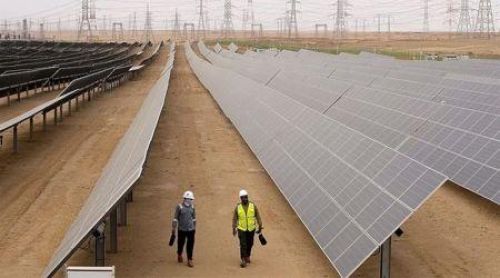
The African Development Bank (AfDB) has approved financing of up to $66 million for the first phase of Egypt’s Dandara Solar Project, marking another significant investment in Africa’s industrial energy transition as manufacturers increasingly seek to remain competitive in global markets shaped by stricter carbon regulations. The financing will support the construction of a 500-megawatt solar photovoltaic plant and a 100-megawatt-hour battery energy storage system in Egypt’s southern Qena Governorate, providing renewable electricity to state-owned aluminium producer EgyptAlum under a 25-year power purchase agreement. According to the AfDB, the investment forms part of Egypt’s broader strategy to decarbonise heavy industry while strengthening export competitiveness in markets introducing carbon-based trade measures.
The approval, announced on 13 July, comes at a time when industrial decarbonisation has become an economic priority rather than solely an environmental objective. Across Africa, energy-intensive industries are increasingly balancing the need to lower emissions with maintaining access to international markets, particularly in Europe, where carbon reporting and border adjustment mechanisms are beginning to reshape global trade.
According to the African Development Bank, the financing package consists of $46 million from its ordinary capital resources alongside $20 million mobilised through the Climate Investment Funds’ Clean Technology Fund. The remaining project financing, bringing the first phase investment to more than $290 million, is expected to be provided by a consortium of international development finance institutions. The Dandara project is being developed by Norwegian renewable energy company Scatec, through its subsidiary Dandara Solar Power. Once completed, the full development will comprise 1,000 MW of solar generation capacity and 200 MWh of battery storage, constructed in two equal phases. The first phase alone is expected to generate approximately 1,373 gigawatt-hours of electricity annually, with commercial operations scheduled to begin in early 2028.
The renewable electricity will be supplied directly to EgyptAlum, one of the country’s largest industrial electricity consumers and a major exporter of aluminium products. A dedicated transmission agreement with the Egyptian Electricity Transmission Company (EETC) will facilitate the delivery of power over the duration of the 25-year agreement. For Egypt, the project represents more than an expansion of renewable energy capacity. It illustrates how clean energy infrastructure is increasingly becoming part of industrial policy, export strategy and long-term economic planning. Aluminium production is among the world’s most electricity-intensive manufacturing activities, and access to reliable renewable power offers producers an opportunity to reduce production costs over time while improving compliance with evolving international carbon standards.
According to the AfDB, the Dandara Solar Project is expected to avoid approximately 12.5 million metric tonnes of carbon dioxide emissions throughout its operational lifetime. While the emissions reductions contribute to Egypt’s climate commitments, they also carry important commercial implications.
One of the principal drivers behind the investment is the European Union’s Carbon Border Adjustment Mechanism (CBAM), which is gradually introducing carbon pricing requirements on imports of products including aluminium, steel, cement and fertilisers. The mechanism seeks to ensure imported goods are subject to carbon costs comparable to those faced by European manufacturers, reducing the risk of carbon leakage while encouraging cleaner industrial production globally. For African exporters, CBAM represents both a challenge and an incentive. Manufacturers relying on carbon-intensive electricity could face higher compliance costs when exporting into European markets, while producers able to demonstrate lower embedded emissions may preserve or even strengthen their competitive position.
According to the European Commission, the transition phase of CBAM is already underway, with reporting requirements preceding the introduction of financial obligations later in the implementation period. This has accelerated interest among African governments and industrial companies in renewable power procurement, energy efficiency investments and industrial decarbonisation initiatives. AfDB Vice President for Power, Energy, Climate and Green Growth Kevin Kariuki described the Dandara project as a practical example of industrial decarbonisation supporting economic competitiveness.
“The project depicts industrial decarbonization at best,”Kariuki said in the bank’s announcement.
The investment also aligns with Egypt’s wider energy transition agenda. The country has significantly expanded renewable energy generation over the past decade while positioning itself as a regional energy hub connecting Africa, Europe and the Middle East. Large-scale projects such as Benban Solar Park have demonstrated Egypt’s ability to attract international renewable energy investment, supported by regulatory reforms and partnerships with multilateral development institutions.
Industrial decarbonisation now represents the next stage of that transition. Rather than focusing exclusively on increasing renewable electricity generation for the national grid, policymakers are increasingly directing clean power toward export-oriented industries where carbon intensity has direct implications for international market access.
The financing further reflects the growing role of blended finance in Africa’s energy transition. By combining AfDB lending with concessional climate finance from the Clean Technology Fund and additional investment from development finance institutions, the project reduces financing risks while attracting larger pools of private capital. Such financing structures are becoming increasingly important as African countries seek to scale renewable infrastructure without placing additional pressure on constrained public finances. According to the International Energy Agency, achieving industrial decarbonisation globally will require substantial investment not only in renewable electricity generation but also in energy storage, transmission infrastructure and long-term power purchase agreements capable of providing stable electricity supplies for industrial users.
Battery storage forms a notable component of the Dandara project. The planned 100 MWh battery energy storage system will improve the reliability of solar generation, enabling greater operational stability for industrial facilities that require continuous electricity supply. Storage technologies are expected to play an increasingly important role across African electricity systems as renewable energy penetration expands.
Construction of the project follows the publication of the AfDB’s environmental and social impact assessment in late 2025, which concluded that the development could proceed subject to agreed environmental and community safeguards. According to the bank, construction activities are expected to continue through the implementation period before operations commence in 2028. Beyond Egypt, the project may offer a practical model for other African economies seeking to reconcile industrialisation with emerging international climate-related trade requirements. Countries with significant mining, metals, cement, fertiliser and manufacturing sectors are likely to face similar pressures as global buyers increasingly evaluate the carbon footprint of supply chains.
While each national context differs, long-term renewable energy supply agreements between independent power producers and industrial consumers are attracting growing attention across the continent. Such arrangements have the potential to reduce exposure to volatile fossil fuel markets, improve energy security and strengthen export competitiveness without relying exclusively on publicly financed electricity infrastructure.
As Africa continues to pursue industrial expansion alongside climate commitments, projects such as Dandara demonstrate how renewable energy investment is increasingly being driven by trade competitiveness, industrial productivity and economic resilience as much as by emissions reduction objectives.


