


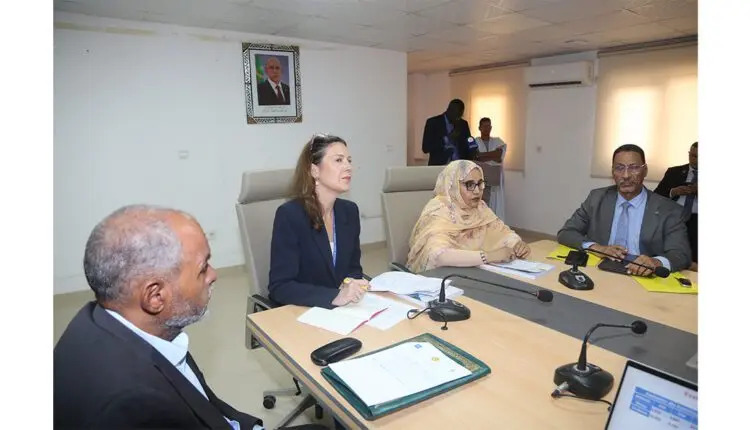
Mauritania has taken a significant step towards strengthening climate governance by validating its first National Transparency Report, a milestone that positions the country to improve accountability, attract climate finance and strengthen evidence-based policymaking under the Paris Agreement. The report, endorsed during a national technical workshop held in Nouakchott on 16 July 2026, marks Mauritania’s first submission under the Enhanced Transparency Framework (ETF), bringing together government officials, United Nations agencies, technical experts and development partners to review the country’s progress in tackling climate change while identifying gaps requiring further investment and international cooperation.
The validation workshop, organised by the Ministry of Environment and Sustainable Development in collaboration with the United Nations Environment Programme (UNEP) and financed by the Global Environment Facility (GEF), reflects growing efforts across Africa to establish stronger institutional systems for monitoring climate action. The report provides a comprehensive assessment of Mauritania’s greenhouse gas emissions, climate adaptation measures, implementation of its Nationally Determined Contributions (NDCs), and the financial, technical and capacity-building support received from international partners.
Its completion comes at a critical moment for African countries as implementation of the Paris Agreement increasingly shifts from policy commitments towards measurable delivery. Under the Enhanced Transparency Framework, all Parties to the Paris Agreement are required to submit regular reports that present transparent, consistent and comparable information on emissions, climate actions and support received or provided. According to the United Nations Framework Convention on Climate Change (UNFCCC), the framework is designed to build trust among countries, strengthen accountability and improve the quality of information used to assess collective progress towards limiting global warming.
Speaking during the opening ceremony, Minister of Environment and Sustainable Development Massouda Bint Baham Mohamed Laghdaf described the validation exercise as a major milestone in implementing Mauritania’s international climate obligations. She noted that transparent reporting enables governments to monitor emissions, evaluate adaptation programmes, assess mitigation measures and demonstrate progress towards national climate objectives while strengthening confidence among development partners and climate finance institutions.
According to the ministry, the report compiles a national greenhouse gas inventory while documenting actions undertaken to reduce emissions, strengthen resilience and implement climate adaptation initiatives across key sectors of the economy. It also provides detailed information on financial assistance, technology transfer and institutional capacity-building received through international cooperation, alongside identifying policy, technical and financial constraints that continue to affect implementation.
The findings are expected to inform future climate policies while helping Mauritania mobilise additional resources to support its transition towards a more climate-resilient and sustainable economy. As international climate finance increasingly emphasises transparency, monitoring and measurable impact, robust reporting systems have become an important prerequisite for accessing global climate funds and attracting development investment.
According to the Organisation for Economic Co-operation and Development (OECD), international climate finance provided and mobilised by developed countries reached more than US$115 billion in recent years, exceeding the long-standing annual commitment of US$100 billion. However, access to these resources increasingly depends on countries demonstrating credible institutional frameworks, transparent reporting systems and effective implementation mechanisms.
For Mauritania, strengthening transparency carries particular significance because of the country’s high exposure to climate risks despite contributing only a small fraction of global greenhouse gas emissions. According to the Intergovernmental Panel on Climate Change (IPCC), the Sahel region remains among the world’s most climate-vulnerable areas, facing increasing temperatures, declining rainfall reliability, desertification and more frequent droughts that threaten livelihoods and economic stability.
Mauritania continues to experience significant environmental pressures affecting agriculture, livestock production, water resources and coastal ecosystems. Desertification has accelerated across large parts of the country, reducing agricultural productivity while increasing pressure on already scarce natural resources. Coastal communities also face growing risks associated with sea-level rise and coastal erosion, particularly around Nouakchott, where a substantial proportion of the country’s economic activity and population are concentrated.
These environmental challenges have reinforced the government’s commitment to integrating climate resilience into national development planning. According to Minister Laghdaf, environmental sustainability under the leadership of President Mohamed Ould Cheikh El Ghazouani has become an important pillar of Mauritania’s long-term development strategy, recognising that sustainable management of natural resources is essential for economic diversification, food security and social stability.
The National Transparency Report therefore serves a broader purpose than fulfilling international reporting obligations. It establishes a baseline against which future climate action can be measured while strengthening coordination among institutions responsible for implementing environmental policies.
Lead technical expert Cheikh Sidi Othmane, who coordinated preparation of the report, explained that transitioning to the Enhanced Transparency Framework represents a significant institutional advancement for Mauritania. According to Othmane, the report establishes the country’s official reporting mechanism under the Paris Agreement while improving national capacity to collect climate data, strengthen institutional coordination and produce consistent information for future reporting cycles.
Reliable climate reporting depends on collaboration across multiple sectors of government. Representatives from ministries responsible for energy, agriculture, water resources, forestry, industry and planning participated in the validation workshop alongside technical experts and United Nations representatives, reflecting the increasingly cross-sectoral nature of climate governance.
According to UNEP, transparent environmental data enables governments to identify policy gaps, evaluate programme effectiveness and improve decision-making by providing a clearer understanding of climate risks and development priorities. Strong reporting systems also reduce duplication of effort among institutions while supporting better coordination between governments and development partners.
Across Africa, countries are strengthening transparency systems as climate reporting becomes increasingly integrated into national economic planning. Nations including Kenya, Rwanda, Ghana, South Africa and Morocco have invested in institutional frameworks that improve greenhouse gas inventories, climate monitoring and reporting capabilities while strengthening their eligibility for international climate finance.
This reflects a broader shift in climate governance, where transparency is no longer viewed solely as a compliance requirement but increasingly as an economic governance tool. Reliable environmental data informs investment decisions, supports infrastructure planning, guides adaptation programmes and helps governments allocate scarce public resources more effectively in response to growing climate risks.
For Africa, stronger transparency systems also support regional cooperation. As countries implement the Paris Agreement alongside the African Union’s Agenda 2063 and the Sustainable Development Goals, comparable climate data enhances knowledge sharing, strengthens regional policy coordination and enables governments to identify common priorities for adaptation, resilience and sustainable development.
The Enhanced Transparency Framework further provides investors and international financial institutions with greater confidence in assessing climate-related investments. As environmental, social and governance (ESG) considerations increasingly influence investment decisions, countries capable of demonstrating credible climate governance and measurable progress may be better positioned to attract concessional finance, blended capital and private-sector investment.
Nevertheless, maintaining robust transparency systems will require sustained investment in institutional capacity, digital infrastructure and technical expertise. Many developing countries continue to face challenges related to data availability, coordination among government agencies and long-term financing for national reporting systems.
Mauritania’s first National Transparency Report therefore represents both an important achievement and the beginning of a continuous process of institutional strengthening. As future reporting cycles build upon this initial foundation, improvements in data quality, policy coordination and implementation monitoring could enhance the country’s ability to integrate climate resilience into broader economic development strategies.
For Africa as a whole, Mauritania’s progress highlights the growing recognition that transparency is becoming a central pillar of climate governance. Beyond meeting international obligations, credible reporting systems are increasingly essential for mobilising finance, strengthening public institutions and ensuring that climate policies contribute to sustainable economic development. As countries across the continent accelerate implementation of their Nationally Determined Contributions, stronger transparency frameworks will play an increasingly important role in translating climate commitments into measurable outcomes that support resilience, investment and long-term prosperity.


