


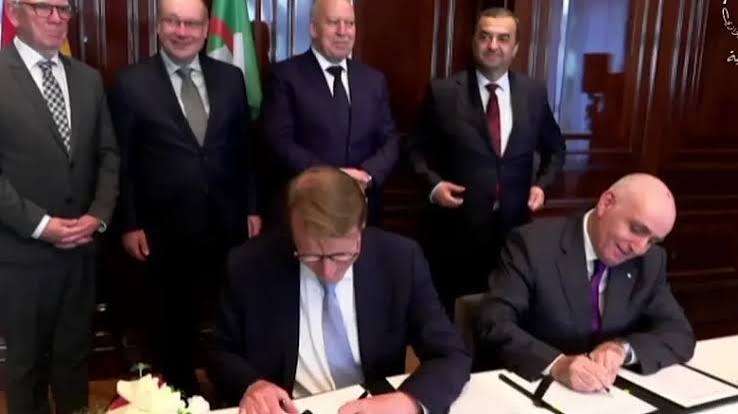
Algeria is strengthening its role as one of Europe’s most important alternative energy suppliers after state-owned energy company Sonatrach signed a new agreement with German energy group VNG to increase pipeline natural gas deliveries to Germany from January 2027. The agreement, signed on 17 July during Algerian President Abdelmadjid Tebboune’s official visit to Germany, also reinforces cooperation on green hydrogen projects that could position North Africa as a major supplier of low-carbon energy to European markets.
The latest agreement comes as Europe continues reshaping its energy supply chains following the disruption of Russian gas imports and ongoing geopolitical tensions affecting global energy markets. For Algeria, the deal represents another milestone in its strategy to deepen commercial ties with Europe’s largest economy while leveraging its extensive natural gas reserves and growing renewable energy potential to become a long-term energy partner for the continent. Although Sonatrach and VNG did not disclose the additional gas volumes, contract duration or financial terms, the agreement confirms that pipeline deliveries to Germany will increase from 1 January 2027, extending a commercial relationship that has expanded rapidly over the past two years.
Speaking during the signing ceremony, Algerian Minister of Energy, Mines and Renewable Energies Mohamed Arkab described the agreement as the result of a long-standing partnership built on trust and cooperation.
“This agreement crowns a long history of trust and cooperation between Sonatrach and VNG. It reflects the strength of the partnership between the two companies and confirms Algeria’s position as a safe and reliable energy supplier,” Arkab said.
The agreement highlights how Algeria has emerged as an increasingly strategic supplier for Europe as governments seek to diversify energy imports while maintaining reliable supplies during the transition toward lower-carbon energy systems. According to the International Energy Agency (IEA), Europe’s energy security strategy since 2022 has focused on diversifying gas imports through increased supplies from Norway, Algeria, Azerbaijan, liquefied natural gas (LNG) exporters and renewable energy investments. Algeria, already Africa’s largest exporter of natural gas through pipelines, has become one of the principal beneficiaries of this strategic shift.
The latest contract builds upon a landmark agreement signed in February 2024, when VNG became the first German company to purchase Algerian pipeline gas. That agreement enabled direct deliveries through the TransMed Pipeline, which transports natural gas from Algeria through Tunisia to Italy before connecting with Central European gas networks. Before Russia’s invasion of Ukraine, Germany relied heavily on Russian pipeline gas, with Russian imports accounting for more than half of its gas consumption. Following the suspension of Russian supplies in 2022, Germany accelerated efforts to diversify its energy mix by expanding LNG import capacity, increasing renewable energy investments and securing long-term gas supply agreements with alternative producers.
According to Eurostat, Germany remains Europe’s largest natural gas market and one of the continent’s largest industrial consumers of energy. Reliable gas supplies remain critical for electricity generation, chemicals, steel production, manufacturing and residential heating while renewable energy capacity continues expanding.
The new agreement also follows another significant development in Algeria’s energy relationship with Germany. On 2 July, Sonatrach completed its first-ever shipment of liquefied natural gas (LNG) to Germany, marking the company’s entry into Germany’s growing LNG market. While that shipment supplied Germany through maritime transport, the new pipeline agreement strengthens Algeria’s position by providing a second supply channel into Europe’s largest economy.
Multiple delivery routes are becoming increasingly valuable as geopolitical uncertainties continue to affect global energy trade. Disruptions to international shipping routes and instability affecting strategic maritime corridors have renewed attention on pipeline infrastructure capable of supplying European markets independently of major shipping lanes. According to the European Commission, strengthening diversified energy infrastructure remains central to the European Union’s REPowerEU strategy, which aims to reduce dependence on single suppliers while accelerating renewable energy deployment and improving energy resilience across member states.
For Algeria, expanding pipeline exports offers both economic and strategic advantages. Hydrocarbon exports remain the backbone of Algeria’s economy, accounting for the majority of export earnings and public revenues. According to the World Bank, oil and gas continue to finance a substantial share of Algeria’s government expenditure, making stable long-term export markets essential for fiscal sustainability. The latest agreement therefore strengthens Algeria’s position not only as a natural gas exporter but also as a strategic energy partner supporting Europe’s broader industrial transition.
The partnership extends well beyond conventional fossil fuels. Sonatrach and VNG are also collaborating on two major hydrogen initiatives the Algeria to Europe Hydrogen Alliance (ALTEH2A) and the SoutH2 Corridor both designed to facilitate large-scale production of green hydrogen in Algeria for export to European markets. These projects reflect Europe’s increasing interest in importing renewable hydrogen from neighbouring regions capable of producing clean electricity at competitive costs. According to the International Renewable Energy Agency (IRENA), North Africa possesses some of the world’s strongest solar and wind resources, providing favourable conditions for producing green hydrogen using renewable electricity. Countries including Algeria, Morocco, Egypt, Mauritania and Namibia are increasingly positioning themselves as future exporters of hydrogen to Europe.
The European Hydrogen Backbone initiative similarly identifies North Africa as a critical future supplier capable of supporting Europe’s decarbonisation objectives through dedicated hydrogen pipeline infrastructure. Hydrogen is expected to play an increasingly important role in decarbonising sectors that are difficult to electrify directly, including steel production, chemicals, fertiliser manufacturing, shipping and heavy transport. For Africa, these emerging hydrogen corridors could create new export industries while encouraging investments in renewable energy, industrial infrastructure, ports and transmission networks.
However, analysts note that hydrogen development also raises important questions regarding domestic industrialisation, electricity access and water resource management. According to the African Development Bank (AfDB), African governments will need to balance export opportunities with domestic energy needs, ensuring that renewable energy investments contribute to local industrial development and improved electricity access rather than serving export markets exclusively.
The Algeria-Germany partnership therefore illustrates a broader transformation occurring across Africa’s energy landscape. Rather than viewing natural gas and renewable energy as competing pathways, many African producers are pursuing integrated energy strategies that combine existing hydrocarbon resources with emerging low-carbon industries capable of generating long-term economic value.
This approach reflects changing global energy markets. According to the International Energy Agency, natural gas is expected to remain an important component of global energy systems during the transition to net-zero emissions, particularly where it supports industrial production and complements renewable electricity generation. At the same time, investments in hydrogen, carbon capture and renewable energy are accelerating as governments seek to reduce greenhouse gas emissions while maintaining industrial competitiveness.
For Algeria, expanding gas exports while simultaneously investing in green hydrogen provides an opportunity to diversify its energy portfolio without abandoning one of its most important economic sectors. For Europe, stronger partnerships with neighbouring African producers contribute to supply diversification while supporting the continent’s long-term climate objectives.
For Africa more broadly, the agreement highlights how the continent’s energy resources are becoming increasingly central to global energy security and industrial transformation. As Europe accelerates decarbonisation while maintaining reliable energy supplies, partnerships with African producers are evolving beyond traditional commodity exports towards broader cooperation encompassing renewable energy, hydrogen infrastructure, industrial investment and technological collaboration.
The success of these initiatives will ultimately depend on sustained investment, regulatory certainty and infrastructure development capable of supporting both conventional energy exports and the emerging low-carbon economy. For African energy producers, the transition increasingly presents not only climate challenges but also significant opportunities to strengthen industrial development, expand export revenues and deepen strategic partnerships in a rapidly changing global energy market.


