


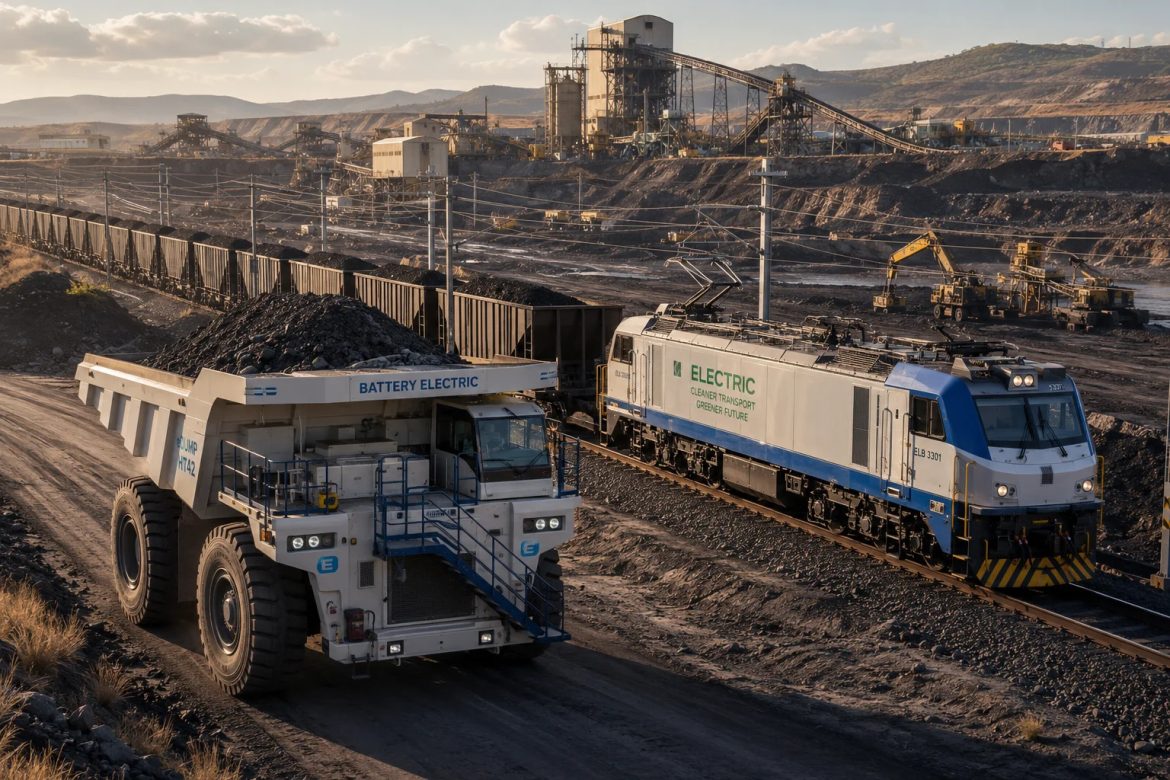
Mozambique’s largest coal mine is preparing to undertake one of the most ambitious mining electrification programmes on the African continent, with Vulcan, the Jindal Group-owned operator of the Moatize coal complex, announcing plans to invest US$160 million in a 300-megawatt power system that will replace large volumes of imported diesel with electricity across mining operations, coal processing facilities and rail transport. The project, centred in the resource-rich Tete Province, could position Moatize as Africa’s first fully electrified large-scale coal mining operation while demonstrating how mining companies are seeking to improve operational efficiency, reduce fuel costs and strengthen energy security, even within conventional extractive industries.
The initiative reflects a broader shift underway across Africa’s mining sector, where electrification is increasingly being viewed not only as a decarbonisation measure but also as a commercial strategy to reduce operating costs, improve energy reliability and limit exposure to volatile international fuel markets. As mining companies face mounting pressure to improve environmental performance while maintaining competitiveness, investment in electric equipment, renewable energy and modern power infrastructure is becoming an integral part of long-term business planning.
Speaking about the project, Vulcan Chief Executive Officer Mukesh Kumar said the company plans to install a 300 MW power plant capable of supplying electricity across its integrated mining and logistics operations. Approximately 90 MW will power mining equipment, 30 MW will supply coal processing facilities and around 100 MW will electrify the railway network transporting coal from Moatize to export terminals. The remaining generating capacity could eventually supply surplus electricity to Mozambique’s national grid, creating benefits that extend beyond the mining operation itself.
“We are installing a 300-megawatt power plant: roughly 90 megawatts will power our mining operations, 30 megawatts will be dedicated to processing, and about 100 megawatts will electrify our rail corridor,” Kumar said.
According to the company, the project is driven as much by economics as environmental considerations. Vulcan currently spends approximately US$150 million each year importing diesel to fuel mining equipment and transport operations. That annual fuel bill is almost equivalent to the total planned investment in the electrification programme, illustrating the financial incentive to reduce dependence on imported petroleum products.
“Our ultimate objective is to enhance and scale up the national economy. Currently, we spend roughly US$150 million solely on diesel imports,” Kumar added.
For Mozambique, reducing industrial diesel consumption carries implications beyond corporate operating costs. The country imports virtually all refined petroleum products required by major industrial consumers, exposing businesses to fluctuations in global oil prices, exchange rate volatility and supply chain disruptions. According to the International Energy Agency (IEA), improving domestic energy utilisation and reducing dependence on imported fossil fuels remain important components of energy security strategies across many developing economies.
Mozambique’s Minister of Mineral Resources and Energy, Estevão Pale, has endorsed the initiative, arguing that replacing diesel-powered machinery with electric systems could improve operational productivity while reducing both fuel costs and local environmental impacts.
“The gradual replacement of fuel-powered equipment with electric systems will make it possible to significantly reduce diesel consumption, lower operating costs, and increase productivity,”Pale said, adding that the transition would contribute to “more efficient and environmentally responsible mining operations.”
The electrification programme will be supported by a 300 MW thermal power plant constructed at Moatize. Rather than relying on conventional coal extraction, the facility will utilise more than 20 million tonnes of accumulated coal waste to generate electricity. This approach seeks to convert legacy mining waste into productive energy while reducing the environmental burden associated with long-term waste storage.
The project received first place in the Megaprojects category at Mozambique’s FACIM 2025 Trade Fair and was recognised as the country’s leading mining and energy investment initiative.
However, the environmental implications of the project remain more nuanced than conventional mine electrification programmes powered by renewable energy. While replacing diesel engines with electric equipment is expected to reduce direct fuel consumption, improve air quality around mining operations and lower operational emissions associated with diesel combustion, the electricity itself will be generated from coal waste. Consequently, the project cannot be classified as a low-carbon mining development in the same way as mining operations powered primarily by solar, wind or hydropower.
Nevertheless, the initiative aligns with a growing international emphasis on improving resource efficiency within existing industrial systems. According to the International Council on Mining and Metals (ICMM), mining companies are increasingly adopting technologies that improve operational efficiency, recover value from waste materials and reduce environmental impacts while maintaining production.
Vulcan has also indicated that ash generated by the thermal power plant could be utilised in the manufacture of green cement, creating an additional industrial application for combustion by-products while reducing the volume of waste requiring long-term disposal. Such industrial symbiosis is becoming increasingly common as companies seek to apply circular economy principles across extractive industries.
The significance of the project is reinforced by the scale of Vulcan’s operations. The company controls a mining concession covering approximately 250 square kilometres in Tete Province and has reportedly produced more than 35 million tonnes of coal annually over the past three years, making Moatize one of Africa’s largest coal-producing assets.
Vulcan’s position in Mozambique’s mining sector expanded significantly following its 2022 acquisition of the Moatize mine and the strategically important Nacala Logistics Corridor from Brazilian mining company Vale. The transaction, valued at approximately US$270 million, provided Vulcan with ownership of both the mining operation and the approximately 912-kilometre railway corridor connecting Moatize to export facilities on the Indian Ocean.
Electrifying the railway therefore represents a critical component of the broader investment. Rail transport accounts for a significant share of mining logistics costs, and replacing diesel-powered locomotives with electric systems has the potential to improve operational efficiency while lowering long-term fuel expenditure. According to the African Development Bank (AfDB), modernising transport infrastructure remains essential for improving the competitiveness of Africa’s extractive industries and supporting regional trade.
The project also illustrates the increasingly complex relationship between Africa’s resource sectors and the continent’s energy transition. While coal remains an important export commodity for several African economies, mining companies are under growing pressure from investors, financiers and customers to reduce operational emissions and improve environmental performance. Electrification, energy efficiency and waste utilisation are emerging as practical approaches that allow operators to improve sustainability without immediately abandoning existing production assets.
For Mozambique, whose economy remains heavily dependent on extractive industries, the investment could generate broader economic benefits beyond the mine itself. If surplus electricity is eventually supplied to the national grid, the infrastructure could contribute to strengthening electricity availability in surrounding communities while supporting industrial development in one of the country’s most important mining regions.
According to the World Bank, reliable and affordable electricity remains fundamental to economic diversification, industrialisation and private sector development across Africa. Investments that strengthen both industrial productivity and national energy infrastructure can therefore create wider economic spillovers beyond individual projects.
Although the Moatize electrification programme is unlikely to redefine the role of coal in Africa’s energy transition, it represents a significant example of how conventional mining operations are evolving to improve efficiency, reduce fuel dependence and integrate more sustainable operating practices. As mining companies continue balancing commercial competitiveness with rising environmental expectations, projects such as Moatize may increasingly demonstrate that operational decarbonisation and industrial productivity can advance together, even within sectors traditionally associated with high carbon emissions.


