


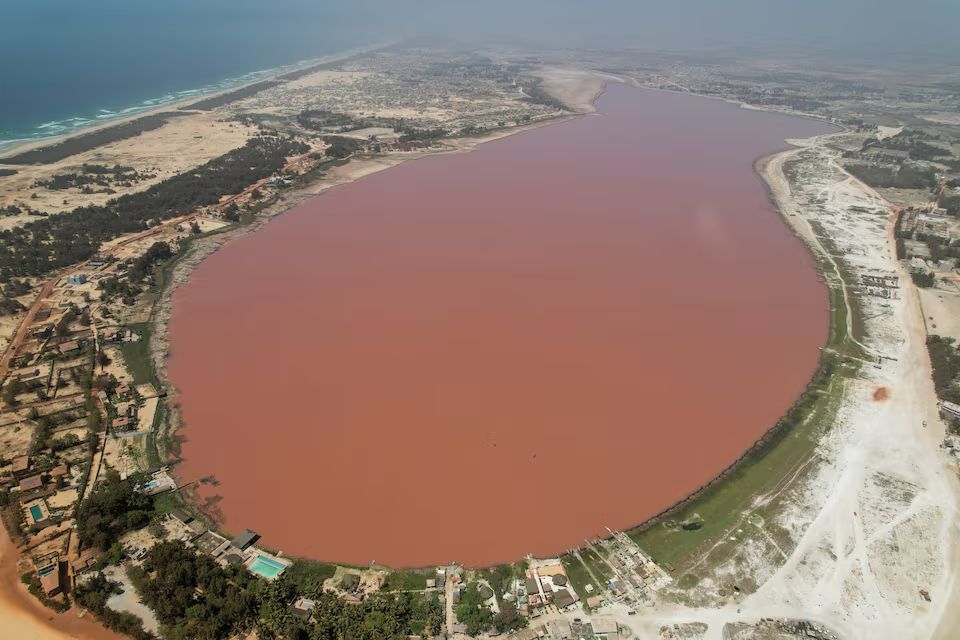
Senegal’s iconic Pink Lake has regained its distinctive rosy hue after nearly four years of ecological restoration, allowing salt production to resume and restoring a vital economic lifeline for thousands of households whose livelihoods depend on one of West Africa’s most recognisable natural assets. The recovery of Lake Retba, located about 30 kilometres Northeast of Dakar, follows an extensive community-led effort to reverse environmental damage caused by emergency flood management measures introduced in 2022, illustrating how ecosystem restoration can reinforce both climate resilience and local economic development.
The lake lost its characteristic colour after authorities diverted significant volumes of floodwater into the basin to protect nearby communities during severe flooding. While the intervention reduced immediate flood risks, it dramatically diluted the lake’s exceptionally high salinity, disrupting the growth of Dunaliella salina, the microalgae responsible for its internationally recognised pink appearance. The decline in salinity also halted salt crystallisation, bringing commercial extraction to a standstill and sharply reducing tourism, two industries that underpin the local economy.
According to local stakeholders, approximately 3,000 salt harvesters rely directly on Lake Retba for their livelihoods, while another 2,000 people generate income through transport services, hospitality, retail trade and other activities linked to the lake’s economy. Before the ecological disruption, the destination attracted between 7,000 and 8,000 visitors during its peak tourism season each year, making it one of Senegal’s most important natural attractions and an important contributor to rural employment.
Faced with mounting economic losses, associations representing salt producers, tourism operators, artisans and local businesses coordinated an ambitious restoration programme to remove excess freshwater and restore the lake’s natural chemical balance. Community organisations raised approximately 23 million CFA francs to finance pumping equipment, fuel supplies and hundreds of metres of drainage infrastructure directing freshwater towards the Atlantic Ocean. Around 100 volunteers participated in the installation and operation of the system before local authorities expanded the effort by providing larger pumps and electricity to accelerate water removal.
As salinity gradually returned to historic levels, the specialised algae recovered, restoring the lake’s internationally recognised pink colour while allowing commercial salt harvesting to resume. Community leaders marked the reopening of extraction activities through a traditional ceremony, signalling the return of an industry that has sustained generations of families despite the physically demanding nature of harvesting salt from hypersaline waters.
The recovery highlights the growing economic importance of ecosystem restoration across Africa as countries confront increasingly frequent climate-related shocks. According to the United Nations Environment Programme, restoring degraded ecosystems not only protects biodiversity but also strengthens food security, water resources and employment while reducing vulnerability to climate change. Lake Retba demonstrates how environmental rehabilitation can generate measurable economic returns when natural capital underpins productive sectors such as tourism and natural resource extraction.
For Senegal, the restoration extends beyond preserving a national landmark. Salt remains an important commodity supporting local commerce and household incomes, while tourism linked to the lake contributes to regional economic diversification. Re-establishing these activities helps strengthen rural economies at a time when climate variability continues to disrupt agriculture, fisheries and other natural resource-dependent sectors across West Africa.
The experience also underscores the value of collaborative environmental governance. Rather than relying solely on public financing, local communities, private stakeholders and government institutions combined financial resources, technical expertise and volunteer labour to restore an ecosystem whose economic value extends well beyond its environmental significance. Such partnerships are increasingly recognised as essential for managing climate risks while protecting productive natural assets.
 The rehabilitation of Lake Retba aligns with broader continental efforts to integrate environmental restoration into economic development strategies. The African Union’s Agenda 2063 identifies sustainable natural resource management and climate resilience as central pillars of long-term growth, recognising that healthy ecosystems provide critical infrastructure supporting agriculture, tourism, water security and employment.
As African governments increasingly seek climate adaptation solutions that deliver both environmental and economic benefits, Lake Retba’s recovery offers a practical example of how ecosystem restoration can preserve livelihoods, strengthen local resilience and sustain economic activity. Its revival demonstrates that investing in natural capital is not simply an environmental objective but an increasingly important component of Africa’s broader strategy for climate-resilient and inclusive economic development.


