


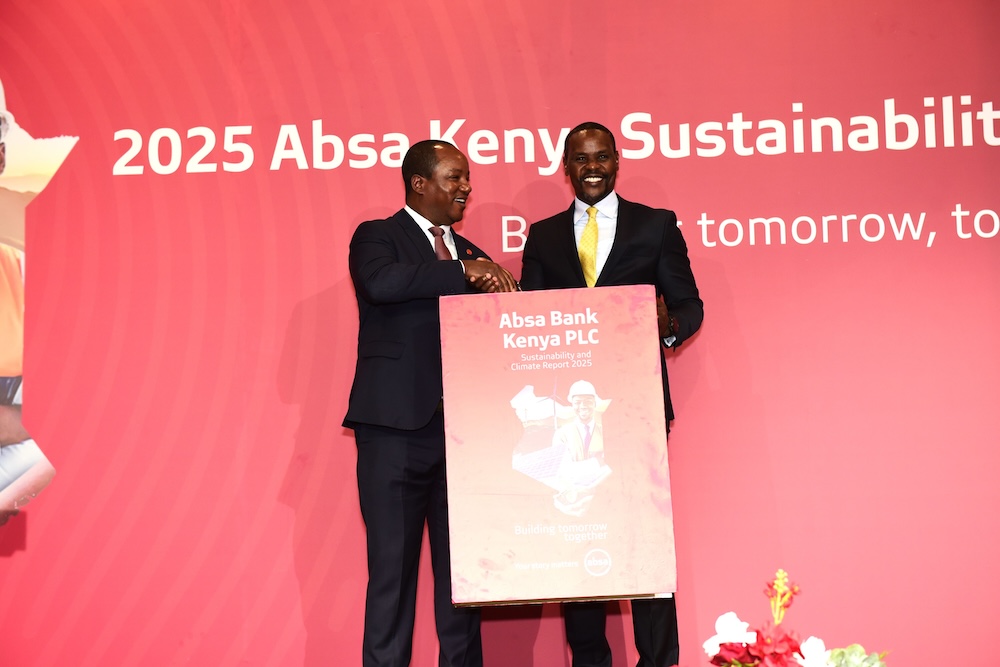
Absa Bank Kenya has taken another step towards decarbonising its operations after successfully completing a solar energy pilot across four branches that delivered energy efficiency improvements of between 30% and 51%, reinforcing the growing role of renewable energy within Africa’s financial sector as banks increasingly align their operations with climate commitments and sustainable finance strategies.
According to the bank’s 2025 Sustainability and Climate Report, the proof-of-concept was implemented at the Nkrumah Road, Meru, Nyeri and Market branches and forms part of a broader programme aimed at reducing operational emissions, improving energy efficiency and lowering long-term operating costs. The pilot comes as financial institutions across Africa increasingly recognise that climate commitments require not only financing green projects but also transforming their own operations to reduce environmental impacts.
The results illustrate how investments in distributed solar energy are becoming commercially attractive for institutions with extensive branch networks operating in countries where electricity costs continue to rise and grid reliability remains an operational concern. According to Absa Bank Kenya, electricity consumption across its operations declined to 3,877,178 kilowatt-hours (kWh) in 2025, compared with 4,058,431 kWh in 2024 and 6,530,896 kWh in 2019, which serves as the baseline year for its net-zero commitment.
The reduction represents a 40.64% decline in electricity consumption over six years and translated into electricity cost savings of Sh111.6 million (US$862,442) during 2025, compared with Sh140.8 million (US$1.09 million) in 2019. While part of the reduction reflects broader efficiency measures implemented across the organisation, the successful solar pilot demonstrates how on-site renewable energy can contribute to lowering operational energy demand while strengthening business resilience.
The initiative reflects a broader shift taking place across Africa’s banking sector as financial institutions increasingly integrate environmental sustainability into both their lending portfolios and internal business operations. Banks have become major financiers of renewable energy, climate-smart agriculture and sustainable infrastructure, but they are also under growing pressure from investors, regulators and customers to reduce emissions generated by their own facilities.
According to the International Energy Agency (IEA), commercial buildings account for a significant share of global electricity consumption, making energy efficiency and distributed renewable energy important components of corporate decarbonisation strategies. Falling solar photovoltaic costs, improvements in battery storage technologies and rising electricity tariffs have strengthened the economic case for businesses to generate part of their own electricity.
However, Absa’s experience also illustrates that transitioning to cleaner operations requires substantial upfront investment.
The bank disclosed that installing solar systems across the four pilot branches increased its capital expenditure by approximately Sh11.5 million (US$88,873) during the 2025 financial year. The report also highlights several operational challenges that could affect wider deployment, including ageing electrical infrastructure within some branches, structural limitations affecting rooftop installations, shading constraints that reduce solar performance and the need for a centralised maintenance framework to ensure long-term system reliability.
These challenges are not unique to Absa. Across Africa, many commercial buildings were constructed long before rooftop solar became economically viable, requiring additional engineering work before renewable energy systems can be installed efficiently. Despite these constraints, declining technology costs continue to improve project economics.
According to the International Renewable Energy Agency (IRENA), the cost of utility-scale solar photovoltaic electricity has fallen by approximately 90% globally over the past decade, while distributed commercial solar systems have also become increasingly affordable. These cost reductions are encouraging businesses, manufacturers, hospitals, universities and financial institutions across Africa to invest in self-generation as a means of improving energy security while reducing carbon emissions.
Absa Kenya now plans to scale the initiative considerably.
The bank is targeting solar installation across 51 branches, its headquarters and 61 automated teller machines (ATMs) as part of its wider commitment to achieve net-zero operational emissions by 2040, while aiming to reduce financed emissions by 2050. To support the expansion, the institution is preparing a comprehensive business case incorporating financial modelling, technical feasibility studies and a long-term vendor maintenance framework designed to ensure operational performance across the network.
The sustainability strategy extends beyond renewable energy deployment.
Five of Absa Kenya’s properties have already achieved EDGE (Excellence in Design for Greater Efficiencies) certification, an internationally recognised green building standard developed by the International Finance Corporation (IFC). EDGE certification evaluates buildings based on improvements in energy efficiency, water conservation and embodied energy in construction materials, helping organisations reduce operating costs while improving environmental performance.
Despite the progress in reducing electricity consumption, the bank reported that its total operational greenhouse gas emissions increased to 6,006 tonnes of carbon dioxide equivalent (tCO₂e) in 2025 from 3,220 tCO₂e the previous year. According to the report, the increase was primarily driven by higher Scope 3 emissions, which include indirect emissions generated across supply chains, business travel and other external activities. At the same time, Scope 2 emissions, which relate directly to purchased electricity, continued to decline as renewable energy and efficiency measures expanded.

The divergence highlights an increasingly common challenge for corporations pursuing net-zero targets. While improvements in operational energy efficiency can significantly reduce direct emissions, emissions associated with suppliers, procurement and financed activities often become proportionally larger as organisations mature in their sustainability journey.
For Kenya, the initiative aligns with broader national efforts to accelerate renewable energy deployment and improve energy efficiency within the private sector. The country already generates more than 90% of its grid electricity from renewable sources, primarily geothermal, hydropower, wind and solar, making it one of Africa’s cleanest electricity systems. Nevertheless, distributed solar remains attractive for commercial users seeking greater energy independence, protection from power interruptions and long-term cost stability.
The banking sector is increasingly emerging as both a financier and adopter of climate technologies. Institutions that demonstrate successful decarbonisation within their own operations may strengthen confidence among clients seeking financing for similar investments in manufacturing, agriculture, real estate and industrial facilities. Operational experience gained through projects such as Absa’s solar rollout can also improve banks’ ability to evaluate renewable energy investments across their lending portfolios.
According to the United Nations Environment Programme Finance Initiative (UNEP FI), financial institutions have an increasingly important role in supporting climate resilience not only through sustainable lending but also by demonstrating leadership in environmental management, resource efficiency and transparent climate reporting.
As Kenya continues implementing its green growth agenda and businesses seek practical pathways towards lower-carbon operations, Absa Bank Kenya’s solar programme illustrates how operational sustainability is evolving from a corporate responsibility initiative into a strategic business investment. While the pilot revealed technical and financial challenges that accompany large-scale renewable energy deployment, its results suggest that distributed solar can simultaneously reduce operating costs, improve energy efficiency and strengthen progress towards long-term net-zero commitments across Africa’s financial sector.


