


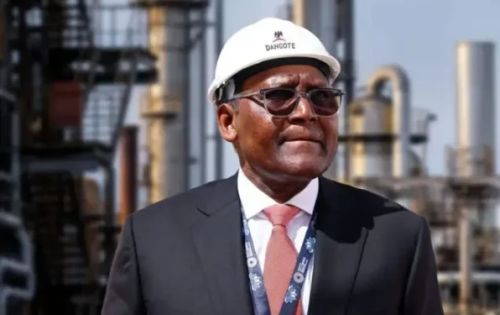
A Kenyan court has ordered parties to maintain the status quo on land earmarked for Dangote Group’s planned $16 billion oil refinery in Lamu, creating a legal uncertainty around the project just days before its scheduled September 30 groundbreaking, although the court has not formally stopped the ceremony. The Environment and Land Court in Malindi will hear the dispute on October 14 after 133 residents from Chandavai challenged the use of land they say their families have occupied, cultivated and developed for generations.
The dispute centres on LR No. 13061 in the Hindi, Manda and Magogoni area of Lamu County, where the residents say they face displacement without adequate compensation or a clear resettlement plan. They have also raised questions over the acquisition process and compliance with environmental and public-participation requirements. The court declined the applicants’ request to halt the planned groundbreaking and wider development of the refinery, but directed that the existing status quo on the disputed parcel be maintained until the October 14 hearing.
The distinction matters because the proposed refinery is one of the largest industrial investments planned for East Africa. Designed to process as much as 700,000 barrels of crude oil per day, the facility would have capacity comparable to Dangote’s Nigerian refinery, which currently operates at about 700,000 barrels per day following an expansion of its crude distillation capacity. Dangote has said the Kenyan project is intended to reduce East Africa’s dependence on imported refined petroleum products while supplying Kenya and neighbouring markets.

Dangote Group has said the September 30 groundbreaking will proceed. Reuters reported on September 29 that the company considers the court ruling insufficient to prevent the official launch, although the order could affect some ongoing or future activities at the site. That leaves the project in an unusual position: its political and ceremonial launch can proceed while a court is still considering claims concerning the land on which development is planned.
The land dispute highlights one of the central challenges facing large infrastructure projects in Africa: the economic value of strategic infrastructure can coexist with complex questions over land rights, compensation and community participation. For governments and investors, those issues can affect project timelines, financing structures and the social legitimacy of developments long after construction begins.
The residents’ case is therefore significant beyond the immediate question of whether the September 30 ceremony takes place. According to reporting on the court proceedings, the 133 applicants say their families have occupied and used portions of the disputed land for generations, including for farming, livestock keeping and residential purposes. Some residents have also said the land contains homes, religious sites and family graves.
The legal challenge comes as preparations for the refinery have moved beyond an initial investment announcement. Engineers India Limited has secured a contract worth more than $450 million to provide project management consultancy and engineering, procurement and construction management services for the greenfield refinery and petrochemical complex. The contract indicates that the project has entered a more substantive planning and execution phase rather than remaining at the conceptual stage.
For Kenya, the economic rationale for the refinery is closely linked to its dependence on imported petroleum products. A large domestic refining facility could alter the structure of the country’s fuel-supply system by creating domestic processing capacity and potentially reducing exposure to imported refined products. Its regional significance would depend on the competitiveness of the resulting fuels, crude-supply arrangements, distribution infrastructure and the refinery’s ability to access markets beyond Kenya.
That regional dimension is central to the project’s positioning. The refinery is planned within the Lamu Port-South Sudan-Ethiopia Transport corridor, commonly known as LAPSSET, a major infrastructure programme intended to connect Kenya’s northern coast with inland markets through transport, energy and logistics infrastructure. The corridor is designed around Lamu Port and includes road, rail and pipeline components intended to improve connections between Kenya, South Sudan, Ethiopia and wider regional markets.
The refinery could consequently become part of a larger industrial and logistics ecosystem around Lamu rather than functioning only as a facility supplying Kenyan motorists. Its location near a deep-water port could provide access to imported crude and create an export platform for refined petroleum products. In principle, this could strengthen Kenya’s role in regional energy trade, although the eventual scale of those benefits will depend on infrastructure connectivity, market demand and commercial competitiveness.
LAPSSET also illustrates why the refinery matters from a broader development perspective. Large transport corridors are intended to generate economic activity around ports, industrial zones, logistics facilities and connected markets. The success of such corridors therefore depends not only on the completion of individual projects but also on whether the different infrastructure components reinforce each other sufficiently to attract manufacturing, trade and investment.
For East Africa, the proposed refinery comes against a backdrop of continued reliance on imported petroleum products. Transport systems, construction, agriculture, aviation and manufacturing remain heavily dependent on liquid fuels, while regional economies are simultaneously investing in electricity generation, renewable energy and energy-efficiency measures. A domestic refinery would not eliminate this dependence on hydrocarbons, but it could change where and how refined products enter the regional market.
Dangote‘s existing Nigerian refinery provides an indication of the company’s broader regional strategy. The Lagos facility was designed as a 650,000-barrel-per-day refinery and has since demonstrated the ability to process around 700,000 barrels per day. The company says the refinery is supplying Nigeria while also exporting petroleum products to international markets.
Africa Finance Corporation has also played a role in Dangote’s industrial expansion. AFC was a participant in the financing of the Nigerian refinery and in August 2026 led strategic investors in a $2.5 billion private placement involving Dangote Petroleum Refinery and Petrochemicals FZE. The financing illustrates the increasingly important role of African development-finance institutions and institutional investors in supporting large industrial assets capable of serving domestic and regional markets.
The Kenyan project, however, will operate in a different market and regulatory environment. Its economics will be influenced by Kenya’s petroleum-import arrangements, crude availability, pipeline and port infrastructure, foreign-exchange conditions, taxation, environmental requirements and regional fuel demand. The project’s $16 billion price tag also means that capital deployment and construction sequencing will be closely connected to investor confidence and the ability to manage long-term project risks.
Land is one of those risks. Large infrastructure projects across Africa have repeatedly demonstrated that unresolved land rights can become a source of delay, litigation and additional costs. The Lamu case illustrates why early engagement with affected communities, transparent compensation processes and compliance with environmental and social safeguards can have implications for project execution as well as community relations.
The legal proceedings also place public participation under renewed scrutiny. The residents allege that the project has not adequately addressed environmental assessment and participation requirements. Those claims remain matters for the court to determine, rather than established findings against the project. The October 14 hearing will provide an opportunity for the respondents to present their positions before the court considers the applicants’ case further.
For Kenya’s public institutions, the dispute highlights the need to balance strategic infrastructure objectives with constitutional and statutory protections around land and the environment. The state is a major participant in the LAPSSET corridor and related infrastructure, meaning the handling of land acquisition and community claims can influence perceptions of future infrastructure projects in northern Kenya.

For investors, the immediate issue is less about whether the September 30 ceremony occurs than what happens afterwards. A groundbreaking is a symbolic milestone, but the more consequential stages will involve land access, engineering, financing, procurement, construction and eventual operations. The court’s October proceedings could therefore become relevant to the pace at which activities on the disputed parcel can proceed.
The refinery also raises a broader question about the relationship between energy security and the energy transition in Africa. Refining capacity can reduce exposure to imported fuels and strengthen industrial supply chains, but it also represents a long-lived investment in petroleum infrastructure at a time when governments are under pressure to diversify energy systems and reduce emissions. The project’s economic case will consequently have to be considered alongside the changing structure of global energy demand and East Africa’s longer-term transition towards lower-carbon energy.
That does not make the refinery incompatible with an energy transition. Petroleum products are likely to remain important to transport and industrial activity across much of Africa for years, even as renewable electricity expands. The relevant development question is therefore how such infrastructure interacts with wider investments in clean energy, public transport, electric mobility, efficiency and industrial decarbonisation.
Lamu’s strategic position adds another dimension. Kenya has invested heavily in making the coast a gateway for regional trade, while LAPSSET is intended to open additional economic corridors into the country’s northern and neighbouring markets. A refinery could increase the volume and value of energy-related activity around that infrastructure, but its regional contribution will depend on whether the corridor develops sufficient complementary roads, pipelines, storage, logistics facilities and industrial capacity.
The dispute involving the 133 residents therefore arrives at a critical point in the project’s development. The court has not cancelled the September 30 groundbreaking, and Dangote has said the ceremony will proceed. But the status-quo order means that the land question remains unresolved, with the October 14 hearing potentially important for the project’s next phase.
For Africa’s infrastructure market, the Lamu refinery illustrates the increasingly complex requirements attached to projects of continental significance. Capital, engineering expertise and government backing can establish the foundation for a major investment, but long-term execution also depends on land governance, environmental compliance, community engagement and institutional coordination.
The proposed $16 billion refinery could eventually reshape Kenya’s petroleum supply chain and contribute to a wider regional energy-trading network. Its development, however, will be measured not only by the capacity of the facility to process 700,000 barrels of crude a day, but also by whether the project can move through its legal, social, environmental and infrastructure requirements without undermining the communities and institutions around it.


