


Kenya has broken ground on a solar-powered green hydrogen facility at Nyeri Hill Farm that will produce ammonia-based fertiliser for coffee production and medical-grade oxygen for nearby hospitals, bringing renewable energy, agricultural inputs and healthcare infrastructure into a single demonstration project. Led by the Catholic Archdiocese of Nyeri and supported through the United Nations Industrial Development Organization’s Accelerate-to-Demonstrate facility, the Green Hydrogen Innovation Centre is designed to produce about 56.8 tonnes of green ammonia fertiliser and 56.4 million litres of medical-grade oxygen annually, providing a local test case for how decentralised clean-energy systems could address some of the practical costs facing African agriculture and rural services.
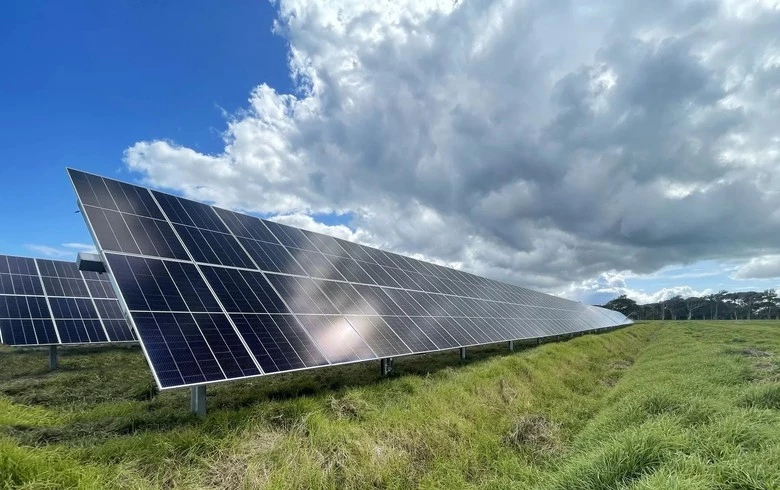
The project is being developed at Nyeri Hill Farm, a 3,000-acre estate with about 825 acres under Arabica coffee. Solar photovoltaic generation will power an electrolyser that separates water into hydrogen and oxygen. The hydrogen will then be combined with nitrogen to produce green ammonia, while the oxygen produced during electrolysis will be purified for medical use. The facility will also incorporate battery and hydrogen storage systems, according to project details released by the project partners.

The financing structure reflects the early-stage nature of green hydrogen development in Africa. Renewables Now reported that the initiative is being financed through UNIDO’s Accelerate-to-Demonstrate Facility, funded by the UK government, with co-financing from the Archdiocese of Cologne’s Starkmacher Impact Revolving Fund. The project brings together technology and implementation partners including Indonesia-based PT MBR Global, German electrolyser company Enapter, Nium, Soventix and Kenya-based CapsHydrogen Energy.
For Kenya’s agricultural sector, the fertiliser component addresses a longstanding exposure to international markets. Kenya’s Agricultural Soil Management Policy states that the country mainly relies on imported fertiliser, with domestic blending accounting for only a limited share of supply. The policy estimates annual fertiliser consumption at about 500,000 tonnes and identifies local manufacture and blending as part of the country’s strategy to reduce costs and improve availability.
The exposure remains visible in trade data. World Bank WITS data shows that Kenya imported $453.4 million worth of fertilisers in 2025, with Saudi Arabia, Russia, Qatar, China and Morocco among the largest suppliers. For nitrogenous fertilisers, Kenya imported about 325,591 tonnes worth $123.2 million in 2024. These figures underline why domestic production capacity has implications beyond the environmental credentials of individual farms: fertiliser prices and availability affect production costs, food prices, farmer margins and the country’s exposure to international commodity and shipping markets.
The Nyeri project is too small to materially change those national import figures on its own. Its importance instead lies in whether a decentralised production model can demonstrate that renewable electricity, green hydrogen and fertiliser manufacturing can operate economically close to agricultural demand. UNIDO describes the project as a proof of concept for decentralised green hydrogen systems and says it aims to reduce reliance on fossil-fuel-based fertilisers while creating a model that could be replicated elsewhere in East Africa.
That distinction is important in assessing the economics of green fertiliser in Africa. Conventional ammonia production depends heavily on fossil fuels, particularly natural gas, both as an energy source and as a feedstock for hydrogen. Green ammonia instead uses hydrogen produced through electrolysis powered by renewable electricity. The environmental benefit therefore depends on the electricity source, the efficiency and cost of the equipment, water availability, storage requirements and the economics of producing and transporting the final fertiliser.
Kenya has positioned green hydrogen as part of its wider industrial and energy-transition agenda. Its Green Hydrogen Strategy and Roadmap identifies hydrogen and its derivatives as potential contributors to economic growth, job creation and environmental objectives, while noting the country’s substantial renewable-energy resources. The strategy also places green hydrogen within a broader industrial framework rather than treating it solely as an energy technology.
The Nyeri facility illustrates what that industrial integration can look like at a local level. Electricity generated on the farm is intended to produce an input used by the same agricultural operation, while the oxygen generated through the process can support healthcare facilities nearby. That creates two potential economic linkages from a single energy system: reducing exposure to imported agricultural inputs and improving the reliability of a locally available medical commodity.
The healthcare component is particularly relevant because oxygen supply remains an infrastructure and logistics issue in many African health systems. According to Kenya News Agency, Consolata Hospital Mathari currently spends between KSh2.5 million and KSh3 million a month on oxygen. The project is designed to produce enough medical-grade oxygen to meet the hospital’s annual requirement, with surplus supply potentially available to other facilities in the county.
For rural economies, the significance extends beyond the physical production of fertiliser and oxygen. Projects of this kind require skills in renewable-energy engineering, electrolysis, chemical processing, storage, maintenance and safety. UNIDO says the initiative is intended to contribute to technical capability and demonstrate commercially available technologies in an African agricultural setting. If the technology performs reliably, the resulting experience could be relevant to other farms and agro-processing operations considering distributed energy and industrial applications.
The financial question, however, remains central. Green hydrogen projects currently face higher upfront costs than established fossil-fuel-based alternatives, particularly at small scale. Demonstration finance can absorb some of the early development and technology risks, but long-term expansion would require projects to demonstrate competitive operating costs and reliable demand. For farmers, the relevant measure will ultimately be the delivered cost and reliability of the fertiliser rather than its production technology alone.
Water availability will also matter. Electrolysis requires water, while agriculture itself is increasingly exposed to rainfall variability and water stress. A decentralised green-fertiliser model therefore needs to demonstrate that industrial water use can be managed without competing with agricultural or household needs. The location-specific availability of renewable electricity, water, storage and transport infrastructure will influence whether similar systems can be replicated across Kenya and other African agricultural regions.
The project is also emerging as Kenya continues to use public policy to address agricultural input costs and food security. The government allocated KSh64 billion to the agriculture sector for the 2026/27 financial year, while it continues to operate fertiliser-support measures aimed at improving affordability and agricultural productivity. In September, the Agriculture Ministry announced the distribution of 99,000 tonnes of subsidised fertiliser to farmers at KSh2,000 per 50-kilogramme bag.
This creates a broader policy question for Kenya: whether investment in local fertiliser manufacturing can eventually complement, rather than remain separate from, efforts to make farm inputs more affordable. Domestic production could reduce some exposure to international supply disruptions, but its competitiveness would depend on energy costs, technology performance, financing conditions, feedstock and distribution economics.
For the wider African market, the experiment is relevant because fertiliser imports remain a significant vulnerability for many food-producing economies, while renewable energy resources are unevenly utilised. Countries with strong solar, wind or geothermal resources could potentially use those assets not only to generate electricity but also to produce industrial inputs locally. That could support a gradual shift from exporting energy resources or agricultural commodities towards developing more integrated domestic value chains.

The Nyeri project therefore represents a relatively small investment in physical terms but a wider test of whether clean-energy technologies can be embedded directly into African production systems. Its success will depend on technical performance, cost competitiveness, water management, reliable renewable power and the ability to move from demonstration finance to commercially sustainable operations. For Kenya, the immediate value lies in the evidence the project can generate. For the wider region, that evidence could help determine whether green hydrogen can move beyond an emerging energy concept and become part of the infrastructure supporting agriculture, healthcare and industrial development.


