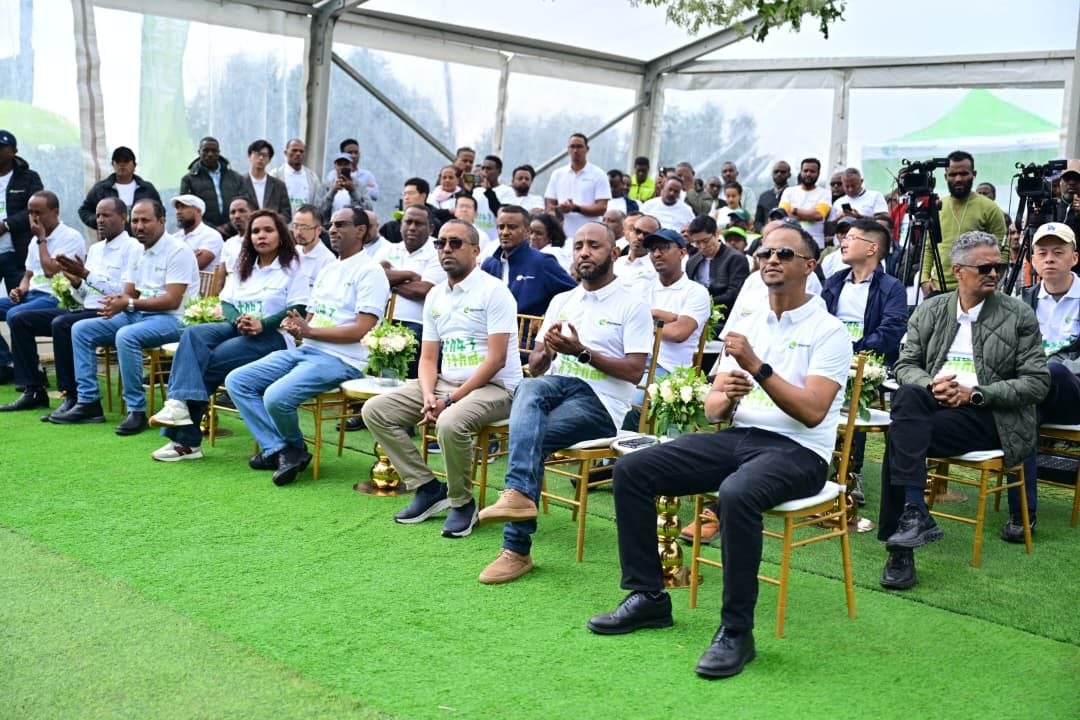
Ethiopia’s state-owned telecommunications operator, Ethio telecom, has expanded its sustainability agenda by launching the eighth edition of its nationwide Green Legacy campaign, planting an additional 250,000 tree seedlings while accelerating investments in renewable-powered telecommunications infrastructure, electric vehicle charging and energy-efficient digital networks. The initiative demonstrates how one of Africa’s largest telecom operators is integrating climate action with digital transformation, positioning telecommunications infrastructure as a contributor to both environmental sustainability and economic development.
The nationwide campaign was launched simultaneously in Addis Ababa and across Ethio telecom’s 18 regional offices under Ethiopia’s national “Planting Hope” initiative and the company’s “For a Green Ethiopia” campaign. More than 3,500 employees, partners and stakeholders participated in the exercise, making it one of the company’s largest annual environmental programmes.
While the large-scale tree planting campaign represents the most visible aspect of Ethio telecom’s sustainability efforts, it forms part of a broader corporate strategy embedded within its three-year “Next Horizon: Digital & Beyond 2028 Strategy.” The framework seeks to align Ethiopia’s digital transformation with environmental stewardship through investments in renewable energy, low-carbon technologies, sustainable infrastructure and inclusive economic development.
The initiative reflects a wider trend emerging across Africa’s telecommunications industry, where operators are increasingly balancing rapid network expansion with commitments to reduce greenhouse gas emissions and improve energy efficiency. Telecommunications companies remain among the continent’s largest commercial electricity consumers, particularly as mobile broadband usage, cloud computing and digital services continue to expand. According to Ethio telecom, its Green Operator Strategy is designed to reduce dependence on fossil fuels while improving the resilience and reliability of telecommunications services, particularly in remote areas where conventional electricity infrastructure remains limited.
A key pillar of the strategy has been the deployment of renewable energy across network operations. The company reported that it has commissioned 190 fully solar-powered telecommunications sites, deployed 867 hybrid solar-and-battery systems, and installed 1,114 lithium-ion battery storage units across its national network. These investments have reduced diesel generator operating time by up to 40 per cent, lowering operational costs while reducing carbon emissions associated with powering telecommunications infrastructure.
During the most recent financial year, Ethio telecom commissioned an additional 215 solar-powered sites while modernising 774 existing network stations. These upgrades added 12.72 megawatts of renewable generation capacity, bringing the company’s installed solar capacity to 39.72 megawatts.
The expansion illustrates how renewable energy is increasingly becoming a commercially viable solution for telecommunications operators serving rural and off-grid communities across Africa. According to the International Energy Agency (IEA), decentralised renewable energy technologies are expected to play a central role in expanding electricity access across the continent while supporting essential infrastructure such as telecommunications, healthcare and education. Replacing diesel-powered base stations with solar and hybrid systems also improves service reliability in areas where electricity supply remains intermittent, reducing fuel transportation costs and operational disruptions that have historically affected network availability.
Beyond network infrastructure, Ethio telecom is extending its sustainability strategy into Ethiopia’s emerging electric mobility sector. Since introducing its electric vehicle charging service in February 2025, the company has established nine ultra-fast charging stations capable of serving 108 electric vehicles simultaneously. Between February 2025 and July 2026, the charging network facilitated more than 481,000 charging sessions, supplying approximately 11.2 million kilowatt-hours of electricity.
According to the company, the initiative helped avoid roughly 15.4 million kilograms of carbon dioxide emissions, an environmental impact it estimates is equivalent to the carbon sequestration capacity of more than 76,000 trees. The expansion of charging infrastructure aligns with Ethiopia’s broader transition towards electric mobility. The government has increasingly promoted electric vehicles as part of efforts to reduce fuel imports, improve urban air quality and lower transport-sector emissions while taking advantage of the country’s predominantly renewable electricity generation mix, which is largely supplied by hydropower.
Environmental restoration continues to remain a significant component of Ethio telecom’s sustainability agenda. Over the past seven years, the operator has planted more than 4.6 million tree seedlings across 889 locations nationwide. The programme has also generated more than 24,800 temporary employment opportunities, primarily supporting local communities involved in seedling production, planting and maintenance.
The company reports an average seedling survival rate of 82.7 per cent, suggesting continued investment in post-planting management rather than one-off planting campaigns. The latest campaign is expected to create an additional 2,000 temporary jobs, with activities covering seedling planting, nurturing and ecosystem protection. Ethio telecom has allocated more than 42.4 million Ethiopian birr for this year’s environmental programme, bringing its cumulative investment in environmental conservation and green development to more than 159.9 million birr.
For Africa, the company’s integrated approach illustrates how digital infrastructure investment can increasingly contribute to broader climate and development objectives rather than existing as a separate sector. Across the continent, telecommunications operators face mounting pressure to expand digital connectivity while managing rising electricity costs and reducing operational emissions. Renewable-powered networks offer an opportunity to lower long-term operating expenses, improve resilience against unreliable electricity supplies and support national climate commitments.
According to the GSMA, mobile connectivity continues to underpin Africa’s digital economy by enabling financial inclusion, digital commerce, education, healthcare and public service delivery. As mobile networks become increasingly central to economic activity, improving their environmental sustainability also becomes an economic governance issue rather than solely an environmental one. Ethio telecom’s investment demonstrates that renewable energy deployment can strengthen network reliability while supporting broader national priorities, including job creation, clean energy development and ecosystem restoration.
The initiative also reinforces Ethiopia’s wider Green Legacy programme, which seeks to combine environmental conservation with economic development through large-scale reforestation, climate adaptation and natural resource management. International recognition of the company’s sustainability efforts has continued to grow. Ethio telecom has twice received the Brand Africa 100 Most Admired Ethiopian Brand Doing Good for Society and the Environment award and was honoured with the Ethiopian Green Award 2025 by the Ethiopian Environmental Protection Authority for its contribution to advancing the country’s environmental agenda.
As telecommunications operators across Africa continue investing in digital infrastructure, Ethio telecom’s experience suggests that integrating renewable energy, ecosystem restoration and electric mobility into corporate strategy may provide a practical model for balancing digital expansion with climate resilience. For African economies pursuing both digital transformation and low-carbon development, such integrated approaches are increasingly likely to shape investment decisions, infrastructure planning and corporate sustainability strategies over the coming decade.