


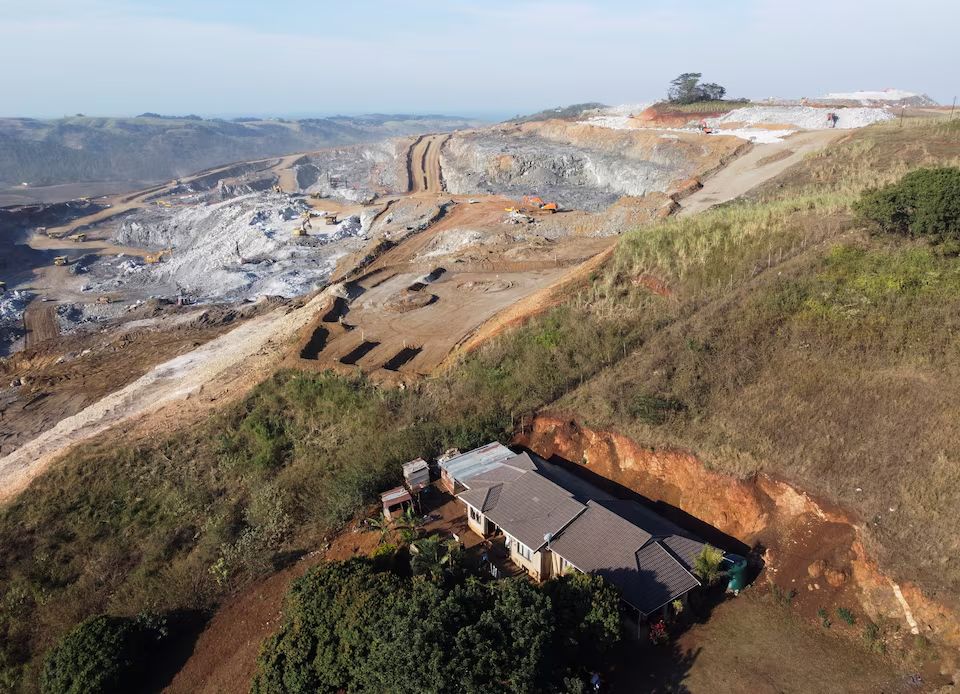
South Africa’s ambition to position itself as a strategic supplier of lithium for the global clean energy transition is encountering growing resistance from farming communities in KwaZulu-Natal, where expanding mining activity is raising concerns over food production, water resources, rural livelihoods and long-term land use. As demand for battery minerals accelerates worldwide, the dispute highlights the increasingly complex balance African governments must strike between attracting investment in critical minerals and safeguarding agricultural economies that underpin employment, exports and community resilience.
The tensions are most visible along South Africa’s Southeastern Coast, where an operational lithium mine is expanding and more than a dozen prospecting licences have been granted since 2023. According to data from South Africa’s Department of Mineral Resources and Energy, lithium exploration rights now cover approximately 73,000 hectares, much of it productive farmland spanning more than 100 farms as well as sections of the coastal tourism zone. While the existing mining operation occupies a comparatively small footprint, local communities fear that future mining approvals could fundamentally alter one of the country’s most productive agricultural regions.
The expansion reflects South Africa’s broader strategy to capture greater value from the global transition to low carbon technologies. Lithium has become one of the most sought-after minerals because of its central role in rechargeable batteries used in electric vehicles and energy storage systems. President Cyril Ramaphosa has repeatedly identified critical minerals as a future pillar of industrial growth, arguing that South Africa’s extensive mineral endowment presents an opportunity to strengthen manufacturing, create employment and attract new investment into value-added industries.
According to government estimates, South Africa possesses critical mineral resources valued at tens of trillions of rand. As countries seek to diversify supply chains away from traditional producers, African resource-rich economies are increasingly viewed as important contributors to global energy security. This has intensified exploration activity across several provinces, particularly where geological surveys indicate commercially viable lithium deposits.
However, the emergence of lithium mining has exposed difficult trade-offs between climate-related economic opportunities and existing productive sectors. KwaZulu-Natal remains one of South Africa’s major sugar-producing regions, supporting thousands of commercial and smallholder farmers alongside downstream processing facilities, transport operators and tourism businesses. Local agricultural production also contributes significantly to export earnings and rural employment.
Read also: https://www.japantimes.co.jp/environment/2026/08/05/energy/lithium-mining-south-africa-farmers/
Community organisations argue that widespread mining development could permanently alter these economic foundations. According to the South Coast Guardians Association, the expansion of lithium prospecting threatens an estimated 30,000 jobs across farming, agricultural services and tourism. Local representatives warn that replacing agricultural land with open-pit mining risks reducing long-term economic resilience even as it creates shorter-term employment opportunities in mineral extraction.
The concerns extend beyond land availability. Farmers report that blasting associated with mining operations has damaged homes, generated persistent dust and increased uncertainty over future farming activity. Some residents say relocation programmes have moved households away from established farming areas to locations that offer fewer opportunities for agriculture and income generation. Mining operators maintain that relocations have been voluntary and that affected families have received improved living conditions, highlighting the differing perspectives that frequently accompany large-scale extractive developments.
Water management has emerged as another central issue. Agriculture in Coastal KwaZulu-Natal depends on reliable water resources, while mining operations require significant volumes for mineral processing and dust suppression. Environmental groups argue that expanding extraction increases the potential for long-term impacts on groundwater, river systems and soil quality, even where companies implement mitigation measures.
Mining companies reject suggestions that their operations are causing widespread environmental degradation. Industry representatives say modern environmental management systems, including water recycling infrastructure and controlled waste management practices, significantly reduce operational impacts and comply with regulatory requirements. According to project developers, wastewater is retained within dedicated facilities rather than discharged into surrounding river systems.
The debate reflects broader questions surrounding Africa’s role in supplying minerals needed for global decarbonisation. While renewable energy technologies generally require less ongoing material extraction than fossil fuel systems over their operating life, expanding production of critical minerals inevitably creates new environmental and social pressures. Governments therefore face increasing expectations to ensure that mining projects meet higher environmental standards while delivering tangible economic benefits to host communities.
The dispute also illustrates how ESG considerations have become increasingly central to mining investment decisions. International financiers and downstream manufacturers are paying closer attention to community engagement, environmental performance, land rights and supply chain transparency when assessing critical mineral projects. Companies unable to demonstrate responsible production practices may face higher financing costs or reduced access to premium international markets seeking sustainably sourced minerals.
 For South Africa, the outcome carries implications beyond a single mining region. Successfully expanding critical mineral production while protecting agricultural productivity will influence investor confidence in the country’s ability to manage competing development priorities. According to analysts, achieving both objectives will require stronger environmental governance, more transparent consultation processes, clearer land-use planning and greater investment in rehabilitation and community development programmes.
Across Africa, similar tensions are likely to become more common as countries seek to leverage their mineral wealth to participate more actively in global clean energy supply chains. The challenge for policymakers will be ensuring that the transition to a low-carbon economy does not simply shift environmental and economic pressures onto rural communities but instead supports diversified development that strengthens both industrial competitiveness and long-term sustainability.


