


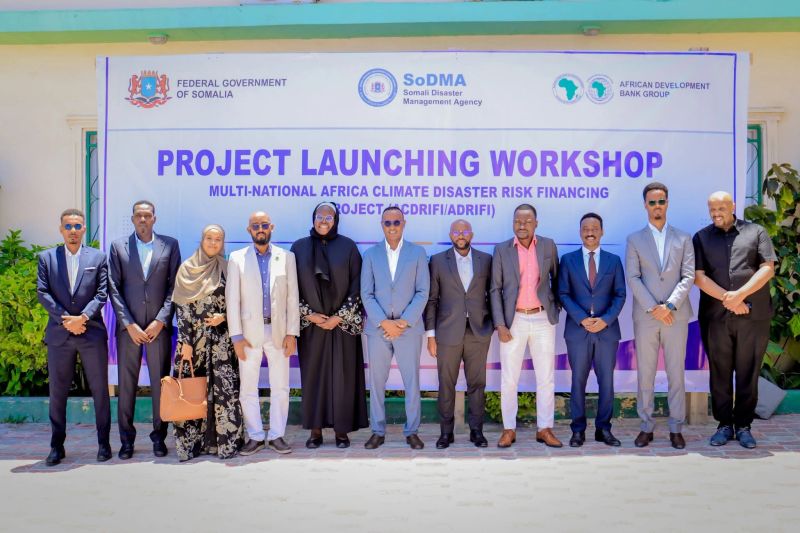
The African Development Bank (AfDB) has launched a new phase of its Africa Disaster Risk Financing Programme (ADRiFi) in Somalia with nearly $19 million in financing, targeting the country’s capacity to prepare for and respond to droughts, floods and other climate-related shocks that continue to disrupt livelihoods, agricultural production and public infrastructure.
The programme, launched in Mogadishu on Aug. 23, 2026, is being implemented jointly by the African Development Bank, the Somali Disaster Management Agency (SoDMA) and Somalia’s Ministry of Finance. The initiative is intended to strengthen disaster preparedness, improve the country’s ability to manage climate risks and support more resilient communities and infrastructure. Local reporting puts the new financing at approximately $19 million, although detailed information on the financing structure, implementation timetable, priority locations and direct beneficiary numbers has not yet been published.
The investment comes as Somalia faces a climate-risk profile in which drought and flooding increasingly interact with existing economic, humanitarian and institutional pressures. The World Bank has described recurrent droughts, floods and locust infestations as major disruptions to agricultural activity, livelihoods, water resources and economic growth. Agriculture and livestock are particularly exposed because a large share of the population depends on climate-sensitive production systems.

For Somalia, the significance of disaster-risk financing lies partly in changing the timing of public intervention. Governments facing climate shocks often have to redirect scarce resources after disasters occur, shifting money from development programmes towards emergency relief and reconstruction. ADRiFi is designed to strengthen anticipatory and ex-ante approaches, including financial protection mechanisms that can provide resources when defined climate risks materialise rather than waiting for the full economic and humanitarian costs to accumulate.
The African Development Bank says ADRiFi was established to help African countries strengthen financial resilience against climate-related disasters, including droughts, floods and tropical cyclones. Its approach includes supporting sovereign disaster-risk financing and insurance, early-warning systems and institutional capacity. The programme has also helped participating African countries access premium subsidies and develop mechanisms for responding to climate shocks before they escalate into larger humanitarian and fiscal crises.
Somalia has already been part of that wider effort. In 2023, the United Kingdom committed £7.4 million, or about $9.63 million at the time, to the ADRiFi Multi-Donor Trust Fund, with a particular focus on supporting Somalia’s sovereign drought insurance protection. The financing was intended to facilitate faster government payouts following severe drought and strengthen the country’s ability to protect vulnerable communities.
The new phase therefore builds on an existing architecture rather than representing an isolated climate-finance intervention. Its potential value will depend on how effectively financial instruments are connected to early-warning information, government response systems and local institutions capable of reaching pastoralist and farming communities.
That connection is particularly important because climate impacts in Somalia are not confined to isolated disaster events. Drought can reduce pasture and water availability, weaken livestock assets and increase food insecurity, while flooding can damage crops, roads, settlements, irrigation systems and markets. When the shocks occur in succession or at the same time, the effect on household assets and public finances can be considerably greater than that of an individual event.
The World Bank has warned that Somalia’s climate vulnerability is compounded by insecurity, economic instability and limited institutional capacity. Its analysis says recurrent climate shocks have interrupted economic activity, increased food insecurity and poverty and contributed to displacement. The bank also expects greater rainfall variability and higher risks of both drought and flooding, increasing the importance of climate information, disaster-risk management and resilient infrastructure.
The agricultural economy makes the issue particularly acute. Somalia’s farming and livestock systems remain heavily dependent on rainfall and natural resources, leaving households exposed to changes in precipitation and temperature. A World Bank assessment noted that agriculture employs more than 70% of Somalia’s population, meaning climate disruptions can transmit rapidly from rural production to food prices, household incomes and wider economic activity.
The AfDB’s wider portfolio in Somalia illustrates the move towards combining disaster preparedness with investments in livelihoods and productive infrastructure. In December 2025, the African Development Fund approved a $9.63 million grant for the Activating Climate-Resilient Agricultural Livelihoods in Somalia (ACALS) project. Together with $2.2 million in in-kind support from the World Food Programme, the initiative has a total value of about $11.83 million and is designed to directly support 180,000 people in Hirshabelle and Puntland, with a further 300,000 expected to benefit indirectly.
ACALS combines climate-smart agriculture with improved water access, irrigation rehabilitation, rangeland restoration, early-warning systems and disaster preparedness. The AfDB’s project framework targets 180,000 people receiving adaptation and resilience investments and includes plans for climate-resilient irrigation, sustainable water-management training and forecast-based financing systems in Puntland and Hirshabelle.
This broader approach matters because financial protection cannot substitute for resilient productive systems. Insurance or contingency financing can provide governments with liquidity following a shock, but the scale of economic losses will also depend on whether communities have access to water, climate information, resilient agricultural inputs, functioning markets and infrastructure capable of withstanding extreme weather.
Somalia is also receiving support from climate-finance institutions beyond the AfDB. In October 2024, the Green Climate Fund approved its Climate Resilient Agriculture in Somalia project, known as Ugbaad, with $79.7 million in GCF grant financing and about $15.2 million in co-financing, taking the total project value to approximately $94.9 million. The project, implemented by the Food and Agriculture Organization of the United Nations, aims to increase resilience for about 2.1 million people through measures including sustainable agriculture, improved water access, climate-resilient seeds, livestock feed and fodder, market access and stronger institutional coordination.
The scale of Ugbaad is notable because it moves climate adaptation beyond emergency response into the productive economy. Somalia’s food and livestock systems are critical to household income and food security, while stronger agricultural productivity can reduce some of the economic pressures created by repeated climate shocks.
The country is also receiving investment in water and sanitation infrastructure. In 2025, the African Development Fund approved a separate $19.7 million grant to strengthen urban resilience for displaced and host communities in Doolow. The project includes climate-resilient housing, stormwater drainage and irrigation infrastructure, demonstrating how adaptation investment is increasingly being linked to urban development, displacement and food production rather than treated solely as an environmental concern.
For Somalia’s public finances, the growing portfolio of adaptation investments presents both an opportunity and a challenge. International grants and concessional finance can reduce the immediate burden on a government with limited fiscal space, but long-term resilience will require national institutions to absorb climate-risk management into budgeting, infrastructure planning and agricultural policy.
The ADRiFi programme is particularly relevant to that fiscal question. The AfDB notes that climate disasters can force governments to reallocate budgets towards emergency response, social protection and recovery while reducing tax revenues through disruptions to production and economic activity. Establishing financial protection before disasters occur can therefore help governments protect development spending when climate shocks strike.
There is also a regional dimension. Somalia’s climate risks are shared across the Horn of Africa, where droughts, floods and food-security pressures can move across borders through livestock markets, trade routes, migration and displacement. Strengthening Somalia’s disaster-risk financing systems could therefore have implications beyond national boundaries, particularly where early-warning information and regional risk-pooling mechanisms are concerned.
The African Risk Capacity is an important part of that wider architecture. ADRiFi has worked with the African Risk Capacity Group to support sovereign risk-transfer mechanisms, including drought insurance. The model is intended to give governments access to funds after predefined climate events, allowing them to begin supporting affected populations without waiting for lengthy post-disaster appeals.
For African policymakers, Somalia’s experience highlights a broader shift in climate finance from response towards preparedness. The economic case is increasingly linked to protecting public budgets, productive assets and household incomes before shocks become full-scale crises. In countries where fiscal space is constrained, the ability to secure predictable financing after a disaster can be as important as the infrastructure built to withstand the disaster itself.
The effectiveness of Somalia’s new $19 million programme will ultimately depend on implementation. Clear triggers for financing, reliable climate and weather information, institutional coordination and the ability to move resources quickly to affected communities will determine whether the programme delivers more than an additional financing commitment.
For communities, the test will be practical: whether earlier warnings reach farmers and pastoralists, whether government agencies can respond before assets are lost, and whether financial mechanisms help maintain water supplies, agricultural production and essential services during periods of severe climate stress.
Somalia’s expanding climate-resilience portfolio suggests that the country’s adaptation agenda is becoming increasingly connected to development finance, public-sector planning and agricultural productivity. The new ADRiFi phase adds a financial-risk layer to that effort, seeking to ensure that when droughts, floods and other climate shocks occur, the government has stronger systems and financing mechanisms available to respond.
For Africa, the wider lesson is increasingly economic. Climate resilience is not simply about reducing exposure to extreme weather. It is also about protecting public finances, preserving productive assets, reducing disruption to food and livestock markets and preventing temporary climate shocks from becoming longer-term development setbacks. Somalia’s experience shows why disaster-risk financing is becoming an increasingly important component of that equation.


