


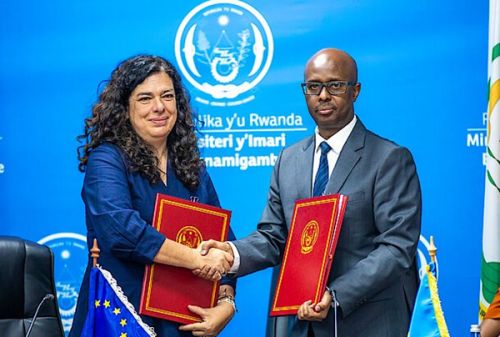
The European Union has committed €40 million (about US$46.2 million) to support Rwanda’s agricultural transformation over five years, with €36 million being provided as direct budget support and a further €4 million allocated to technical assistance, capacity building and policy studies. The financing agreement, signed in Kigali on August 4, will support climate-smart farming, irrigation expansion, sustainable land management, ecosystem restoration, agricultural value-chain development and improved climate information systems, reinforcing Rwanda’s government-led approach to agricultural reform at a time when climate volatility and productivity constraints continue to shape the country’s rural economy.
The programme, known as HANGARIBIHE: Transformational Climate-Smart and Inclusive Agriculture in Rwanda, places particular emphasis on using Rwanda’s national planning and public financial management systems rather than establishing a collection of stand-alone donor projects. That approach is significant because it gives the government greater responsibility for implementation while linking external financing directly to national agricultural and development priorities.
The EU financing comes as Rwanda seeks to make agriculture more productive, commercial and resilient to increasingly unpredictable weather conditions. Agriculture remains a major source of employment and livelihoods, particularly in rural areas, while the sector continues to face structural constraints including limited arable land, dependence on rainfall, low productivity in some value chains and exposure to droughts and floods.
Rwanda’s Fifth Strategic Plan for Agriculture Transformation (PSTA 5), covering 2024 to 2029, places climate resilience and sustainable agri-food systems at the centre of the country’s agricultural policy. The strategy is aligned with the National Strategy for Transformation 2 (NST2) and seeks to improve food and nutrition security, modernise production, strengthen commercialisation and increase the competitiveness of agricultural enterprises. Rwanda’s Ministry of Agriculture says NST2 targets annual agricultural growth of more than 6 percent, an expansion of irrigated land from 74,375 hectares to 132,171 hectares, and an increase in annual milk production to more than 1.3 million tonnes by 2028/29.
The new EU programme is therefore positioned within an existing national policy architecture rather than operating separately from it. Its focus on irrigation is particularly important because greater access to reliable water can reduce farmers’ exposure to rainfall variability while enabling multiple production cycles and improving yields. Rwanda has already been expanding irrigation and watershed investments, including through financing from the International Fund for Agricultural Development, which approved more than US$78 million in 2026 for irrigation and integrated watershed management.
Climate resilience is increasingly becoming an economic necessity for African agriculture rather than simply an environmental objective. For smallholder farmers, a failed season can translate directly into lower household income, higher food prices and increased demand for public support. Investments in irrigation, land management, climate information and resilient production systems can therefore reduce some of the fiscal and economic pressures associated with climate-related agricultural shocks.
The programme will also target agricultural value chains and expand opportunities for smallholders, cooperatives, women, young people and agribusinesses. That emphasis reflects the increasingly important distinction between raising farm output and building commercially viable food systems. Higher yields alone do not necessarily translate into higher incomes if farmers remain disconnected from markets, storage, processing, finance and reliable buyers.
Rwanda has been seeking to address those constraints through a more integrated agricultural transformation strategy. The Ministry of Agriculture’s current policy framework identifies modern production, agribusiness development, post-harvest management, commercialisation and competitiveness as key elements of the transformation process. Recent government data indicates that Rwanda has reached nearly 83 percent food self-sufficiency, while agricultural export revenues are targeted to increase substantially by 2028/29.
For the European Union, the financing also represents a continuation of a long-standing partnership with Rwanda in agriculture, rural development and climate resilience. An EU evaluation found that the bloc committed €725 million through 10 budget-support operations in Rwanda between 2011 and 2018, including programmes covering agriculture, nutrition, energy and public financial management.
The EU has previously used budget support to align external financing with Rwanda’s national systems. A subsequent agricultural cooperation programme included €52 million in sector budget support, alongside €17 million for complementary assistance, with funding linked to farmer incomes, agricultural services, climate-smart practices, agroforestry and landscape restoration.

The latest agreement therefore represents a continuation of a financing model that has played a significant role in Rwanda’s development partnership with Europe. Under budget support, funds are transferred through government systems against agreed policy reforms, performance indicators and monitoring arrangements. The model can strengthen national institutions and reduce duplication, but it also places greater importance on the quality of public financial management, transparency, monitoring and measurable results.
That consideration is particularly relevant as development finance becomes more constrained globally. Rwanda’s Finance Minister Yusuf Murangwa has highlighted the challenge of shrinking concessional finance and rising borrowing costs, while stressing the need to use public resources strategically to support resilience and structural transformation.
The country’s 2026/27 national budget also places agricultural productivity, irrigation and resilience among its key priorities. The government has allocated resources towards agricultural inputs, irrigation and infrastructure while seeking to maintain macroeconomic stability. This alignment between national spending priorities and external financing increases the potential for the EU programme to reinforce rather than duplicate domestic investment.
For Africa more broadly, Rwanda’s experience offers a case study in how development finance can be channelled through national systems while remaining tied to measurable sector reforms. The approach can potentially strengthen government ownership and institutional capacity, although its effectiveness ultimately depends on implementation quality, monitoring and the ability to convert financing into improvements that farmers can see in productivity, incomes and resilience.
The EU’s involvement also forms part of the broader Team Europe Initiative on Investing in Sustainable and Inclusive Agricultural Transformation, reflecting a shift in European development cooperation towards combining public finance, technical assistance and investment around nationally defined development priorities.
For Rwanda, the immediate challenge will be converting the €40 million commitment into functioning irrigation infrastructure, stronger agricultural services, improved climate information and commercially viable value chains. The longer-term significance will depend less on the size of the financing than on whether it helps farmers move from climate-vulnerable production towards more productive and market-oriented agriculture.
As African governments confront rising food demand, climate shocks and tighter development finance conditions, Rwanda’s use of budget support illustrates the growing importance of aligning external capital with domestic planning, public institutions and measurable economic outcomes. In that context, the HANGARIBIHE programme is not simply an agricultural financing agreement; it is part of a broader effort to use development finance to strengthen the institutions and productive systems on which long-term food security and climate resilience depend.


