


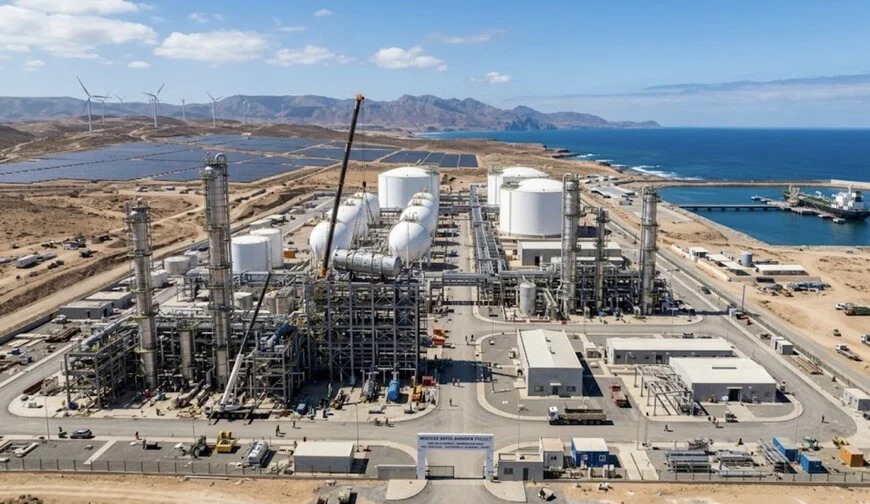
Morocco has taken another step towards developing a large-scale green ammonia industry after ORNX Green Hydrogen selected U.S. engineering group KBR and a consortium of technology companies to conduct preliminary engineering studies for a planned 560,000-tonne-a-year facility in Laâyoune, bringing one of the country’s flagship southern green hydrogen projects closer to a potential investment decision. The study, supported by a grant from the U.S. Trade and Development Agency (USTDA), will examine the plant’s power supply, electrolyser configuration, equipment requirements and commercial economics before the project can progress to front-end engineering design and ultimately a final investment decision.
The development is significant because Morocco’s green hydrogen programme is moving from broad investment announcements towards project-level engineering, where technical assumptions, financing requirements and commercial viability begin to determine whether proposed facilities can reach construction. In March 2025, Morocco selected five national and international investors to develop six green hydrogen projects across its three southern regions, with announced investment of 319 billion dirhams. ORNX, comprising U.S.-based Ortus, Spain’s Acciona and Germany’s Nordex, was selected to develop an ammonia project.
For ORNX, the latest agreement marks the beginning of a more detailed technical assessment. KBR will lead a consortium that includes GE Vernova, Electric Hydrogen and Terabase. According to USTDA, the pre-FEED work will evaluate electricity supply options, determine the optimal sizing and configuration of industrial equipment and produce financial projections and business models. Electric Hydrogen’s electrolyser technology will also be assessed as part of the study. The proposed facility is expected to produce up to 560,000 tonnes of ammonia annually.

KBR will provide its ammonia production technology alongside its engineering role. The company’s Sustainable Technology Solutions division identifies ammonia and hydrogen among its energy-transition capabilities, including green ammonia technology and integration with renewable power and hydrogen production. Jay Ibrahim, KBR’s President of Sustainable Technology Solutions, remains responsible for the division as the project advances through the early engineering phase.
The USTDA involvement is also important because development agencies are increasingly using technical assistance to reduce uncertainty before large private investments are committed. The agency signed the grant agreement with ORNX Laayoune 1 SASU in July, describing the study as support for a large-scale ammonia plant in Morocco’s southern provinces using U.S. technology. Thomas R. Hardy, USTDA’s Deputy Director and Chief Operating Officer, said the agency’s assistance would place U.S. technology and expertise at the centre of the project’s development.
For Morocco, the project forms part of a much larger attempt to establish a competitive green hydrogen industry around the country’s renewable-energy resources. The government’s March 2025 selection process covered six projects with a combined estimated investment of 319 billion dirhams across Laâyoune-Sakia El Hamra, Dakhla-Oued Eddahab and Guelmim-Oued Noun. Government documents subsequently confirmed progress towards preliminary land reservation agreements for the selected investors.
The location in Laâyoune gives the project strategic relevance beyond hydrogen production itself. Green ammonia can serve as a hydrogen carrier and industrial feedstock, with established applications in fertiliser production and potential future uses in maritime fuel and other energy-intensive sectors. This gives Morocco an opportunity to develop an export-oriented industrial value chain rather than limiting its renewable-energy ambitions to electricity generation.
That opportunity, however, depends on economics. Producing green ammonia at scale requires substantial quantities of renewable electricity, electrolysers, water-treatment infrastructure, ammonia synthesis equipment, transmission or dedicated power infrastructure and logistics facilities. The pre-FEED stage is intended to establish whether these components can be configured at a cost that makes the proposed facility commercially viable.
The 900 MW electrolyser requirement reported for the project illustrates the scale of the infrastructure challenge. Integrating such a system with renewable electricity will require careful assessment of power availability, intermittency, grid connections and potentially dedicated renewable generation. These considerations will have direct implications for the project’s capital requirements and the competitiveness of its eventual ammonia output.
The development also has wider implications for Africa’s energy-transition ambitions. Across the continent, countries with strong solar and wind resources are seeking to move beyond exporting raw energy resources towards producing green hydrogen derivatives, including ammonia, methanol and green fuels. Morocco’s approach is notable because it combines renewable-energy development with industrial policy, land allocation, international technology partnerships and efforts to attract large-scale private capital.
For African economies, the distinction between an announced project and a bankable project is critical. Large green hydrogen announcements can generate significant headline investment figures, but conversion into operating industrial assets depends on successful feasibility studies, affordable electricity, reliable infrastructure, long-term offtake arrangements, financing and appropriate regulation. ORNX’s progression into pre-FEED therefore provides a more concrete measure of implementation than the headline value of Morocco’s wider hydrogen pipeline.
It also demonstrates the growing role of international development institutions in reducing early-stage project risk. By funding technical studies before major capital commitments, institutions such as USTDA can help developers establish clearer information on costs, technology choices and commercial structures. If the resulting projects reach financial close, such interventions can potentially help convert development-stage opportunities into investable infrastructure.
For Morocco, the stakes extend into industrial competitiveness, employment and regional development. The government’s selection of major hydrogen projects in the southern provinces is intended to create new economic activity around renewable energy and industrial production. The ORNX project could therefore become part of a broader industrial ecosystem involving renewable generation, electrolyser supply, ammonia production, engineering services, logistics and potentially downstream manufacturing.
The next stages will be decisive. ORNX must move from pre-FEED to more detailed FEED studies and eventually demonstrate that the project can secure the investment, infrastructure and commercial arrangements required for construction. The USTDA-backed study is consequently less a confirmation of a final project than a mechanism for determining whether the proposed facility can withstand technical and financial scrutiny.
Morocco’s broader green hydrogen strategy is already attracting substantial international interest, but its long-term significance for Africa will depend on how effectively announced investments translate into productive assets, local capabilities and competitive industrial value chains. The ORNX project in Laâyoune now enters a phase in which those ambitions will increasingly be tested against engineering requirements, financing conditions and the economics of global green ammonia markets.


