


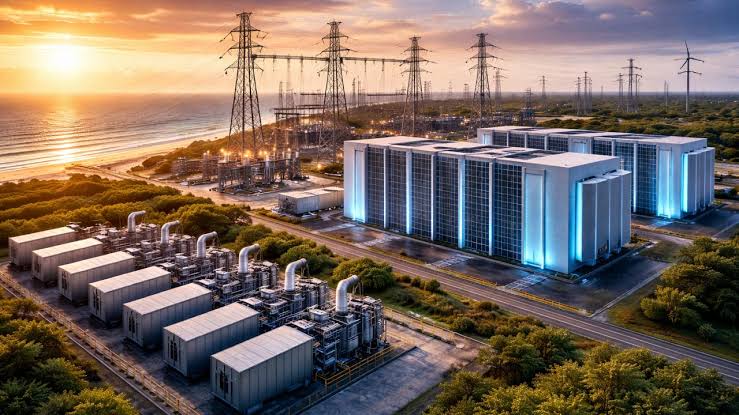
Greek multinational Amaco Energy Group is seeking approval for a proposed $1.5 billion artificial intelligence data centre in Mombasa that would generate its own electricity from an offshore liquefied natural gas (LNG)-powered platform, a model designed to allow the facility to operate independently of Kenya’s national grid. If the proposal advances beyond the exploratory stage, it would test a new approach to financing and powering hyperscale computing in Africa, while raising questions about energy security, emissions, infrastructure integration and how much economic value large AI investments can create locally.
Amaco Chief Executive Officer Theodore Theodoropoulos has been in Nairobi holding discussions with Kenyan government officials as the company explores the project. The proposal remains subject to approvals and further commercial and technical development, and the company has yet to publicly establish the facility’s final computing capacity, construction schedule, site footprint or land requirements. Those outstanding details mean the proposed $1.5 billion investment should be viewed as a project under consideration rather than committed capital.
At the centre of the proposal is Amaco’s HERCULES platform, an offshore smart-power concept that integrates electricity generation, cooling and AI data-centre infrastructure into a single installation. Amaco describes the system as an independent offshore solution capable of supporting hyperscale and AI facilities without relying on national grid infrastructure. Its stated objective is to address the growing electricity requirements of AI computing while providing dedicated power and cooling directly to the data centre.
The proposition addresses one of the most difficult constraints facing the expansion of AI infrastructure: electricity. Large AI facilities require substantial and highly reliable power because computing workloads depend on continuous operation and sophisticated cooling systems. Unlike conventional office or enterprise data centres, hyperscale AI facilities can concentrate very high electricity demand in a single location, creating challenges for grids that must simultaneously supply households, industry, transport and other commercial users.
Kenya’s experience with recent data-centre proposals demonstrates the significance of that constraint. Microsoft and Abu Dhabi-based artificial intelligence company G42 announced a $1 billion digital ecosystem initiative for Kenya in 2024, including a planned data-centre campus at Olkaria designed to operate on geothermal energy. The initiative was intended to support a new Microsoft Azure East Africa Cloud Region as well as local AI research, skills development and connectivity.
The project subsequently encountered difficulties around its power requirements and commercial structure. Reuters reported in May 2026 that the Microsoft-G42 data-centre project had faced delays over payment terms, including discussions around a minimum annual capacity payment requested by the companies. Kenya’s Information Ministry said the project had not been cancelled and that further structuring was required because of the proposed scale and power needs.

Those developments underline why Amaco’s proposed off-grid model is significant. Rather than requiring Kenya Power and the national transmission system to provide all of the electricity required by the facility, the HERCULES concept seeks to make the data centre substantially self-sufficient in energy. Amaco says its platform is designed around LNG-based generation, with compatibility with renewable energy and a future transition towards hydrogen. The company’s project portfolio targets offshore smart-power systems capable of supporting AI data-centre architecture, with a stated longer-term ambition for up to 4 GW of smart-power capacity by 2030.
For Kenya, however, LNG introduces a separate strategic question. The country has built much of its electricity system around renewable generation, particularly geothermal, hydro and wind. According to the International Energy Agency, Kenya has one of the highest shares of renewable electricity generation in Africa, with geothermal playing a particularly important role in baseload power. An LNG-powered AI facility would therefore create a different energy pathway from the geothermal model proposed for the Microsoft-G42 project.
The distinction matters because data-centre investors increasingly face two requirements at the same time: reliable electricity and credible environmental performance. AI companies need power that is available around the clock, while governments and investors are under growing pressure to reduce the emissions intensity of digital infrastructure. Amaco’s model attempts to resolve the first issue through dedicated generation. The second will depend on the project’s final fuel mix, efficiency, methane management, emissions controls and any future integration of renewable or hydrogen-based energy. At this stage, those details have not been established sufficiently to determine the project’s eventual emissions profile.
The proposed facility also highlights the changing economics of AI infrastructure in Africa. Kenya has spent years positioning itself as an East African technology hub, supported by mobile-money innovation, growing broadband connectivity, data-centre investment and relatively strong renewable-energy resources. The next stage of that digital economy is likely to require significantly more computing infrastructure.
Airtel Africa’s Nxtra is already constructing a 44 MW data centre at Tatu City, near Nairobi, designed for cloud computing and AI workloads. Kenya’s Ministry of Information, Communications and the Digital Economy described the facility as East Africa’s largest data centre when construction began in September 2025, with completion originally targeted for the first quarter of 2027. The timeline has since moved. Recent reporting indicates that the facility is now targeting July 2027, with the $150 million campus expected to deliver its 44 MW capacity in two phases. The project is being developed with high-density, GPU-ready infrastructure and multiple fibre routes to support demanding cloud and AI applications.
iXAfrica is also expanding Kenya’s hyperscale capacity. Its Nairobi campus includes an 18 MW IT-load facility and a planned site with more than 53 MW of future IT load, demonstrating the scale of investment being considered as African demand for cloud, enterprise computing and AI services expands.
Amaco’s proposal is therefore entering an increasingly competitive market rather than an empty field. Its key difference is geography and energy architecture. Tatu City provides access to established terrestrial infrastructure, while Mombasa offers a different strategic advantage: international connectivity. The coastal city is a major landing point and connectivity hub for submarine fibre systems linking East Africa with international markets. That makes Mombasa relevant to data-centre developers seeking low-latency connections between African users and global cloud, content and AI platforms. For AI workloads, connectivity is as important as electricity. Training and inference operations can involve large volumes of data moving between computing facilities, cloud platforms and customers. A facility located close to major international fibre routes can therefore reduce some of the network constraints associated with serving regional and international clients.
The combination of offshore power generation and coastal connectivity is consequently central to the commercial logic of the Amaco proposal. But the model also raises questions about integration with Kenya’s wider economy. An independently powered offshore facility could reduce direct pressure on the national electricity grid. That may be attractive if Kenya wants to attract large computing investments without diverting scarce power capacity from households and productive industries. Yet the economic benefits of a self-contained installation will depend on how much of its value chain is connected to the Kenyan economy. A project can have a large headline investment while generating comparatively limited domestic activity if most equipment, specialised services, financing and technical expertise are imported.
This makes local employment, skills transfer, procurement, tax revenues, infrastructure development and domestic technology partnerships important considerations for policymakers assessing the proposal. The question is particularly relevant because data centres are capital-intensive but not necessarily large employers relative to the size of their investment. Their wider economic contribution often comes through the businesses and digital services that depend on them rather than direct employment alone. For Kenya, the strategic value of an AI data centre could therefore extend to cloud services, fintech, telecommunications, government digital services, research, software development and AI startups. If sufficient computing capacity becomes available locally, businesses may face fewer barriers to accessing advanced computing resources.
That could support the country’s ambition to become a regional digital-services hub. However, infrastructure alone does not guarantee such an outcome. Affordable connectivity, data protection, cybersecurity, skilled workers, access to capital and a sufficiently large customer base are also necessary for a sustainable digital ecosystem.
Energy economics remain the most immediate issue. Amaco’s own description of HERCULES identifies the growing electricity requirements of AI infrastructure as a central problem, arguing that expanding data centres can strain existing grids and create delays in power infrastructure upgrades. Its proposed solution is to provide independent power generation directly alongside the data centre. That approach reflects an international trend in which large technology companies and data-centre developers are increasingly considering dedicated energy supplies. The model can provide greater control over reliability and reduce dependence on grid expansion, but it also transfers significant energy, financing and operational responsibilities to the project developer.
For Kenya, that could reduce some of the infrastructure burden associated with a hyperscale facility. It would not, however, eliminate the need for regulation. An offshore LNG-powered platform would require scrutiny covering maritime operations, environmental impacts, fuel supply, emissions, safety, cooling systems, grid-interconnection arrangements and potentially the use of coastal infrastructure.
There is also a public-policy question around whether surplus electricity could eventually benefit the wider economy. Amaco has indicated that its proposed system could potentially generate excess electricity that could be supplied to Kenya’s grid. That possibility should not yet be treated as additional national generation capacity because the project remains under discussion and the technical and commercial arrangements for such exports have not been established. If structured effectively, however, the ability to operate independently while potentially supplying surplus electricity could create a more flexible relationship between the data centre and the national power system.
The bigger issue is whether LNG represents a transitional solution or a long-term power model. Kenya’s climate and energy policies have increasingly emphasised renewable energy, and the country’s electricity generation has benefited from geothermal, wind and hydro resources. An LNG-powered data centre could provide reliable power, but its compatibility with Kenya’s long-term decarbonisation trajectory would depend on how the project manages emissions and whether it can incorporate cleaner energy sources over time. Amaco’s HERCULES concept is explicitly presented as future-ready, with the company’s materials describing LNG as an initial energy source and hydrogen as a potential future fuel. Whether that transition can be achieved at commercial scale will depend on technology, fuel availability and cost.
The debate also reflects a wider African challenge. Many countries want to capture the economic benefits of AI but face electricity systems that were not designed for large concentrations of high-density computing. The result could be a new class of infrastructure in which data-centre companies increasingly finance their own electricity generation, storage and cooling systems. For countries with constrained grids, that may accelerate investment. But it could also create two parallel energy systems: one highly reliable and privately financed for major digital infrastructure, and another serving the wider economy with more limited capacity.
That distinction makes regulatory design important. African governments will need to balance the interests of technology investors with broader energy-access and industrial-development priorities. Large private projects should not necessarily be expected to solve national infrastructure deficits, but their investment structures can influence how scarce energy, land, water and connectivity resources are allocated. Mombasa’s location introduces another consideration: water and marine ecosystems. Data centres require cooling, while offshore installations interact directly with coastal environments. The environmental assessment of such a project would therefore need to consider not only greenhouse-gas emissions but also marine ecosystems, thermal discharge, fuel handling, construction impacts and coastal resilience.
These considerations are particularly important for Mombasa, where the blue economy supports fisheries, tourism, shipping and other livelihoods. The project could nonetheless create an opportunity to demonstrate how digital infrastructure can be developed alongside coastal economic planning. That would require transparent environmental assessment and clear rules governing the interaction between the offshore installation and existing maritime activities. For Kenya’s public finances, the proposed $1.5 billion investment could provide a potentially significant source of private capital if it reaches financial close. But the government will need to distinguish between announced investment, proposed investment and capital actually committed. The project’s current status means its ultimate financing structure, tax contribution and construction impact cannot yet be assessed with certainty.
The experience of the Microsoft-G42 initiative offers a useful comparison. That project demonstrated both Kenya’s attractiveness to major technology companies and the difficulty of matching hyperscale computing ambitions with electricity infrastructure and commercial requirements. Amaco is effectively proposing a different answer to the same problem: instead of adapting the data centre to the grid, build the energy system around the data centre.
Whether that approach is commercially viable at $1.5 billion remains to be demonstrated. For investors, the key questions will include the cost and security of LNG supply, offshore construction costs, data-centre utilisation, customer commitments, financing terms, connectivity, cooling efficiency and the long-term competitiveness of the facility against land-based centres powered by Kenya’s renewable electricity. For the Kenyan government, the assessment will extend beyond those commercial factors. It will need to consider whether the project strengthens the country’s digital economy, contributes to local skills and infrastructure, fits within energy and climate policy, and provides sufficient economic benefits relative to its environmental and infrastructure footprint.
For Africa more broadly, the proposed Mombasa project reflects an emerging contest over the physical foundations of the AI economy. Countries are competing not only for cloud companies and AI developers but also for the electricity, fibre, land, water and specialised infrastructure needed to host them. Kenya has several advantages in that competition, including its established technology sector, international connectivity and substantial renewable-energy resources. But the growing scale of AI computing means that electricity availability and reliability could become increasingly decisive in determining which African markets attract the next generation of data-centre investment.
Amaco’s proposal places that challenge in unusually clear terms. Its offshore HERCULES model seeks to combine computing and energy infrastructure into a single system, potentially allowing a major AI facility to operate without drawing its full power requirement from Kenya’s national grid. The concept remains at the proposal stage, and the final test will be whether it can secure approvals, financing, customers and technical viability while meeting Kenya’s environmental and development requirements.
But the discussion itself is significant. As Africa seeks to participate in the global AI economy, the continent’s ability to attract data centres may increasingly depend not only on fibre connectivity or digital talent, but on the availability of large quantities of reliable, affordable and environmentally credible electricity.
For Kenya, the proposed Mombasa facility therefore represents more than another technology investment. It is a test of whether Africa can build the energy and digital infrastructure required for AI at scale without allowing the computing boom to deepen existing pressure on electricity systems, coastal resources and public infrastructure.


