


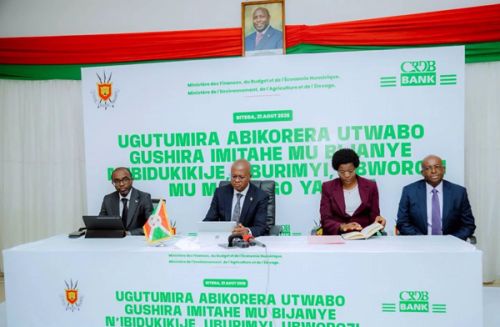
Burundi has launched a BIF 300 billion ($100.5 million) credit facility through CRDB Bank Burundi to finance agriculture, livestock, agro-processing and other productive investments, giving businesses access to loans at an annual interest rate of 5% as the government seeks to address one of the country’s persistent constraints to economic transformation: limited affordable financing for productive sectors.
The facility, announced by the government on Aug. 21, is intended to support purchases of agricultural machinery, livestock equipment and other productive assets. It forms part of a broader effort to raise agricultural output, strengthen domestic processing, reduce food imports and create employment. The facility is among the more significant recent attempts to connect commercial banking with Burundi’s agricultural transformation agenda.
The timing is significant because agriculture remains central to Burundi’s economy while productivity and access to capital remain constrained. The sector accounts for about 39.6% of GDP, 84% of employment and around 95% of the country’s food supply, according to the figures cited in the government’s announcement. That makes the availability and cost of agricultural finance an issue extending beyond individual farmers to food prices, industrial activity, imports, employment and foreign-exchange earnings.
Under the facility, eligible investors will be able to seek financing through CRDB Bank Burundi, while access to state-owned land for productive projects will be administered separately by the Ministry of Environment, Agriculture and Livestock. The government has stressed that land allocation and credit applications are separate processes, placing the bank at the centre of the financing component.

The 5% lending rate is particularly important in a country where inflation, foreign-exchange shortages and high financing costs have complicated private investment. The African Development Bank’s 2026 Burundi Country Focus Report says the economy grew by an estimated 4.6% in 2025, after 4.1% in 2024, but continued to face fuel shortages, foreign-exchange scarcity and inflationary pressures. The bank projects real GDP growth of 4.3% in 2026 and 4.6% in 2027, with agriculture, mining, electricity, construction, investment and consumption expected to support expansion.
The financing initiative therefore sits at the intersection of two needs: increasing the supply of capital to productive businesses while encouraging a shift away from consumption-led economic activity towards investment that generates additional output. For agriculture, that means financing more than seasonal inputs. Machinery, irrigation equipment, livestock facilities, storage systems, milling equipment and other processing assets require capital that can remain productive over several years. A relatively affordable loan can make those investments more viable, although the ultimate impact will depend on eligibility criteria, repayment structures, collateral requirements and the ability of borrowers to generate sufficient cash flow.
The distinction between agricultural production and agricultural value addition is particularly important. Burundi’s Vision 2040-2060 identifies agriculture as a major source of wealth creation and calls for stronger links between agriculture and industry across the value chain. The national strategy specifically highlights investment in mechanisation and labour productivity while seeking to connect agricultural production with industrial processing.
That approach could allow the new credit facility to support a wider economic ecosystem. A farmer purchasing machinery creates demand for equipment suppliers and repair services. A dairy or meat processor creates demand for livestock producers, packaging, transport and cold-chain services. A grain-processing plant can create markets for farmers while generating demand for storage, logistics and financial services. The government has already been using other instruments to increase agricultural production, including improved seed distribution and fertiliser subsidies. President Évariste Ndayishimiye said in August that agriculture and related sectors are central to the country’s Vision 2040-2060 and called for greater efficiency in the distribution of subsidised fertiliser and stronger support for producers. He also called for increased production of meat and milk and greater development of poultry, pig and rabbit farming.
The financing programme could complement these measures by addressing a different constraint. Subsidised inputs can help farmers produce more in a particular season, but access to machinery, irrigation, storage and processing equipment can determine whether productivity gains are sustained over time. The African Development Bank has similarly identified agricultural value chains as a strategic priority in Burundi. Its current country strategy places agricultural value-chain development and economic and financial governance at the centre of its first strategic priority, alongside energy and transport infrastructure under a second pillar.
The bank’s recent work in Burundi illustrates the scale of the country’s agricultural financing challenge. An African Development Bank-supported emergency agricultural production project distributed 812 tonnes of hybrid maize seed, 734 tonnes of certified rice seed and 1,660 tonnes of fertiliser to more than 72,500 farming households, including 48,000 women. The project subsequently supported production of more than 116,000 tonnes of maize and 63,000 tonnes of rice. Those interventions address immediate production constraints. The new BIF 300 billion facility, by contrast, is aimed more directly at investment capital. Its significance will therefore depend on whether it can help businesses move from small-scale or subsistence production towards commercially viable operations.
This is also where the banking system becomes important. The African Development Bank says Burundi’s banks account for about 80% of the country’s financial sector, while only 19.7% of the population had a bank account or microfinance account in 2024. The bank argues that strengthening financial inclusion and expanding the country’s financial system will be important to mobilising development finance at scale.
CRDB Bank Burundi already has a significant role within that financial system. Its leadership is headed by Managing Director Fredrick Siwale, while the bank’s management structure includes dedicated directors for corporate banking, credit, retail banking, treasury and risk and compliance. The bank has also said its strategy includes strengthening SME and MSME portfolios and expanding green finance.
The facility consequently provides a test of whether commercial banks can become more deeply involved in financing Burundi’s productive economy. Agriculture can be difficult to finance because revenues are exposed to weather, commodity prices, infrastructure constraints and market volatility. Livestock and processing projects face different risks, including disease, input costs, electricity reliability and access to markets. A BIF 300 billion lending envelope does not by itself remove those risks. Banks will still need to assess borrowers and projects, while investors will need predictable markets and adequate infrastructure. The quality of project preparation and financial management could determine how much of the facility ultimately reaches viable productive enterprises.
There is also a macroeconomic consideration. Burundi has a narrow fiscal space and continues to face foreign-exchange constraints. The African Development Bank says the country’s 2025 tax burden was 13.6%, while the informal economy accounted for approximately 40% of GDP. It also notes that the financial system remains insufficiently developed to support the country’s long-term development ambitions.
This makes private-sector mobilisation particularly important. The government cannot finance the entire agricultural transformation through public spending. Commercial lending, development finance, guarantees, insurance and private investment will all be required if businesses are to invest in larger production and processing capacity. The country’s Vision 2040-2060 reflects this requirement. The strategy aims to build a competitive economy increasingly driven by agro-food and industrial value addition and identifies agricultural development as a wealth-creation and food-security objective. It sets a target of increasing the share of the national budget allocated to agriculture from 9.4% in 2022 to 10% by 2040 and 2060.
The government is also trying to align its medium-term budgeting with that broader vision. In April, the Ministry of Finance presented the 2026-2029 Medium-Term Budgetary and Economic Programming Document, which is intended to guide resource allocation and maintain consistency between public spending and the country’s development priorities.
The financing facility could therefore become part of a broader policy architecture in which public resources support the enabling environment while banks provide capital to businesses capable of expanding production. For rural communities, the effects could be significant if financing reaches enterprises that create stable markets for farmers. Agricultural transformation is rarely achieved through farm-level interventions alone. Processing plants, storage facilities, transport companies, input suppliers and financial institutions are needed to connect production with consumers.
Coffee offers one example of the importance of this value-chain approach. Burundi is a major coffee-producing country relative to the size of its economy, and coffee remains an important source of export earnings. The government and development partners have increasingly focused on improving agricultural value chains and export capacity, while recent discussions with the Multilateral Investment Guarantee Agency have included support for the coffee sector and rehabilitation of irrigation infrastructure in the Rusizi area.
Rice is another priority. President Ndayishimiye recently instructed the leadership of the Société Régionale de Développement de l’Imbo to pursue higher rice production, stronger farmer support, improved access to fertilisers and high-yielding seed varieties, with the longer-term objective of developing rice as both a food-security crop and an export-oriented value chain.
These examples illustrate why agricultural credit should be viewed in terms of productive systems rather than individual loans. The economic return from financing a machine, irrigation system or processing facility depends on whether farmers can supply it, whether electricity and roads are available, whether buyers exist and whether the resulting products can reach markets competitively.
Climate risks add another layer. Burundi’s agricultural economy remains highly exposed to rainfall variability, soil degradation and other environmental pressures. Investments in irrigation, improved seeds, soil conservation, water management and climate-resilient production could therefore help protect the productivity of assets financed through commercial credit.
The African Development Bank has identified climate change, youth inclusion, gender equality and private-sector development as cross-cutting priorities within its Burundi strategy. The challenge for the new credit facility will be to ensure that financing supports not only immediate increases in output but also investments capable of remaining productive under changing climatic and market conditions.
For the banking sector, the programme also provides an opportunity to build a stronger track record in agricultural lending. If borrowers demonstrate reliable repayment and productive investments generate predictable cash flows, banks may become more comfortable financing agriculture without relying exclusively on state-backed programmes.
That would matter beyond the BIF 300 billion facility. A successful lending cycle could help establish a stronger commercial market for agricultural finance, attracting additional lenders and potentially development-finance institutions. Conversely, weak project selection or repayment problems could reinforce banks’ concerns about agricultural risk.
Burundi’s economic transformation will therefore depend on what happens after the credit is approved. The critical measure will be whether capital is converted into machinery, livestock, irrigation, storage and processing capacity that raises productivity and generates sufficient revenues to repay loans.
The BIF 300 billion facility is significant because it places affordable credit at the centre of that transition. But the larger challenge remains structural: connecting finance with land, technology, infrastructure, markets and reliable agricultural production. For Burundi, where agriculture remains the country’s largest source of employment and food supply, improving that connection could have implications well beyond the balance sheets of farmers and banks. It could influence food-import demand, rural employment, industrial development, export earnings and the country’s capacity to diversify its economy.
The 5% facility is therefore best understood not simply as a government lending programme, but as an attempt to address the financing gap standing between Burundi’s agricultural potential and a more productive commercial economy. Whether that potential is realised will depend on the quality of investments financed, the strength of agricultural value chains and the ability of the financial system to continue lending after the initial public intervention.


