


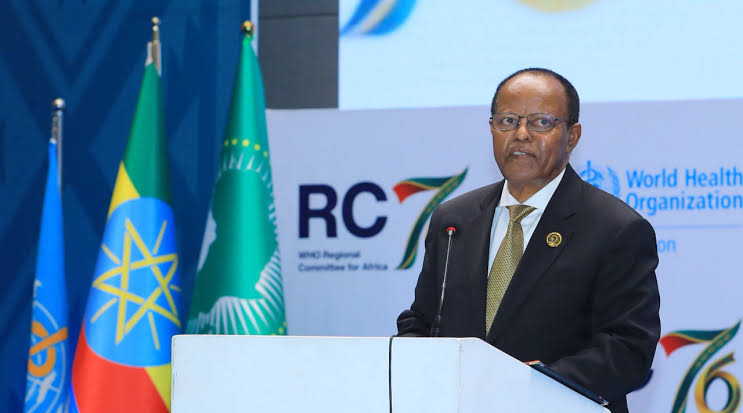
Ethiopia is increasingly framing climate resilience, public health and peacebuilding as interconnected components of national development, with President Taye Atske-Selassie using the 76th session of the World Health Organization Regional Committee for Africa in Addis Ababa to highlight investments in primary healthcare, environmental restoration and national dialogue as mechanisms for strengthening the country’s ability to withstand economic, environmental and social shocks.
Speaking on Aug. 25, President Taye said Ethiopia’s experience demonstrates the importance of treating health as a strategic investment rather than simply a social-sector expenditure. His remarks came as health ministers and senior officials from the WHO African Region gathered in Addis Ababa for the regional body’s annual policy meeting, which is addressing health-system financing, workforce development, medical-product regulation, emergency preparedness and universal health coverage.
The meeting has brought together representatives of all 47 WHO African Region member states, alongside development partners and global health institutions. The agenda itself reflects the financial and institutional pressures facing African health systems, with new regional strategies covering sustainable health financing, health workforce planning, medical-product regulation and emergency response. For Ethiopia, the government’s approach places primary healthcare at the centre of resilience. President Taye said continued public investment has expanded access to essential services and strengthened the country’s health workforce, linking improvements in maternal, newborn and child health with sustained investment in frontline services.
That emphasis is significant as African governments confront tighter development budgets and changing patterns of international health financing. WHO Director-General Tedros Adhanom Ghebreyesus, addressing the same regional meeting, said the African region had experienced some of the deepest cuts in international health financing in a generation. He called for greater domestic financing and stronger health sovereignty, noting that families across Africa still pay a significant share of health expenditure directly from their own resources.
The WHO’s regional agenda for 2026-2035 reflects the same shift. Its proposed Strategy for Financing the Future of Health in Africa seeks to move countries towards more sustainable domestic financing, while the Africa Health Workforce Agenda focuses on long-term planning, training and distribution of health workers. A separate regional strategy addresses regulation of medical products, creating a policy framework for stronger pharmaceutical and health-product systems.
Ethiopia’s environmental programme provides the second major element of its resilience strategy. The Green Legacy Initiative, launched in 2019, has developed into one of the government’s most prominent environmental programmes, combining reforestation, watershed restoration and climate-resilience objectives. On Aug. 3, Ethiopia conducted a nationwide campaign targeting 800 million seedlings in a single day. The government subsequently reported that 805.3 million seedlings had been planted, while more than 26 million people participated. Official figures put cumulative planting under the Green Legacy Initiative at more than 48 billion seedlings over seven years. The country’s 2026 campaign has a broader target of eight billion seedlings.
The environmental significance of the programme extends beyond the number of seedlings planted. Ethiopia’s highlands are important sources of water for the country’s river systems, making watershed degradation relevant to agriculture, hydropower, water security and downstream communities. President Taye has previously linked the initiative to restoration of catchments, improved water retention and agricultural livelihoods. The economic value of such interventions depends, however, on what happens after planting. Long-term environmental benefits require appropriate species selection, land management, protection from grazing and fire, and adequate survival rates. For governments seeking to translate large-scale restoration into measurable climate adaptation, monitoring the survival and ecological impact of planted trees is therefore as important as the headline number of seedlings planted.
The health implications are equally material. Climate change can influence the geographical distribution of infectious diseases, increase heat exposure, affect water availability and intensify risks to food security. Environmental degradation can also increase pressure on agricultural livelihoods and water systems, indirectly affecting nutrition and household health. That creates a direct policy connection between environmental restoration and public health. A functioning watershed can support water supplies and agricultural production; resilient agricultural systems can strengthen household food security; and stronger health systems can improve the ability of communities to respond when climate-related shocks occur.
Ethiopia’s approach also extends into urban development. Addis Ababa has invested in urban greening and environmental restoration as part of efforts to improve the city’s physical environment. The economic relevance of these measures includes air quality, urban heat, drainage, public spaces and the overall resilience of rapidly growing cities. The third pillar identified by President Taye is peacebuilding. He linked political stability to the ability of governments to maintain health services, protect infrastructure and sustain long-term development investments. Conflict can divert public expenditure towards emergency needs, disrupt healthcare delivery and displace populations, while environmental shocks can intensify existing social and economic pressures.
Ethiopia’s National Dialogue was presented as an institutional mechanism for addressing some of those pressures. The process involved more than 4,000 delegates and sought to create a platform for dialogue across political and social groups. Its development implications extend beyond politics because institutional stability affects the government’s ability to plan and implement long-term investments in infrastructure, health, environmental management and human capital. The connection between peace and development is particularly relevant for Africa, where conflict and climate vulnerability frequently overlap. The World Health Organization has noted that emergencies, displacement and fragile health systems can reinforce one another, making health-system resilience increasingly important to national security and economic stability.
The Addis Ababa meeting also brought the question of African ownership into sharper focus. President Taye called for stronger African leadership of health priorities, including increased domestic investment and greater local production of medicines, vaccines and diagnostic products. This position is consistent with a broader continental policy shift. In February 2026, African leaders adopted a declaration supporting local manufacturing of health products as a priority for health security and sovereignty. The declaration calls for stronger African pooled procurement, sustainable financing for manufacturers, skills development and technology transfer. For African economies, local health manufacturing has implications beyond emergency preparedness. Developing pharmaceutical and diagnostic industries can generate skilled employment, create demand for research and technical services, improve supply-chain resilience and retain a greater share of health-related expenditure within African markets.
The COVID-19 pandemic exposed the risks associated with excessive dependence on imported medical products. Supply disruptions, export restrictions and competition for vaccines and medical equipment demonstrated that health security is also a trade, industrial-policy and economic-resilience issue. The WHO’s current regional agenda reflects this changing understanding. Its strategy on medical-product regulation is designed to strengthen regulatory systems across the continent, while the health-financing strategy addresses the fiscal foundations required to sustain national health systems. Ethiopia’s preparations to host COP32 in Addis Ababa in November 2027 provide another link between these issues. The UN Framework Convention on Climate Change has formally accepted Ethiopia’s offer to host the 32nd Conference of the Parties from Nov. 8 to 19, 2027.
The conference could provide Ethiopia and other African governments with a platform to place adaptation, health and resilience more prominently within international climate-finance discussions. Africa remains highly exposed to climate-related risks, while many governments face constrained fiscal space for infrastructure and social-sector investment. For health systems, adaptation finance can support climate-resilient hospitals and clinics, disease surveillance, emergency preparedness, water infrastructure and heat-response measures. For rural communities, it can support water management, agricultural resilience and livelihood diversification. The financing question will remain central. Climate adaptation projects often generate broad social and economic benefits that are difficult to capture through conventional commercial returns. This can make concessional finance, public investment and development partnerships important in mobilising capital.
At the same time, Ethiopia’s emphasis on domestic ownership reflects a broader concern across Africa that external financing should complement rather than substitute for national institutions. The WHO’s current regional agenda similarly places greater emphasis on sustainable domestic financing and health sovereignty. The economic implications are substantial. Healthier populations are more able to participate in education and employment, while functioning health systems reduce the economic disruption caused by disease outbreaks. Environmental restoration can protect agricultural productivity and water resources, while political stability creates more predictable conditions for investment and public-service delivery.
The challenge is turning these interconnected policies into measurable outcomes. Tree-planting programmes need credible survival and restoration data. Health spending needs to translate into accessible and quality services, particularly for rural and underserved populations. Local manufacturing requires commercially viable markets, regulatory capacity and reliable financing. Peacebuilding requires institutions capable of sustaining dialogue beyond individual political processes.

The experience of Ethiopia illustrates why resilience increasingly has to be considered across government rather than within individual ministries. Climate policy affects health and agriculture. Health-system strength affects economic productivity. Peace and institutional stability affect the government’s ability to maintain both. That cross-sector approach is becoming increasingly relevant across Africa as countries face simultaneous pressures from climate change, constrained public finances, health emergencies and political instability. The policy challenge is not simply to spend more, but to ensure that investments in different sectors reinforce one another.
The 76th WHO Regional Committee meeting provides a continental setting for that discussion. With health ministers from 47 countries considering new frameworks for financing, workforce development, medical-product regulation and emergency preparedness, the outcome could influence how African governments structure health resilience over the next decade. For Ethiopia, the combination of health investment, environmental restoration and peacebuilding represents an attempt to connect national resilience with long-term development. Whether that model delivers sustained results will depend on implementation, financing, institutional capacity and the ability to measure outcomes beyond individual programmes.
The broader lesson for Africa is economic as much as environmental or social: resilience is becoming an infrastructure and governance issue. Countries that can protect their health systems, natural resources and institutions from shocks are better positioned to preserve economic activity and sustain development investment when external conditions deteriorate.


