


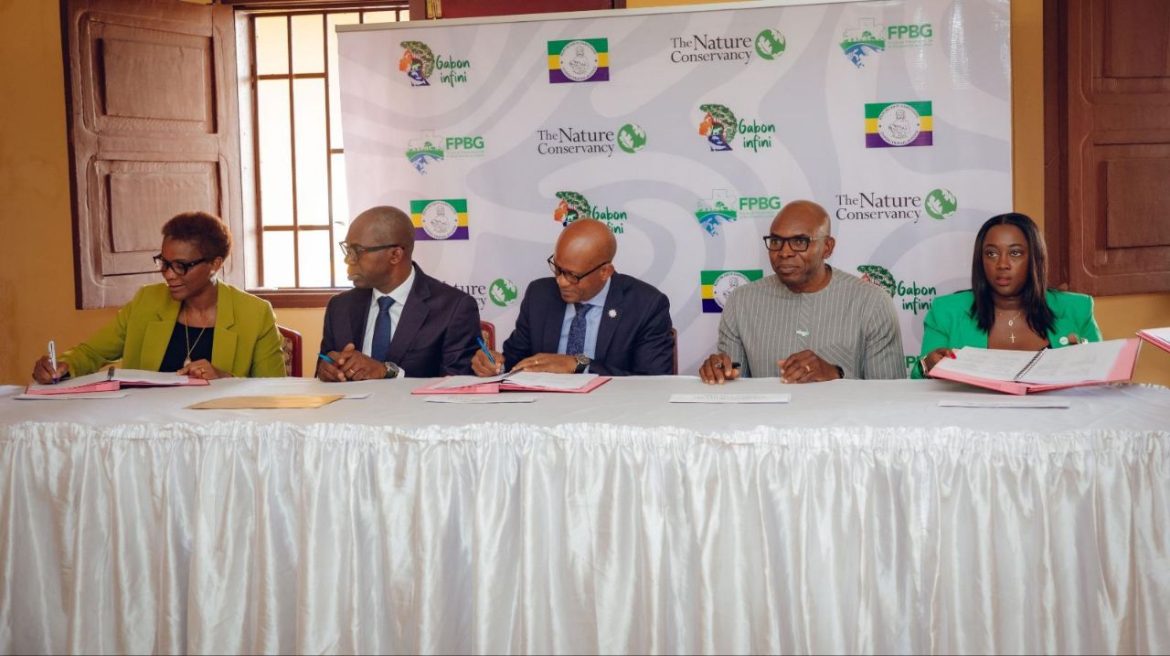
Gabon has formally launched Gabon Infini, a long-term Project Finance for Permanence (PFP) initiative designed to mobilise up to $200 million over the next decade for biodiversity conservation, protected-area management and community development, as the Central African country seeks to make the protection of its forests, freshwater and marine ecosystems part of a broader economic strategy. Developed by the Government of Gabon in partnership with The Nature Conservancy (TNC), Enduring Earth and other conservation and financing partners, the programme is intended to expand protected areas, improve management of existing conservation landscapes and channel investment into sustainable economic activities for communities living around them.
The initiative represents a shift in the way conservation is being financed in Gabon, moving beyond short-term project funding towards a structure designed to provide longer-term financial support and link funding to conservation and development outcomes. The model is particularly relevant for Gabon because its natural ecosystems are both a global biodiversity asset and an important component of the country’s economic and social resilience. Gabon Infini is built around a national Community Development and Conservation Plan that proposes the creation of an additional 3.7 million hectares of protected areas while strengthening the management of about 3.8 million hectares already under protection. The programme supports Gabon’s commitment to protect 30% of its terrestrial, freshwater and marine ecosystems by 2030.
The financing structure is intended to combine international conservation funding with domestic resources. The Nature Conservancy says the programme is expected to include $94 million in donor financing from organisations including the Global Environment Facility, the Bezos Earth Fund and other private donors, alongside up to $86 million in new funding from the Gabonese government. The structure is also intended to establish longer-term financial mechanisms that can continue supporting conservation and community benefits beyond the initial 10-year PFP period.
That design is significant because one of the persistent challenges in conservation finance is the gap between the scale of ecosystems requiring protection and the availability of predictable long-term funding. Protected areas require recurring expenditure on management, monitoring, enforcement, infrastructure and community engagement. Short-term grants can finance individual interventions but do not necessarily provide the financial certainty required to maintain conservation systems over decades.
The PFP model attempts to address that problem by bringing multiple sources of funding into a single long-term framework. In Gabon’s case, the mechanism builds on the country’s earlier experience with conservation finance, including the 2023 Nature Bonds transaction facilitated by TNC. That transaction generated approximately $163 million for ocean conservation, demonstrating how financial instruments can be used to connect debt management with environmental objectives.
Gabon Infini is intended to take the approach further by linking biodiversity protection with community development. The programme is expected to finance activities including sustainable forestry, ecotourism, community enterprises, measures to reduce human-wildlife conflict and initiatives that help communities respond to climate-related pressures such as coastal erosion and flooding. This community dimension is important because conservation outcomes in rural areas depend partly on whether communities living alongside protected landscapes have viable economic alternatives and a meaningful role in managing natural resources. Restrictions on access to forests, fisheries or agricultural land can create economic tensions if they are not accompanied by alternative livelihood opportunities or effective benefit-sharing arrangements.
Gabon’s government has therefore placed community livelihoods at the centre of the programme. Vice-President of the Government Herman Immongault has linked Gabon Infini to the country’s 2026-2030 National Growth and Development Plan, arguing that biodiversity should become a strategic component of economic development rather than being treated only as an environmental concern. The economic implications extend beyond rural communities. Gabon’s forests, rivers, wetlands and marine ecosystems provide services that influence agriculture, water systems, fisheries, tourism and climate resilience. Maintaining those ecosystems can therefore reduce economic risks associated with environmental degradation while supporting sectors that depend directly or indirectly on natural capital.
The country’s biodiversity also gives the programme an international dimension. Gabon’s tropical forests form part of the Congo Basin, one of the world’s most important forest ecosystems and a major carbon sink. The country is home to significant populations of forest elephants, western lowland gorillas, chimpanzees and other species. TNC says Gabon contains more than half of the world’s remaining forest elephants and about one-quarter of surviving lowland gorillas.
Those ecosystems are nevertheless under pressure from several directions. Climate change is altering rainfall patterns and increasing exposure to flooding, coastal erosion and other environmental risks, while demand for minerals, timber, agricultural products and other natural resources creates competing pressures on land and ecosystems. For Gabon, the policy challenge is therefore not simply to increase the area under protection but to improve the effectiveness of conservation while allowing communities and the wider economy to generate income from natural resources in ways that do not undermine ecological systems.
This is where the programme’s proposed economic activities become important. Ecotourism, sustainable forestry and community enterprises can potentially create revenue streams connected to biodiversity rather than dependent on its degradation. The success of those activities, however, will depend on infrastructure, market access, skills, governance and the ability of communities to capture a meaningful share of the value generated. The Fonds de Préservation de la Biodiversité au Gabon (FPBG) is expected to play a central role in this financing architecture. The independent conservation trust fund will channel resources towards conservation and sustainable development projects and is intended to provide a mechanism for translating financial commitments into measurable activities on the ground. The FPBG has described the programme as a mechanism for reconciling ecosystem protection with socio-economic development.
The institutional architecture will be particularly important because large conservation-finance programmes involve multiple stakeholders, including government ministries, communities, international donors, conservation organisations and private-sector actors. Clear responsibilities for allocating funds, measuring outcomes and reporting results will be necessary if Gabon Infini is to maintain confidence among both domestic and international financiers. The programme also comes as Gabon works to strengthen the economic value of its forest sector. Recent government discussions around Gabon Infini have included efforts to improve the competitiveness of forest products and implement recommendations from the programme’s steering committee. This suggests that conservation and sustainable resource use are increasingly being considered together within national economic planning.
The approach has wider implications for Africa. Many African countries possess significant biodiversity assets but face fiscal constraints that limit their ability to finance conservation from domestic budgets alone. At the same time, communities living around protected areas often depend on natural resources for their livelihoods and remain exposed to climate shocks. Gabon’s experience illustrates one possible response: combining public resources, philanthropic capital, conservation finance and sustainable economic activity within a longer-term framework. Similar models could become increasingly relevant as African governments seek to attract international capital for nature protection while retaining greater national ownership of development priorities.
There are nevertheless risks. Conservation finance does not automatically translate into effective protection. Funds must reach projects with measurable outcomes, protected areas need capable management institutions, and local communities need to see tangible economic benefits. The programme will also need to demonstrate that sustainable forestry, ecotourism and community enterprises can generate durable revenues rather than remain dependent on external grants. The structure of Gabon Infini attempts to address part of this challenge by establishing mechanisms intended to generate financial returns and sustain conservation investments beyond the initial PFP period. The Nature Conservancy says these include a conservation endowment fund, sustainable-finance mechanisms, an ecotourism expansion programme and a community enterprise investment fund.
The programme therefore places biodiversity finance within a wider development question: how can African countries convert natural capital into long-term economic value without exhausting the ecosystems on which that value depends? For Gabon, the answer will depend on implementation. Expanding protected areas is only one measure of conservation success. The more consequential test will be whether new and existing protected landscapes are effectively managed, whether communities receive sustainable economic opportunities, and whether financing remains available after the initial commitments have been deployed.
Gabon Infini’s significance ultimately lies in that connection between conservation and economic development. Its $200 million framework is designed not simply to finance protected areas, but to establish a longer-term financial architecture around biodiversity, community livelihoods and sustainable economic activity. If implemented effectively, it could provide Gabon with a mechanism for treating nature as part of its economic infrastructure while strengthening the resilience of communities exposed to climate and environmental pressures.
For the wider African conservation-finance market, the programme also highlights an increasingly important shift: biodiversity protection is becoming less of a stand-alone environmental expenditure and more of a question of investment, risk management and economic planning. As governments face growing pressure to protect ecosystems while creating jobs and raising rural incomes, the ability to align conservation finance with development outcomes will become increasingly important.


