


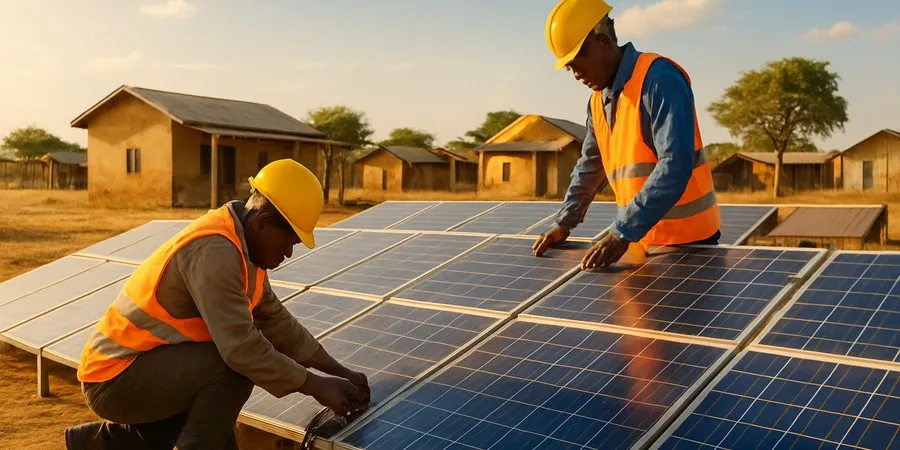
Africa50 has secured US$71 million in commitments for a new Distributed Renewable Energy Fund aimed at financing smaller clean-energy businesses and projects across Africa, as investors and development institutions seek to address the continent’s electricity access gap without relying solely on large national grids. Backed by the International Solar Alliance, Nigeria Sovereign Investment Authority and the World Bank Group, the fund is targeting a final size of US$200 million and will provide equity to companies operating in commercial and industrial solar, mini-grids, standalone solar, clean cooking and electric mobility.
The commitment comes as distributed renewable energy becomes increasingly important to Africa’s efforts to expand electricity access, particularly in markets where grid infrastructure is costly, slow to develop or unable to reach remote communities and smaller commercial users. According to the International Energy Agency, achieving universal electricity access in Sub-Saharan Africa by 2035 would require about US$15 billion in annual investment, including roughly US$5 billion a year for mini-grids and US$3 billion for solar home systems. The scale of that requirement places distributed energy alongside conventional generation and transmission as a significant infrastructure investment category.
 For African small and medium-sized enterprises, the financing issue is closely connected to the cost and reliability of electricity. Businesses that cannot depend on the national grid often turn to diesel generators, battery systems or other backup arrangements, increasing operating costs and making energy expenditure less predictable. For manufacturers, retailers, agricultural processors and service businesses, unreliable electricity can also affect production schedules, cold storage, digital services and the ability to expand operations.
The Africa50 fund is therefore targeting a part of the energy market where the infrastructure requirement is often smaller in physical scale but more fragmented financially. Mini-grids, rooftop solar systems and standalone power solutions can serve individual businesses, industrial clusters or communities without waiting for major transmission and distribution projects to be completed. The challenge for investors has been to aggregate these smaller opportunities into portfolios large enough to justify institutional capital while managing country, currency, regulatory and commercial risks.
According to Africa50, the Distributed Renewable Energy Fund will invest in companies rather than simply financing individual power assets, giving it exposure to businesses developing and operating distributed-energy solutions across multiple markets. The approach could help address one of the structural weaknesses in Africa’s energy transition: the gap between the scale at which clean-energy technologies can be deployed and the scale at which institutional investors typically allocate capital.
The fund also fits into a broader shift in the architecture of African infrastructure finance, in which development institutions are increasingly trying to use public and concessional capital to attract larger pools of private investment. Africa50’s wider investment platform includes the Alliance for Green Infrastructure in Africa Project Development Fund, while the broader Mission 300 initiative led by the African Development Bank and World Bank is seeking to connect 300 million Africans to electricity by 2030. More than 50 million people had been connected under Mission 300 across 40 countries by June 2026, according to the African Development Bank and World Bank.
Read also: https://furtherafrica.com/2026/09/09/africa50-renewable-energy-fund-raises-71m-for-smes/
The distinction between grid expansion and distributed power is becoming less clear as governments consider how to meet electricity-access targets at the lowest feasible cost. National grids remain essential for industrialisation and urban growth, but extending them to every remote settlement can require significant capital and long development periods. Distributed renewable systems can provide an alternative or complementary route, particularly where demand is dispersed or where existing infrastructure is weak.
For governments, this financing model also carries implications beyond electricity access. Reliable power can influence the productivity of small businesses, the viability of rural enterprises and the operating costs of public facilities. In agriculture, decentralised electricity can support irrigation, refrigeration, milling and processing, allowing more economic activity to take place closer to production areas. In urban markets, commercial solar and battery systems can reduce dependence on diesel generation for businesses exposed to grid interruptions.
The economic implications are particularly significant because electricity reliability is closely tied to the ability of African businesses to invest and scale. Energy costs are often passed through supply chains, affecting the price of manufactured goods, food processing and services. Where businesses rely heavily on diesel, changes in fuel prices and currency movements can quickly translate into higher operating expenses. Distributed renewable energy can reduce some of that exposure, although its financial viability still depends on equipment costs, financing terms, customer creditworthiness, tariffs, regulation and the availability of appropriate payment models.
The US$71 million first commitment is consequently small relative to Africa’s overall electricity investment requirement, but its significance lies in the type of capital being directed toward the sector. Equity financing can help distributed-energy companies strengthen balance sheets, develop project pipelines and attract additional debt or institutional investment. If the fund reaches its US$200 million target, its effectiveness will depend less on the headline size of the vehicle than on whether it can demonstrate commercially viable models that can be replicated across African markets.
There are, however, risks that investors and policymakers will need to manage. Distributed energy businesses operate across regulatory environments with different tariff structures, licensing requirements, currency conditions and levels of consumer purchasing power. Foreign-currency financing can create additional pressure where revenues are generated in depreciating local currencies. Smaller projects can also carry higher transaction costs relative to their size, making aggregation and standardisation important to achieving acceptable returns.
The experience of African energy funds suggests that capital alone will not resolve these constraints. Project preparation, predictable regulation, credible utilities, payment systems and appropriate local financing structures remain important to turning energy demand into bankable investment opportunities. Mission 300’s emphasis on national energy compacts and private-sector participation reflects the same challenge: governments need to create the policy and institutional conditions that allow private capital to move from commitments into operating infrastructure.
Africa50’s fund therefore arrives at a point when the continent’s energy transition is increasingly being shaped by the interaction between public infrastructure policy and private investment. The focus is no longer only on how much renewable generation Africa can build, but also on whether financing structures can reach the businesses and communities that remain underserved by existing electricity systems.
For African economies, that distinction matters. Closing the electricity gap will require large investments in transmission and generation, but it will also require capital capable of financing smaller, commercially viable systems that can operate alongside national grids. The success of Africa50’s Distributed Renewable Energy Fund will ultimately be measured by whether it can turn fragmented demand for reliable power into investable businesses and infrastructure, while helping reduce the financial and operational constraints that unreliable electricity places on African enterprises.


