


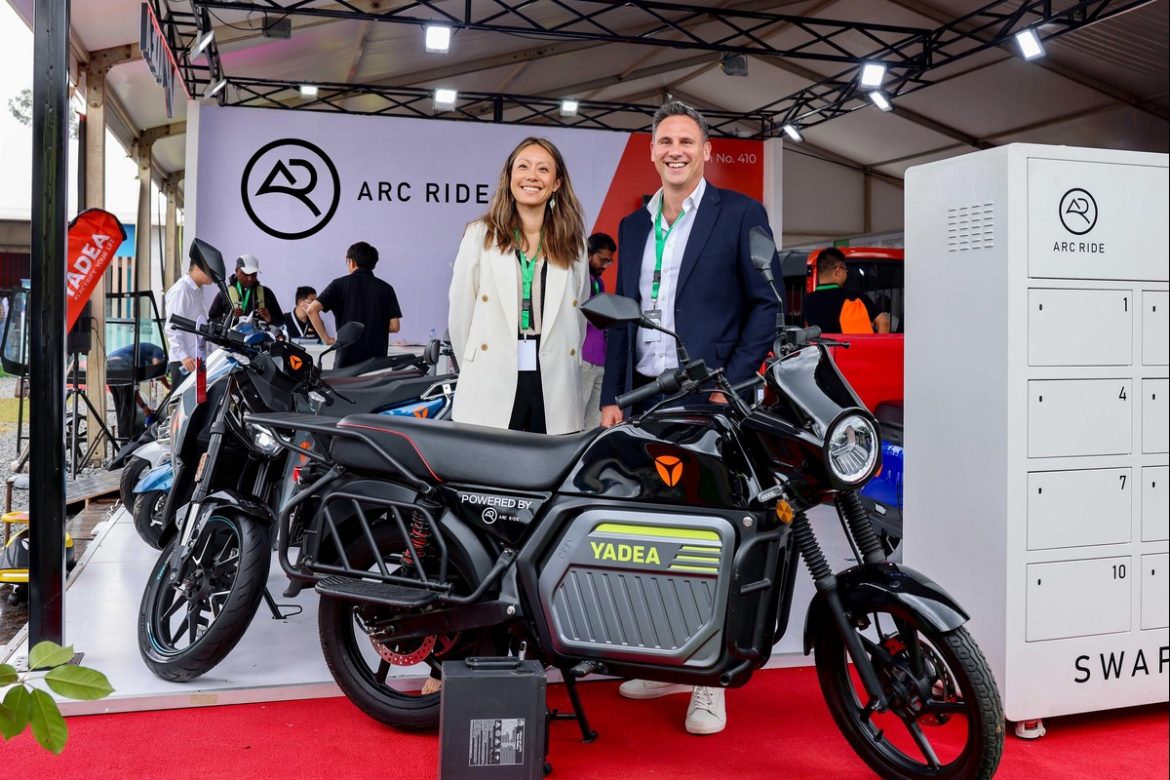
Kenyan electric mobility company ARC Ride has raised $33.3 million in a combined equity and debt financing round as it prepares to expand its battery-swapping network, deploy 5,000 additional electric motorcycles and enter four new African markets, strengthening a growing push to build the infrastructure needed to move two-wheeler transport away from petrol. The financing, led by Novastar Ventures and Norrsken22 with participation from the International Finance Corporation (IFC), British International Investment (BII) and Proparco, will support expansion in Kenya as well as planned operations in Ghana, South Africa, Tanzania and Uganda.
The financing comprises a $23 million Series A equity round and $10 million in debt, according to Proparco, with the debt component involving BII’s Kinetic programme and Mirova. Existing investors Musashi Seimitsu Industry and Talanton also participated, giving ARC Ride a combination of venture capital, development finance and debt at a stage when the company is moving from a predominantly Kenyan operation towards a wider sub-Saharan African platform.
The capital is directed at a bottleneck that has become increasingly important to Africa’s electric mobility transition: infrastructure. Electric motorcycles can reduce fuel consumption and operating costs, but their commercial viability depends on riders being able to access charged batteries quickly and reliably. ARC Ride’s Battery-as-a-Service model separates the battery from the vehicle purchase and allows riders to exchange depleted batteries at dedicated stations rather than waiting for conventional charging.

That distinction is particularly important for Africa’s motorcycle economy. Two-wheelers are not simply private vehicles in many African cities. They are income-generating assets used by commercial riders to transport passengers and goods, often operating for long hours each day. For these riders, several hours spent charging can translate directly into lost income. A battery-swapping system therefore addresses an operational problem as much as an environmental one.
ARC Ride’s model is designed around that constraint. The company develops and assembles electric two-wheelers while operating the battery infrastructure required to keep them moving. IFC’s assessment of the company says its principal operation is in Kenya and that its model combines IoT-enabled electric motorcycles with Battery-as-a-Service infrastructure and battery-swap facilities. IFC also identified network density, service capacity, regional expansion and technology development as central elements of the company’s growth plans.
The latest funding follows several years of investment in that infrastructure. Musashi Seimitsu, a Japanese automotive supplier, began working with ARC Ride in 2021 and supported a demonstration project in Nairobi involving electric motorcycles, batteries, swapping stations and digital services. The project recorded thousands of battery swaps per day, according to Musashi.
BII has also been an existing investor. In 2025, the development finance institution committed funding to support the deployment of 5,000 electric two-wheelers and expansion of battery-swapping infrastructure in East Africa. BII said its wider investment in ARC Ride is intended to make electric transport more affordable for boda boda riders while supporting lower-emission transport and economic opportunities for workers.
The new financing suggests that investors see battery infrastructure as a potentially scalable part of Africa’s electric mobility market rather than merely a supporting service for individual vehicle sales. Proparco said the latest round is expected to finance 5,000 electric motorcycles and charging infrastructure, while also supporting more than 300 direct jobs and nearly 2,900 indirect jobs over time.
The environmental implications are also material. Proparco estimates that the investment could avoid about 100,000 tonnes of carbon dioxide emissions annually as internal-combustion motorcycles are replaced with electric alternatives. BII has similarly framed ARC Ride’s expansion as part of efforts to reduce emissions and improve air quality in African cities.
But the significance for African economies extends beyond emissions. Motorcycles are among the most accessible forms of commercial transport in many African cities and peri-urban areas, particularly where formal public transport networks are limited. Fuel is therefore a major operating expense for riders. IFC’s assessment notes that fuel expenses can account for a significant share of daily income for traditional two-wheeler drivers and that electrification can provide economic advantages when the infrastructure and financing barriers are addressed.
That economic calculation is central to whether electric motorcycles can move beyond early adopters. A cleaner vehicle is unlikely to achieve mass adoption if its upfront cost, charging requirements or financing structure make it less attractive to a rider whose income depends on daily vehicle utilisation. Battery-as-a-Service attempts to change that equation by shifting battery ownership and infrastructure costs away from the rider. Instead of paying for the battery as part of the initial vehicle purchase, riders access the energy service through the swapping network. In principle, that can lower the upfront cost of an electric motorcycle while giving commercial riders access to a predictable energy supply.
The model also creates a different business structure for the mobility company. ARC Ride is not only selling vehicles; it is building a recurring-revenue infrastructure network around batteries, swapping and related digital services. Proparco described the model as being based on recurring revenues, while ARC Ride’s own platform positions its network as a core component of its electric mobility offering.
The challenge is that infrastructure expansion is capital intensive. A battery-swapping network requires cabinets, batteries, maintenance facilities, software, electricity supply and logistics. As the network expands across countries, companies must also deal with different electricity markets, regulatory regimes, vehicle standards and consumer financing systems. ARC Ride’s new funding is therefore significant partly because it combines different types of capital. Equity can support corporate expansion and technology development, while debt can finance assets such as batteries and infrastructure that generate revenues over time. Development finance institutions can also provide longer-term capital where commercial lenders may be reluctant to finance early-stage mobility infrastructure.
That financing structure reflects a broader pattern in Africa’s clean-energy transition, where the availability of technology is often less of a constraint than the cost and structure of capital required to deploy it at scale. Kenya provides an important test case. The country has become one of Africa’s leading markets for electric two-wheelers, supported by a large motorcycle-taxi sector, increasing investor interest and policy measures aimed at encouraging electric mobility. IFC has said ARC Ride’s expansion could contribute to the competitiveness of Kenya’s and East Africa’s electric vehicle ecosystem by deepening the battery and charging infrastructure available to riders.
ARC Ride’s existing network has also been expanding. The company has described a growing footprint of automated swapping stations in Nairobi, while a 2026 report from Business Daily documented riders using swapping infrastructure during the working day to avoid the long charging periods associated with conventional plug-in systems.
The next stage will test whether that model can travel across national borders. Ghana, South Africa, Tanzania and Uganda have different transport markets and regulatory environments. South Africa, for example, has a more developed automotive market but a different two-wheeler landscape from Kenya. Ghana has a rapidly growing urban transport sector, while Tanzania and Uganda have significant motorcycle-based commercial transport markets.
A standardised technology platform may help ARC Ride reduce some expansion costs, but infrastructure density will remain critical. A rider is unlikely to adopt an electric motorcycle if swapping stations are too far apart or if batteries are unavailable when needed. This creates a network-effect problem: infrastructure attracts riders, but sufficient riders are needed to justify further infrastructure investment. ARC Ride’s plan to develop automated battery swapping, smart charging and renewable-energy integration is aimed at improving that economics. The company has also identified battery lifecycle management as an area for investment, an increasingly important consideration as Africa’s electric vehicle fleets grow.
Battery management has implications beyond operational efficiency. Batteries represent a substantial portion of an electric vehicle’s value and require appropriate systems for monitoring, maintenance, reuse and eventual disposal or recycling. IFC’s environmental and social review of ARC Ride specifically examined hazardous waste handling, occupational health and safety, community safety and the company’s environmental and social management capacity as part of its assessment of future expansion.
That scrutiny illustrates how the sustainability credentials of electric mobility depend on the entire system rather than the vehicle alone. Replacing petrol motorcycles with electric ones can reduce tailpipe emissions, but the wider environmental outcome also depends on electricity sources, battery production, battery durability, end-of-life management and the infrastructure used to operate the fleet.
There is also an employment dimension. Africa’s transition to electric mobility will affect mechanics, fuel retailers, vehicle assemblers, battery technicians, software providers and transport workers. ARC Ride’s expansion could create new technical roles around battery maintenance, swapping infrastructure and fleet management, while reducing demand for some conventional maintenance and fuel-related services.
The company’s existing investor base reflects the increasingly diverse pool of capital seeking exposure to this transition. Novastar Ventures and Norrsken22 bring venture capital, while IFC, BII and Proparco bring development-finance capital. Musashi provides an industrial automotive connection, while Mirova brings climate-focused investment expertise.
For investors, the attraction is not necessarily limited to electric motorcycles themselves. The larger opportunity lies in the infrastructure layer that could support millions of electric two- and three-wheelers if adoption accelerates across African cities. For governments, that infrastructure could become part of broader efforts to reduce dependence on imported petroleum products and improve urban air quality. But the fiscal and infrastructure implications will need to be considered alongside the benefits.
Electric mobility increases demand for reliable electricity and requires investment in distribution networks and charging infrastructure, while policies around batteries, standards, taxation and vehicle registration will influence the pace of adoption. For riders, however, the most immediate calculation remains economic: how much it costs to acquire a motorcycle, how much it costs to keep it running and how much income can be earned each day.
That is why the success of ARC Ride’s expansion will depend on whether its battery-swapping model can translate environmental benefits into commercially attractive economics for African transport workers. The $33.3 million financing gives the company substantially more capital to test that proposition across multiple markets. Its plan to deploy 5,000 additional motorcycles, expand the swapping network and introduce more automation and renewable-energy integration represents a move from building a Kenyan model towards attempting a regional infrastructure platform.
The wider significance for Africa lies in that shift. Electric mobility will require more than importing electric vehicles. It will require financing structures, energy infrastructure, technical skills, battery-management systems and business models adapted to the way Africans move and earn. ARC Ride’s latest funding puts all of those elements into one investment case. Whether battery swapping becomes a dominant model for African two-wheelers will depend on adoption, infrastructure utilisation, financing costs and regulatory support. But the investment demonstrates that a growing group of global and African financiers is prepared to back the infrastructure required to make electric mobility commercially workable.
For Africa’s cities, the question is no longer simply whether electric motorcycles can replace petrol bikes. It is whether the financial and physical infrastructure can be built quickly enough, and at a cost riders can afford, to make that transition economically sustainable.


