


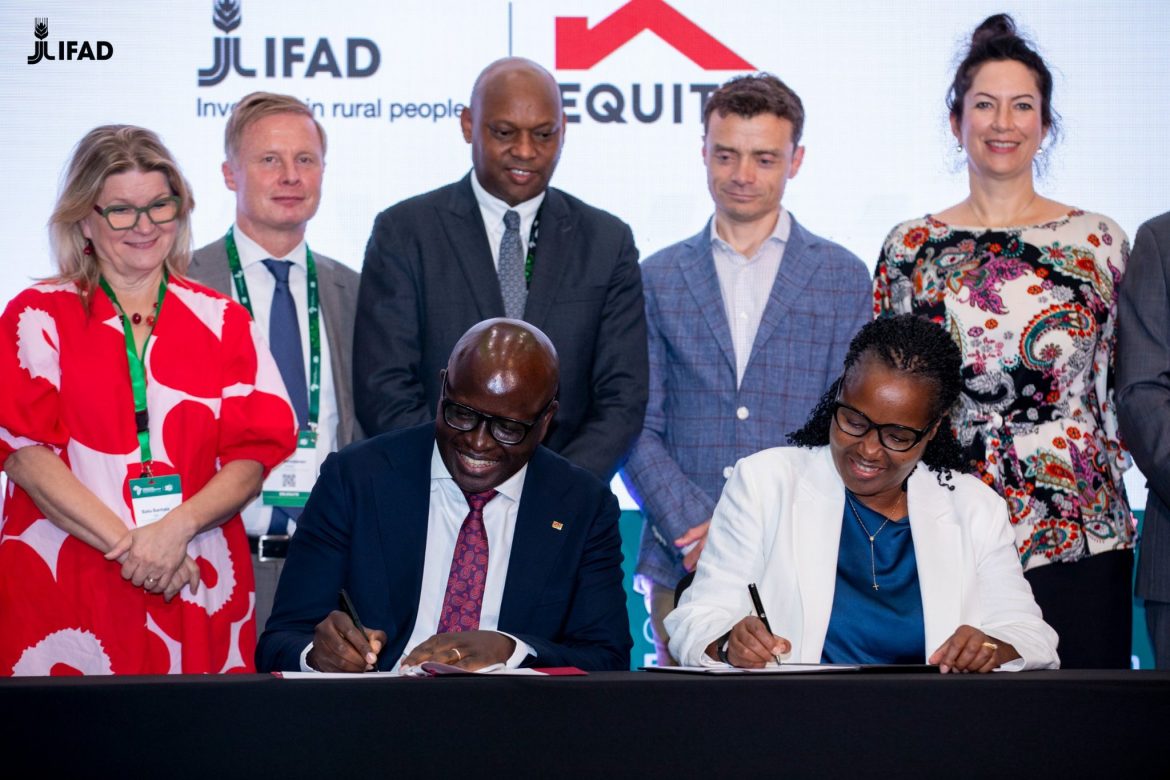
Equity Group and the International Fund for Agricultural Development (IFAD) have launched a $200 million financing mechanism to expand climate adaptation finance for smallholder farmers and rural businesses in Kenya, Uganda, Tanzania and Rwanda, in a move aimed at turning resilience investment into a more conventional lending market for African financial institutions. The 12-year Africa Rural Climate Adaptation Finance Mechanism (ARCAFIM), launched in Kigali during the Africa Food Systems Forum 2026, combines $180 million in lending capital with about $20 million in technical assistance and is expected to reach 260,000 smallholder producers and 500 rural enterprises.
The mechanism comes as climate-related shocks increasingly affect agricultural production, rural incomes and food security across East Africa, while climate finance remains difficult for small-scale producers to access. IFAD has previously estimated that small-scale producers receive only a small share of global climate finance despite being among the groups most exposed to climate impacts. Its analysis has also found that climate finance directed to small-scale agriculture has struggled to reach agricultural value-chain businesses and financial institutions that could expand access to farmers.
ARCAFIM is structured differently from a conventional development-finance programme. Equity Group will contribute $90 million from its own balance sheet to the lending pool, matching the $90 million provided through IFAD and its financing partners. The programme’s lending capital is expected to revolve through roughly four investment cycles, generating about $266 million in loans over its lifetime for farmers and rural micro, small and medium-sized enterprises.
That structure is important because the objective is not simply to inject concessional capital into agricultural lending. The partners are seeking to demonstrate that financing climate resilience can become a commercially sustainable banking activity. Gérardine Mukeshimana, IFAD’s vice president, said the mechanism is designed to translate international climate commitments into investments that reach rural communities. Equity Group Chief Executive James Mwangi has similarly positioned the initiative as an effort to build a market in which climate-resilience lending becomes part of ordinary banking rather than remaining dependent on philanthropic or concessional funding.
The distinction matters for East Africa’s agricultural economies. Farmers often know which investments could reduce their exposure to drought, floods, changing rainfall patterns and other climate risks, but access to capital can remain the limiting factor. Irrigation, water harvesting, resilient livestock systems, post-harvest storage, renewable energy and climate-resilient processing can require upfront investment that many small producers and rural enterprises cannot finance from their own cash flows.
Under ARCAFIM, the lending will support precisely those types of investments. In Kenya, Equity Bank will provide finance directly to agricultural producers and rural businesses while also working through microfinance institutions, savings and credit cooperative organisations and agricultural value-chain companies. The approach is intended to widen the channels through which climate adaptation capital reaches rural borrowers rather than relying solely on conventional bank branches.
The programme also has a deliberate inclusion target. At least 50% of intended beneficiaries are expected to be women and 30% youth. IFAD and Equity estimate that ARCAFIM could strengthen food security for about 1.2 million people and benefit around 1.5 million people directly and indirectly. Those targets are significant because access to agricultural finance is uneven across gender and age groups. Women and young people frequently operate smaller businesses or have less access to collateral and formal financial services, meaning that a climate finance facility can reproduce existing inequalities if lending criteria are not adapted to the realities of rural enterprises.
ARCAFIM’s technical assistance component is intended to address part of that problem. About $20 million will support training and expertise for participating financial institutions, farmers and rural businesses. The programme will also use a climate adaptation taxonomy to help lenders identify investments that qualify as viable adaptation activities and assess their potential climate and commercial value. This technical layer is important because agricultural lending and climate finance are not automatically the same thing. A farmer borrowing to purchase equipment may improve productivity without necessarily reducing climate vulnerability. Conversely, an investment in irrigation or water harvesting may deliver substantial resilience benefits but have a repayment profile that does not fit a conventional short-term agricultural loan.
The taxonomy and technical assistance are intended to help financial institutions bridge that gap by identifying investments where climate resilience and commercial returns can be assessed together. The programme’s risk-sharing architecture is another central feature. ARCAFIM uses concessional capital and credit protection to absorb part of the risk that can make agricultural lending unattractive to commercial banks. Equity, however, remains exposed to the performance of the portfolio rather than simply administering funds provided by development partners. IFAD describes this as a key distinction in the mechanism’s design.
That approach reflects a broader challenge in African climate finance. Development capital can help establish new markets, but the scale of Africa’s adaptation needs is far beyond what public and concessional resources can finance alone. The longer-term objective is therefore to use limited public capital to reduce risk sufficiently to bring commercial financial institutions into areas they might otherwise avoid. For Equity, the model also builds on an existing climate-finance strategy. The bank has previously expanded lending to agriculture and climate-related investments, while its climate-smart agriculture programmes have reached millions of farmers. Equity has also been recognised by the International Finance Corporation for climate-finance reporting.
ARCAFIM gives the group an opportunity to move from financing individual climate-related activities towards developing a dedicated adaptation lending market across several countries. The geographical design is also important. Kenya, Uganda, Tanzania and Rwanda have closely linked agricultural markets but different financial systems, policy environments and levels of infrastructure development. A financing model that can operate across the four markets would provide a useful test of whether climate adaptation lending can be standardised enough to scale while remaining responsive to local agricultural conditions.
The Green Climate Fund is providing $55 million to ARCAFIM, including $45 million in financing and a $10 million grant. Finland is contributing $30 million in returnable capital, while the Nordic Development Fund is providing $15 million. Denmark and the European Union are also supporting the programme through grants. The Green Climate Fund’s project documentation classifies ARCAFIM as a private-sector adaptation programme and estimates that the wider mechanism could increase resilience for about 1.4 million people. The project was approved by the GCF Board in October 2023, with its financing agreement executed in March 2026.
The financing comes against a persistent mismatch between climate vulnerability and climate capital. Smallholder farmers are among the groups most exposed to weather-related production risks, yet agricultural businesses often have limited collateral, volatile cash flows and insufficient financial records. For banks, these characteristics can increase the cost of assessing and managing agricultural loans. IFAD’s research has found that only a small proportion of tracked climate finance for small-scale producers has been directed to value-chain actors such as agricultural enterprises and SMEs, while even less has reached formal financial institutions. The finding points to a structural problem: financing farmers at scale requires not only capital for producers but also stronger financial intermediaries and agricultural businesses capable of absorbing and deploying that capital.
ARCAFIM attempts to address both sides of that market. A dairy processor, for example, may require financing to install renewable energy or improve cold storage, while the farmers supplying it may need loans for livestock improvements or water systems. Financing one without the other can leave weaknesses elsewhere in the value chain. By working through rural enterprises, value-chain companies and financial intermediaries, ARCAFIM has the potential to finance adaptation at multiple points in the agricultural economy.
For Kenya, the implications extend beyond individual farmers. Agriculture remains closely connected to employment, household incomes, food prices, exports and rural economic activity. Improving resilience at farm and enterprise level can therefore reduce some of the economic volatility associated with climate shocks. The same applies across Uganda, Tanzania and Rwanda, where agricultural production remains central to rural livelihoods and domestic food supply. However, the success of ARCAFIM will ultimately depend on how the financing is deployed. A $200 million facility is substantial, but it is small relative to the capital requirements of East Africa’s agricultural economy. Its significance will therefore depend on whether it changes lending behaviour within participating institutions and demonstrates that adaptation investments can generate sufficient financial returns to attract commercial capital.
That is why the revolving structure matters. If $180 million in lending capital can generate approximately $266 million in cumulative loans through multiple investment cycles, the programme would demonstrate a higher degree of capital efficiency than a facility that lends once and closes. The partners are also considering replication beyond East Africa. IFAD and Equity have identified Southern and West Africa as potential regions for future expansion, suggesting that ARCAFIM is being positioned as a model rather than a one-off regional facility. Such expansion would require adaptation to different agricultural systems, financial markets and climate risks. A financing structure suitable for Kenyan horticulture or Ugandan dairy production may not automatically translate to West African cereals or Southern African livestock systems. The programme’s technical-assistance component will therefore be as important as its lending capital if the model is to travel.

The timing is also relevant. The Africa Food Systems Forum 2026, where ARCAFIM was launched, focused on investing in African food systems, creating jobs and strengthening resilience. The forum brought together governments, investors, development institutions and agricultural stakeholders at a time when food-system financing is increasingly being discussed alongside climate adaptation and economic transformation. The broader question is whether climate adaptation can move from being treated as a development expenditure to being recognised as an investable economic activity. For a farmer, irrigation can mean a more reliable production cycle. For a dairy enterprise, resilient cooling can reduce losses. For an agro-processor, renewable energy can reduce exposure to unreliable power and fuel costs. For a bank, however, these investments still have to meet credit requirements and generate cash flows sufficient to service debt.
ARCAFIM is designed around that intersection. Its most consequential test will therefore not be the amount of money announced, but whether financial institutions continue lending for climate resilience after concessional capital becomes less central to the portfolio. If the mechanism can demonstrate that farmers and rural businesses can repay adaptation loans while lenders manage the associated risks, it could help establish a new category of agricultural finance across the region.
For East Africa, where climate shocks increasingly affect the reliability of food production and rural incomes, that would have implications beyond the banking sector. It could influence how farmers invest, how agricultural businesses manage risk and how governments and development institutions structure future climate-finance programmes.
The $200 million ARCAFIM mechanism is consequently less about filling a single financing gap than testing whether climate adaptation can become part of the mainstream financial system. Its success will be measured by whether capital reaches farmers before climate shocks become losses, whether rural enterprises can finance resilience alongside growth, and whether banks ultimately regard adaptation lending as a viable commercial business rather than a specialised development product.


