


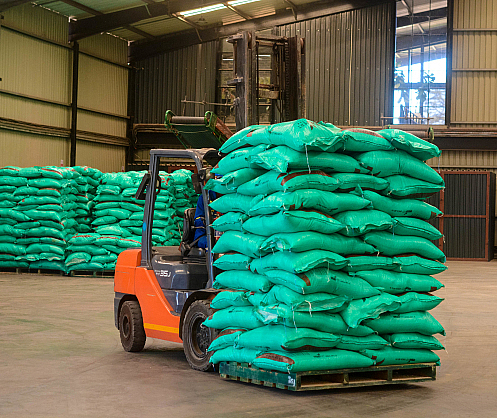
The African Development Bank Group has launched a response plan of up to US$5.1 billion to help African economies address pressures on energy security, fertiliser availability and agricultural production, linking the continent’s immediate economic vulnerabilities with a longer-term push to strengthen climate resilience and food systems. The initiative comes as higher energy and input costs continue to expose African countries to external price shocks, while unreliable electricity, dependence on imported fertiliser and climate-related disruptions constrain agricultural productivity and industrial development.
The plan reflects the increasingly close relationship between energy markets and food security across Africa. Fertiliser production and distribution depend heavily on energy, while agriculture itself requires reliable electricity for irrigation, processing, refrigeration and storage. When energy costs rise, the effect can move through agricultural supply chains, increasing the cost of fertiliser, transport and food production. For countries that rely substantially on imported energy and agricultural inputs, these pressures can also translate into higher inflation and greater pressure on foreign-exchange reserves.
 According to the African Development Bank, the new response is intended to support energy security, revive projects and address the economic effects of higher fertiliser costs. The approach places infrastructure and productive capacity alongside short-term economic support, reflecting the difficulty African governments face in managing immediate price pressures while still financing investments required to reduce their exposure to future shocks.
The fertiliser component is particularly significant because Africa remains heavily dependent on external supplies despite possessing substantial natural resources and considerable potential for domestic production. Fertiliser prices are affected not only by global agricultural demand but also by natural gas and electricity costs, shipping conditions and geopolitical disruptions. For smallholder farmers operating with limited financial margins, increases in input prices can result in lower application rates, reduced yields or a shift towards less input-intensive crops.
The consequences extend beyond individual farms. Agriculture remains a major source of employment and income across much of the continent, while food prices have a direct influence on household purchasing power and inflation. When farmers reduce fertiliser use because of higher prices, the effects can emerge later through lower production and tighter domestic food supplies. Governments may then face pressure to increase imports or introduce subsidies, placing additional demands on already constrained public finances.
Energy security has therefore become an agricultural policy issue as much as an infrastructure concern. Africa’s electricity deficit continues to constrain economic activity, with businesses and agricultural enterprises in many markets relying on diesel generation when grid supply is unreliable. The cost of this backup power can make irrigation, cold storage, food processing and other value-adding activities less competitive.
Read also: https://furtherafrica.com/2026/09/09/afdb-energy-fertiliser-plan-mobilises-51bn/
The challenge is particularly important as African countries seek to move beyond the export of unprocessed commodities. Processing agricultural products closer to where they are produced requires dependable electricity and transport infrastructure. Without those systems, farmers can remain exposed to losses from inadequate storage while countries continue exporting raw commodities and importing higher-value processed products.
Climate change adds another layer to the problem. Changes in rainfall patterns, rising temperatures, droughts and extreme weather events are already affecting agricultural planning in several African regions. The latest climate-finance data show that Sub-Saharan Africa received about US$55 billion in climate finance in 2024, of which US$11 billion went to adaptation. That adaptation financing represented a 15% decline from 2023, highlighting the difficulty of directing sufficient capital towards resilience even as climate-related risks become more material to African economies.
The financing gap also places greater importance on the balance sheets of development finance institutions. African governments have limited fiscal room to finance energy and agricultural infrastructure entirely through public budgets, particularly where debt-servicing costs remain high. The OECD estimates that Africa could mobilise substantially more infrastructure finance through improved sovereign debt conditions, stronger domestic revenue mobilisation and greater development-finance participation.
For the AfDB, the response plan therefore sits within a broader effort to use development finance to crowd in additional investment while directing capital towards sectors with economy-wide consequences. Energy infrastructure, fertiliser supply chains and climate-resilient agriculture are closely connected to industrialisation, trade and public finances, meaning investment in one area can affect the viability of the others.
The bank’s earlier African Emergency Food Production Facility provides an indication of the scale of intervention required. The facility, launched in response to food and fertiliser disruptions, supported agricultural production across 35 countries and was designed to help farmers access fertiliser and other inputs. Such programmes illustrate the role development banks increasingly play when international price shocks exceed the capacity of national budgets to respond without compromising longer-term investment.
The central challenge now is whether emergency-oriented financing can translate into structural changes in Africa’s food and energy systems. Short-term support can help governments and producers absorb price shocks, but reducing vulnerability requires investment in domestic fertiliser production, renewable energy, electricity grids, irrigation, storage, transport and agricultural processing.
That transition will also require stronger coordination between energy and agricultural policy. Expanding domestic fertiliser production, for example, can reduce exposure to international supply disruptions but may increase domestic demand for gas and electricity. Expanding irrigation can raise agricultural output while increasing electricity demand. Electrifying agricultural processing can reduce dependence on diesel but requires reliable distribution networks and affordable finance.
These trade-offs make the financing structure as important as the amount of money involved. Concessional finance can help lower the cost of capital for projects that have significant development benefits but may not immediately meet commercial investment thresholds. Guarantees and blended-finance structures can also help reduce perceived risks for private investors, particularly in markets where currency volatility, weak infrastructure and regulatory uncertainty increase financing costs.
For African consumers and businesses, the practical outcome of these investments will ultimately be measured through the cost and reliability of essential services. More dependable electricity can reduce the operating costs of food processors and manufacturers. Better fertiliser supply can improve farmers’ ability to maintain production when input prices rise. More resilient irrigation and storage systems can reduce exposure to rainfall variability and post-harvest losses.
The AfDB initiative consequently illustrates a wider shift in how sustainability and resilience are being treated within African economic policy. Climate resilience is increasingly tied to questions of energy affordability, food prices, industrial competitiveness and fiscal stability rather than being treated as a separate environmental agenda.
For governments, the immediate task is to manage external shocks without diverting scarce public resources away from productive investment. For development financiers, it is to structure capital that can support infrastructure and businesses beyond the life of emergency programmes. And for private investors, the emerging opportunity lies in infrastructure and agricultural systems where rising demand for reliable energy, inputs and climate resilience can support commercially viable investment.

Africa’s vulnerability to energy and fertiliser shocks is unlikely to be resolved by a single financing programme. But the AfDB’s response places the connection between energy security, agricultural productivity and climate resilience at the centre of the continent’s development-finance challenge. The longer-term test will be whether such capital can help African economies move from repeatedly absorbing external shocks to building the infrastructure, markets and institutions needed to withstand them.


