


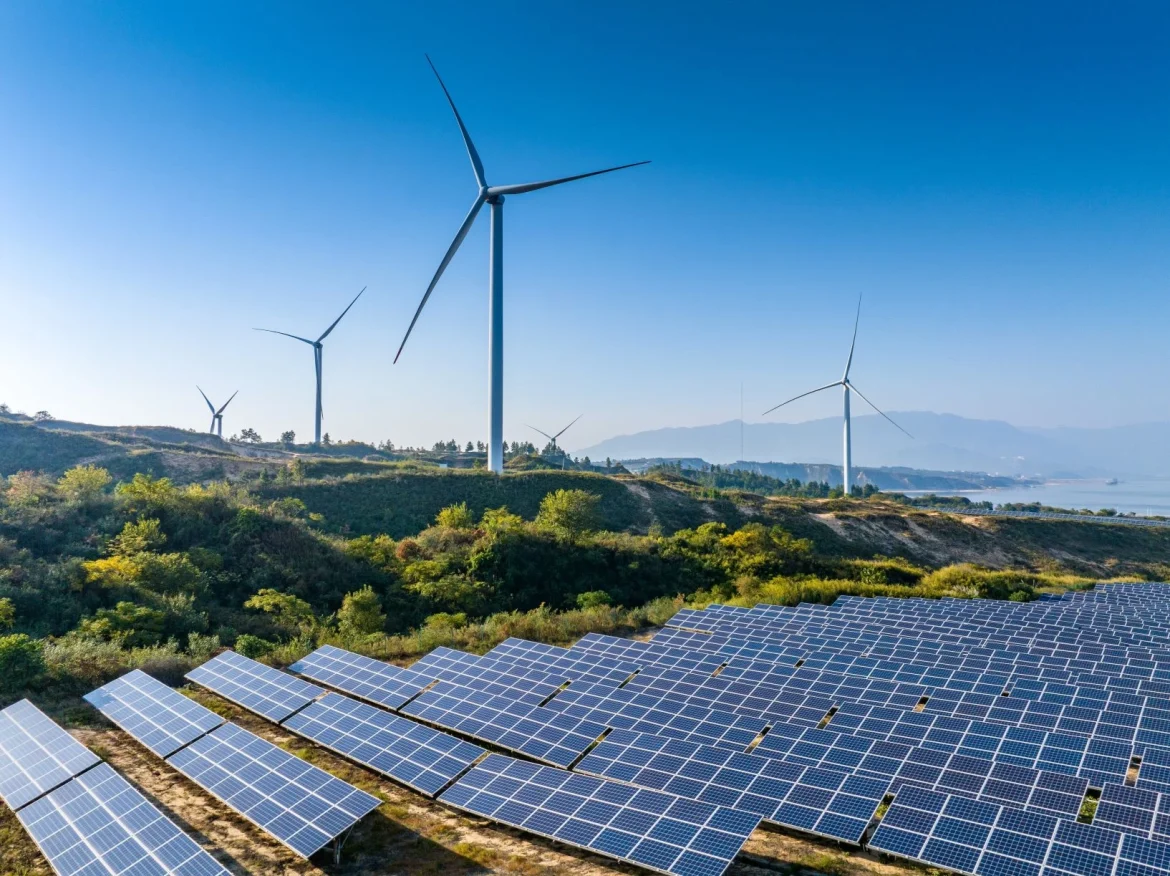
South Africa’s energy transition is entering a new phase in which corporate buyers, rather than government auctions, are becoming the main source of new utility-scale renewable energy, according to BloombergNEF’s South Africa Transition Factbook 2026. Corporate power purchase agreements are expected to support 73% of the 2.3 gigawatts of solar and wind capacity anticipated to be added in 2026, marking the first year in which private procurement is expected to exceed state-led auctions and signalling a broader shift in how new electricity investment is being financed and contracted.
The change reflects the growing role of businesses in managing electricity costs and supply risks after years of power shortages and load shedding. For companies operating energy-intensive mines, manufacturing plants and industrial facilities, securing electricity has increasingly become an operational and financial consideration rather than a matter confined to national energy policy. Corporate PPAs allow businesses to contract directly or indirectly for renewable electricity, giving developers a more predictable revenue stream while allowing large power users to manage part of their future energy requirements.
 According to BloombergNEF, corporate demand has accelerated since South Africa removed the previous 100MW licensing threshold for private power projects in 2023. Corporates have signed contracts to procure about 5GW of clean power since 2020, while corporate PPAs supported around 670MW, or 48%, of the 1.4GW of renewable capacity tracked in 2025. Major buyers have included Sibanye-Stillwater, Rio Tinto, Tronox, Air Liquide and Sasol.
The emergence of private procurement changes the structure of South Africa’s electricity market, but it does not remove the role of public infrastructure. Renewable projects developed through corporate agreements still require access to transmission and distribution networks, and the electricity system must balance supply and demand regardless of who finances the generation. BloombergNEF identifies transmission capacity as an increasingly important constraint, raising the possibility of a widening gap between the speed at which private developers can secure investment and the pace at which the grid can accommodate new generation.
That constraint matters because South Africa’s renewable investment pipeline is increasingly concentrated in areas where transmission capacity is limited. A developer can secure land, financing and an industrial customer, but the project cannot contribute to the electricity system until it can obtain a viable grid connection. The resulting bottleneck shifts part of the energy transition challenge away from generation finance and towards network investment, planning and regulation.
The issue has wider implications for Eskom and the state’s role in the electricity sector. South Africa has spent years attempting to stabilise a power system dominated by the state utility, while reforms have sought to introduce more independent generation, strengthen transmission planning and create a more competitive electricity market. The growth of corporate PPAs indicates that private capital is increasingly responding directly to electricity demand, but the public system remains responsible for much of the shared infrastructure that connects those projects to customers.
The shift is taking place even as coal remains central to South Africa’s electricity supply. Coal accounted for 78% of electricity generation in 2025, down from 90% in 2015, according to BloombergNEF. The transition is therefore not a rapid replacement of coal with renewables but a gradual restructuring of the generation mix as ageing coal plants face retirement, renewable capacity expands and battery storage becomes more important to system flexibility.
Read also: https://furtherafrica.com/2026/09/09/south-africa-energy-transition-shifts-to-private-power/
BloombergNEF’s economic transition scenario illustrates the scale of that structural change. It expects South Africa’s electricity demand to rise by 35% to 319 terawatt-hours by 2050, while solar and wind could account for 69% of annual generation under that scenario, with coal declining to 21% as older plants retire. These figures are scenario-based rather than forecasts, but they illustrate the infrastructure and investment requirements associated with a more diversified power system.
The economics of corporate PPAs are also becoming more important as companies weigh energy security against cost. BloombergNEF’s 2026 corporate PPA price survey indicates that average solar PPA prices are expected to fall to about R848 per megawatt-hour this year, while onshore wind prices are expected to rise marginally to R1,104 per megawatt-hour. Solar PPAs averaged R935/MWh in 2024 and 2025, compared with R1,102/MWh for onshore wind. The difference reflects, among other factors, the stronger generation profile of wind and the declining value of additional solar output for buyers that have already contracted significant daytime generation.
The changing procurement model also has consequences for South Africa’s industrial competitiveness. BloombergNEF identifies high industrial electricity costs and grid constraints as factors that could limit investment, manufacturing and the development of the country’s critical-minerals sector. This is significant because South Africa’s energy transition is closely connected to its ambitions to process more minerals domestically and retain a larger share of value from its resource base.
Reliable and competitively priced electricity is particularly important for mining and mineral processing, where energy can represent a substantial operating cost. If renewable procurement allows large industrial users to secure more predictable electricity supplies, it could influence investment decisions in sectors ranging from mining and metals to chemicals and manufacturing. At the same time, network constraints and high transmission costs could limit how quickly those benefits materialise.
There is also an emerging industrial-policy question around the supply chains supporting the transition. South Africa remains dependent on imported clean-energy equipment. According to analysis of the BloombergNEF data, China supplied 98% of South Africa’s solar equipment and 95% of its battery imports in 2025, highlighting both the depth of existing supply-chain dependence and the potential challenge of developing local manufacturing capacity.
The implications extend beyond South Africa. As the largest renewable-energy investment market in Sub-Saharan Africa, South Africa provides a test case for how private capital can contribute to power-sector transformation in an emerging market where state utilities, public infrastructure and industrial consumers remain deeply interconnected. BloombergNEF estimates that South Africa attracted US$5.4 billion in renewable-energy investment in 2025, although that was 41% below the US$8.6 billion recorded in 2024. Small-scale solar was an exception, with investment rising 35% to US$1.8 billion.
Other African economies are also experimenting with private generation, direct power procurement, mini-grids and renewable-energy auctions as governments seek to expand electricity supply without placing the entire investment burden on public balance sheets. South Africa’s experience suggests that attracting private capital into generation can move faster than reforming the shared networks required to connect that generation. The lesson is relevant to countries seeking to replicate private-sector-led energy investment while managing constrained public finances.
The development of South Africa’s wholesale electricity market is another part of that transition. The South African Wholesale Electricity Market has been delayed and is expected to be introduced in stages from the second quarter of 2027, according to BloombergNEF reporting. The eventual structure of the market will influence how independent generators, corporate buyers, traders and the national system interact, and could determine how much flexibility businesses have in procuring electricity outside traditional utility arrangements.
For the state, the growing role of corporate procurement creates a different policy challenge from the one that dominated the country’s electricity crisis. The immediate shortage of generation has eased, but the investment requirements are moving towards transmission, storage, market reform and system flexibility. Public resources will still be required for infrastructure that private developers have limited incentives to build on their own, particularly where network investments generate benefits across multiple users.
For companies, meanwhile, the growing use of PPAs means that electricity strategy is becoming more closely connected to capital allocation, operational resilience and sustainability reporting. Renewable procurement can affect exposure to energy-price volatility and, depending on the contractual structure, the emissions profile of operations. That makes power sourcing increasingly relevant to corporate risk management and ESG disclosures, particularly for exporters and companies supplying international customers with increasingly stringent climate requirements.
South Africa’s transition is therefore becoming less about whether private capital will participate in the electricity market and more about whether the country’s institutions and infrastructure can keep pace with that participation. Corporate PPAs are creating a new route into renewable investment, but generation contracts cannot substitute for transmission lines, system planning or functioning electricity markets.
 The emerging model could ultimately give South Africa a more diversified electricity investment base, with businesses playing a larger role in determining where new generation is developed and how it is financed. But the economic benefits will depend on whether the grid, market rules and public institutions can connect those private investments to the wider electricity system. For South Africa, and for other African economies considering similar reforms, the transition is increasingly a test not only of renewable-energy investment but of whether public infrastructure can support a more private, decentralised and commercially driven power market.


