


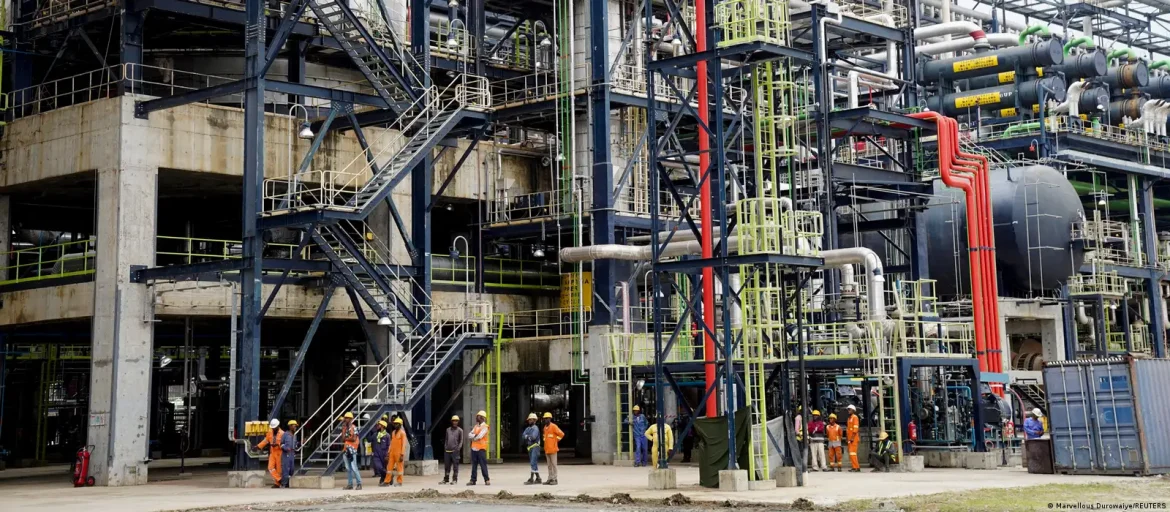
Aliko Dangote’s proposed US$15 billion to US$16 billion refinery in Lamu is moving towards construction with a planned 700,000 barrels-per-day capacity, but the project faces a fundamental question over where it will obtain enough crude to operate in a country that currently has no commercial-scale oil production. The refinery, expected to break ground later this month and be completed by 2030, is intended to reduce Kenya’s dependence on imported refined petroleum and supply a wider East African market, but its economics will depend on securing reliable feedstock, financing the infrastructure around Lamu Port and managing significant environmental and regulatory risks.
The project represents Dangote Industries’ attempt to replicate in East Africa the vertically integrated refining model it has developed in Nigeria. The company’s Lagos refinery, which began operations in 2024, has become Africa’s largest refining facility and is increasingly supplying both Nigeria and international markets. The Kenyan project would extend that strategy into a region that remains heavily dependent on imported petroleum products but lacks Nigeria’s large domestic crude-production base.
 The difference in feedstock availability is central to the Kenyan project. Kenya has proven oil reserves in the Lokichar Basin but has yet to establish commercial production, while Uganda’s crude is tied to the East African Crude Oil Pipeline to Tanzania and South Sudan’s exports depend on infrastructure running through Sudan, where insecurity has repeatedly disrupted oil flows. A proposed pipeline linking South Sudan and Kenya’s Lokichar Basin to Lamu remains far from operational.
That leaves the refinery potentially dependent on crude imported by sea, creating a different cost and risk structure from Dangote’s Nigerian operation. According to oil and gas lawyer Maximillian Ezeude, the lack of straightforward regional feedstock routes could leave the Lamu facility exposed to the international seaborne crude market. That exposure matters at a time when geopolitical tensions in the Middle East are already pushing crude prices towards US$100 a barrel and disrupting major oil-trading routes.
The timing adds another layer of uncertainty. Brent crude approached US$100 a barrel on September 9 as renewed conflict involving Iran and regional actors heightened concerns about global supply disruptions. A refinery dependent on imported crude would not necessarily be unviable in a high-price environment, but higher feedstock and freight costs could affect refining margins and ultimately the competitiveness of petroleum products supplied to East African markets.
The proposed location in Lamu also means that refinery economics are tied to the pace of development of the wider Lamu Port–South Sudan–Ethiopia Transport, or LAPSSET, corridor. The refinery is planned within the LAPSSET special economic zone close to the deep-water port, but Reuters reports that Lamu currently lacks operational oil-storage terminals. LAPSSET plans provide for storage capacity of between one million and 1.5 million barrels and marine facilities capable of handling vessels up to Suezmax class, but much of that supporting infrastructure remains unbuilt.
That gap is important because refining is not simply a question of installing processing units. A large refinery requires dependable crude unloading facilities, storage, pipelines, water, electricity, roads, product-storage infrastructure and distribution networks. Delays in any one component can increase financing costs and weaken the commercial case for the wider project.
For Kenya, the potential economic benefits are significant because petroleum products remain a major component of the country’s import bill. Kenya spent roughly US$4 billion on petroleum products last year, making fuel the country’s largest import, according to official data cited by Reuters. A functioning refinery could reduce some dependence on imported refined products, although it would not eliminate Kenya’s exposure to international crude prices if the facility relies heavily on imported feedstock.
The distinction is important for policymakers. Refining crude locally can reduce some of the logistics and foreign-exchange costs associated with importing finished products, but it does not make a petroleum-dependent economy insulated from global oil markets. If the refinery imports most of its crude, Kenya would remain exposed to international crude prices, shipping costs, currency movements and geopolitical disruptions.
The regional dimension is equally important. The proposed facility is designed to serve markets beyond Kenya, potentially supplying Uganda, Rwanda, Tanzania, South Sudan and other East African economies. Dangote has also suggested that regional governments could collectively take as much as a 30% equity stake in the project, creating a potential mechanism for sharing both financing requirements and commercial exposure. No details of such agreements have yet been finalised.
Regional participation could give the refinery a broader commercial base, but it would also introduce more complex governance arrangements. Equity participation by sovereign entities would require clear agreements over capital commitments, crude procurement, product offtake, tariffs, foreign-exchange exposure and the allocation of project risks. For governments already managing significant infrastructure and debt-financing pressures, participation would need to be assessed against competing demands for public capital.
Financing is another substantial test. Dangote Industries has indicated that the Kenyan refinery could be financed through internal cash flow, bonds and an initial public offering, potentially alongside commercial lenders and development-finance institutions such as Afreximbank. But the group is simultaneously pursuing a US$14.3 billion expansion of its Nigerian refinery and other energy projects. Reuters reports that Dangote is seeking around US$40 billion between 2025 and 2030 for announced energy projects, including Lamu.
The financing environment therefore matters as much as the project’s headline investment value. A refinery of this scale requires long-term capital and stable revenue assumptions, while lenders will need to assess feedstock security, product demand, infrastructure readiness, environmental liabilities and regulatory conditions. Any deterioration in those fundamentals could increase the cost of capital or delay financial close.
The project also carries a significant environmental governance dimension because of its location. Lamu Old Town, a UNESCO World Heritage site, lies about 10 kilometres from Lamu Port. UNESCO has continued to require Kenya to strengthen conservation planning and provide an updated report on the property’s state of conservation by December 2026.
Environmental concerns extend beyond the heritage site. Greenpeace Africa has raised concerns about potential habitat destruction and marine degradation associated with the project. Those concerns place environmental assessment, coastal ecosystem management and community consultation alongside financing and infrastructure as material execution issues.
For Kenya, this makes the refinery a test of how large-scale industrial development can be integrated into a sensitive coastal environment. The issue is not simply whether the project can meet its construction and production targets, but whether its supporting infrastructure, environmental safeguards and community-management systems can keep pace with its physical scale.
The project also arrives as the economics of oil refining are changing. Refiners globally are facing pressure from shifts in fuel demand, tighter environmental standards and the expansion of alternative energy technologies. At the same time, geopolitical disruptions have demonstrated the continuing importance of refining capacity and supply-chain resilience. Dangote’s own Nigerian refinery has benefited from tight global refined-product markets while simultaneously confronting the challenge of securing competitively priced crude. Nigeria is now considering reforms to its domestic crude-supply system to improve feedstock access for local refiners.
That Nigerian experience offers a relevant lesson for Kenya. A large refinery can create domestic value by processing crude closer to its end market, but its commercial performance ultimately depends on the reliability and price of its feedstock. For Lamu, the absence of a mature domestic crude-supply system makes that question more pronounced.
There is also a broader infrastructure-policy implication for East Africa. If the refinery is to operate as a regional energy hub, its success would depend on more than Kenyan demand. Pipeline connections, storage, road and rail infrastructure and cross-border petroleum markets would determine whether refined products can move efficiently to neighbouring countries. Regional coordination on standards, tariffs and energy-security arrangements could therefore become increasingly important as the project develops.
The proposed refinery consequently represents both an opportunity and a concentration of risks. It could reduce Kenya’s reliance on imported refined petroleum, support the development of Lamu as an industrial and logistics centre and create a new regional source of fuel. But its viability depends on solving several interconnected problems: crude supply, port infrastructure, storage, financing, environmental management and regional market integration.
 For Kenya’s economy, the central question is therefore not simply whether a 700,000-barrel-per-day refinery can be built. It is whether the infrastructure and supply system around it can support commercially competitive operations over the long term without transferring excessive financial, environmental or geopolitical risk to the public sector.
As construction approaches, the Lamu project is becoming a test of whether East Africa can build a large-scale petroleum-processing industry around regional infrastructure that is still developing and crude supplies that remain fragmented. Its outcome will have implications beyond Kenya, offering a measure of how African economies balance energy security, industrial ambition, private capital and environmental governance as they continue to navigate a changing global energy market.


